
What You Need To Know About Art Dubai’s Online Portrait Exhibition Series

Accompanied by intimate films the digital “crash course” reminds viewers of the intense individual journeys behind the works of the region’s most seminal contemporary artists, often lost in exponential fairs
Ahead of the fair’s physical iteration to be held in March, Art Dubai’s series of highly user-friendly digital exhibitions act as art history crash courses, providing a window into the lives and workspaces of key participating artists.
Created in partnership with BMW Middle East, the well-scored films provide a space for the artists to define themselves on their own terms, interspersed with studio shots and a look into upcoming work, allowing natural conversation to flow.

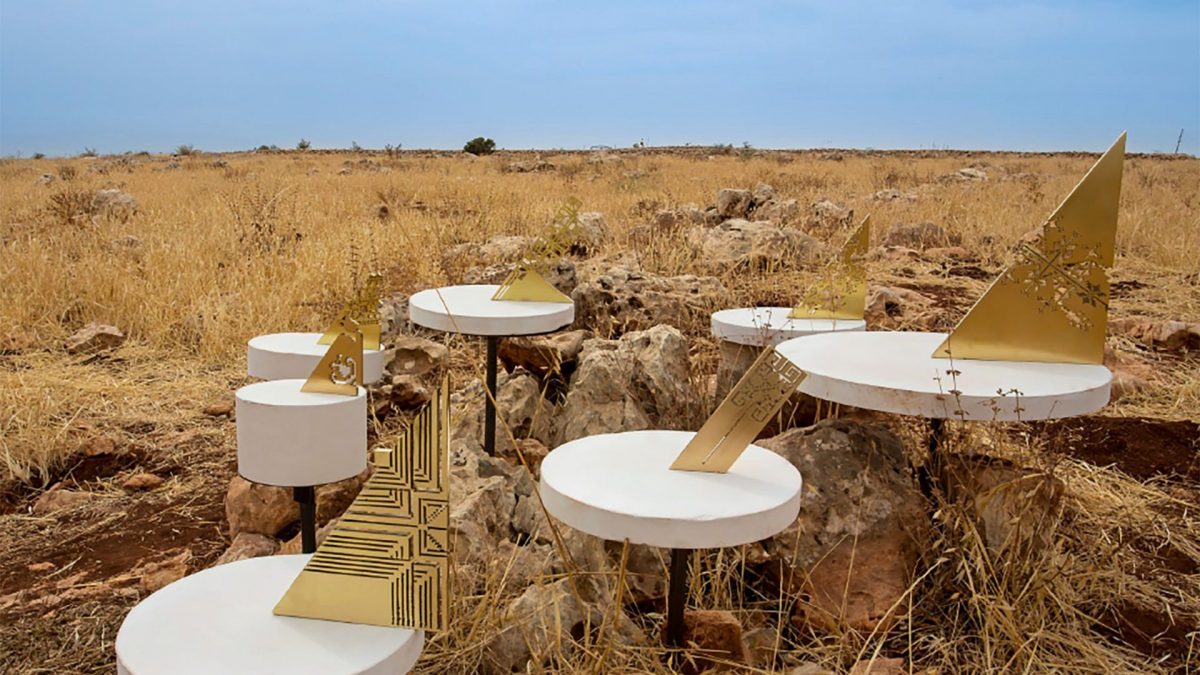
Starting with Timo Nasseri, the digital exhibitions which follow feature Mohamed Ahmed Ibrahim, Dia al-Azzawi, Naqsh Collective, Aya Haidar, Mohammed Kazem and Abdul Rahman Katanani. Emirati artist Mohamed Ahmed Ibrahim, part of the UAE’s first generation of contemporary artists who embraced previously unheard of avant-garde techniques in the ‘80s, insists his practice does not consist of creating a visual language, but is an exploration into the shapes that make-up his daily visual landscapes.
From the seaside and the three mountains that encase his native Khor fakkan, to the wheels connecting the motorbike that he uses every day, his personal visual interpretation of these shapes are repeatedly combined and reconfigured on a singular plane.

On view and available for immediate sale, is a collection of the artist’s monochromatic works. His studio is filled to the brim with multicoloured antennae-like sculptures of all sizes, photographs throughout the years and books piled atop one another.
Scheduled to represent the UAE at the upcoming Venice Biennale, Mohamed’s work is spiritual and continuous, guided mostly by mediating his subconscious, which results in each piece forming its own personality. He explains, “Sometimes they become aggressive. We cannot deal with each other right now,” as the camera points to a sculpture tucked into the corner.

The series also features regional works from a generation prior, exhibiting early works from the 1970s alongside recent paintings and prints from the pioneering Iraqi artist Dia al-Azzawi. One of, if not the most, fortitudinous individuals forging a modern Arab Art and cultural heritage, Dia was born in Baghdad in 1939.
The artist is known for his richly hued paintings that flawlessly manoeuvre abstract subjects, taken from fables in ancient civilisations to pop forward toward the viewer, while simultaneously emanating the illusion of depth and hazy shadows.
Dia is less inclined to speak on his individual practice. Instead, he shares his observations of the change from localised hubs to more inclusive and prominent global sites for cultural practitioners, and is clearly optimistic about the possibilities and challenges for future MENASA generations. British-Lebanese millennial artist Aya Haidar, whose life and work has been informed by a constant transnational movement that much defines our current era, is also invited to explain her practice, providing a distinct perspective.

Her work is much more fluid, as she embraces a variety of new mediums, exclusively working with used items that she re-appropriated and introduces into new contexts, which she approaches as a network and inherently interconnected.
Citing generational narratives, and the choice of ‘remembering of forgetting’ as major themes in her work, her work can also be understood as rejecting the practice of distancing ourselves from complex webs of historical relations.
Art Dubai’s Portraits Exhibition runs until 20 January 2021. The full schedule can be accessed online here at artdubai.ae
Images courtesy of Art Dubai and the artists
From the Winter 2020 issue of Harper’s Bazaar Interiors, The Art Issue