Dubai-based Artist Suzi Fadel Nassif On Her Transition Into Distortion
The Lebanese artist reveals her new ongoing series entitled Distortion, depicting an altered, exaggerated reality
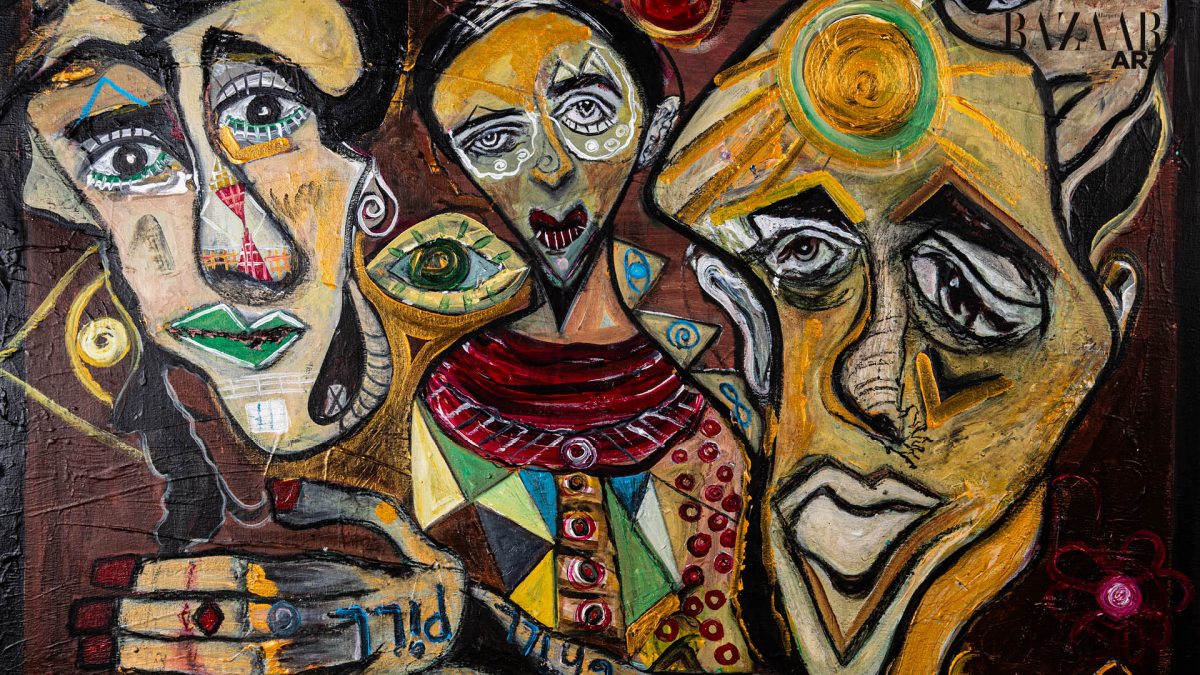
Reviving the spirit of late master painters such as Pablo Picasso, Frida Kahlo, Andy Warhol, Kahlil Gibran, Vincent van Gogh, Gustav Klimt and Salvador Dalí (her first muse), Dubai-based surrealist Suzi Fadel Nassif portrays a twisted reality through her latest body of work; one which manifests itself through distorted, swirling figures, uneven shapes and bold colours.
Influential philosophers such as Nietzsche and Aristotle have substantially marked her work, as have Latin cultures. “A trip to Cuba made me realise that a major part of myself belonged to their world,” she explains. “I explored their heritage and searched for every possible medium and material in their history.”
In the process, the artist fell in love with the Mexican queen of pain and passion, Kahlo, a restless artist who defined herself with no limitations and no apologies. “I am happily abducted by such powerful icons who created a golden history in different areas of time.”

Suzi Fadel Nassif gleaming around her artwork
In February 2015, Suzi presented her inaugural solo exhibition at Authentique Art & Design gallery in Dubai, later showcasing her work at an array of art events and shows across France, Russia, Japan, Italy, England, USA, Lebanon, Portugal and the UAE.
She is also the recipient of the 2015 Vera Award (Lisbon), the 2015 UNICEF Award (Palermo), the 2015 Leonardo da Vinci Award (Florence), the 2016 Casanova Arts Lover Award (Venice) and the 2017 Certificate of Excellence, Palm Award (Munich). Most recently, Suzi has completed a course in Art Crime: Forgery, Fraud and the Law at Sotheby’s Institute of Art.
In 2020, the artist transitioned from portraiture to mind-bending, distortion work, playing with twisting, stretching, melting techniques and asymmetrical appearances. “Reality isn’t always what it seems,” she expresses. “Your sense of reality is easily deceived by tricks, prejudices and assumptions. We all see reality through a personal lens shaped by our beliefs, culture, religion and experiences.”

Suzi Fadel Nassif. See Where I’m Coming From? 2021. Acrylic on canvas. 100x80cm
Her newest series, entitled Distortion (2020), imbued with symbolism and deconstructivism, depicts the state of today’s pandemic-stricken world. “Distortion is what our world is today,” she says. “A twisted, altered and broken-down norm of life.”
Featured works such as She Rose To Fame (2021) and Lend Me Your Ear (2021) trigger a sense of mystery within the viewer, intertwining hints of humanity’s daily struggles such as fear, irony, loss, dark humour and isolation.
“I believe art is a form of exaggeration: music is the exaggeration of sound, and dance is the exaggeration of movement. This is what a great story relies on,” says the artist. “I wonder, maybe the tools we use to express our ideas are insufficient and fail to mimic the complexities of our souls and imaginations. Maybe the canvas is a fundamentally flawed medium for expressing the genius inside of us.”

Suzi Fadel Nassif. Wipe That Smirk Off Your Face. 2021. Acrylic on canvas. 70x50cm
Other new works include See Where I’m Coming From? (2021), a story of a love triangle with a secret; Tell Me About It, Sir Nietzsche (2020), drawing on the comfort of the late German philosopher’s words on hope and optimism, and Do You Buy This? (2021), inspired by Kahlo’s imagined take on the Covid-19 pandemic. She quotes the late English writer Aldous Huxley: “There are things known and there are things unknown, and in between are the doors of perception.”
Stimulating the supernormal, the purpose of Distortion lies in portraying the transformation of reality into dreamlike forms. “Many have experienced the feeling of being moved by a work of art, whether it’s a song, play, novel or a painting,” says Suzi.
“I strive to channel this energy as a spiritual practice. When we are touched, we are transported to a new reality and become aware of a feeling that may not be unfamiliar to us, but which we did not actively focus on before. I want the viewer to pause and voyage in this transformative experience and connect with their own soul, reflect, contemplate and embrace the beauty of distortion.”

Suzi Fadel Nassif. Do You Buy This? 2020. Acrylic, collage, fabric and glue on canvas. 110x95cm
Each artwork is named after a recognised phrase that holds a layered meaning; paradoxical expressions that translate based on subjective perception and symbolism. “This series discusses social matters and triggers reality checks,” reveals Suzi. “Where you feel provoked is where the purpose is served; each piece is meant to shed layers and dig deep, beyond the eye’s shallow perception.”
The ongoing series, comprising nine works, asks the viewer: When have you misattributed evil? “I challenged myself and the viewer to see if we have misperceived someone as evil simply because the elements of our light are different than theirs; all of us have been guilty of this,” she admits.
“The challenge is to understand the world as a complex optical illusion: people can see opposing things yet simultaneously be right. Challenge yourself to always seek perspective, clarity, empathy and harmony. Distortion can be beautiful too.”

Suzi Fadel Nassif. She Rose To Fame. 2021. Acrylic on canvas. 170x40cm
Subtle influences of Dubai are evident in Suzi’s works: the use of bold colours and gold leaf, fashion references and diversity of style. “Dubai has motivated my growth, evolution, determination and my golden dreams; It has taught me that the sky is the limit,” she shares.
“I love this quote: ‘Once the sand of Dubai has settled on your shoulders, you can never shake it off!’ The city has opened many doors for me, locally and internationally.”
Suzi has learned over the years to put faith in the fact that art is never conclusive: “You can always touch up a painting, edit a book or rewrite a lyric or melody. Art can be refined, unfinished or maybe abandoned for one reason or another, but only time will tell.”
Photo Courtesy: Aasiya Jagadeesh; ITP Images
From Harper’s Bazaar Art Book, Exhibition 001, The Dubai Edition