

How Bulgari’s Le Gemme Sahare Pays Homage to The Desert Rose

Master Perfumer Yann Vasnier speaks exclusively to Bazaar Arabia about the inspiration behind this distinctive scent
How to stand out from the crowd, yet fit in with one of the most elevated scent collections in the world? That quest for originality drove Yann Vasnier, who was tasked with crafting a new fragrance for Bulgari’s Le Gemme High Perfumery range, to the Middle East – and specifically, the endless horizons of the Sahara desert.
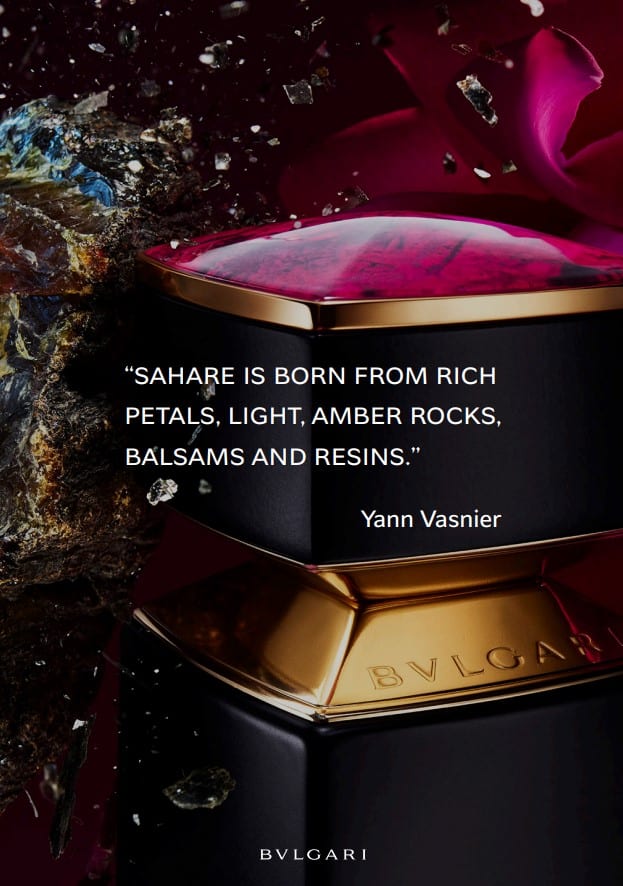
Le Gemme Sahare’s secret ingredient? A Taif rose accord exclusive to Bulgari. “Compared to Bulgarian and Turkish Rose Damascena essences, the Taif rose unveils a clear terroir effect, which means a unique level of richness, of minerality, with a hot spicy character,” Yann tells us. “Taif Rose presents a very singular duality, as it also develops a genuine clarity, through a green, natural, and almost peony-like petally effect.”
We sat with the famed fragrance maestro to talk about reaching all the right notes.
The Story Behind Le Gemme Sahare
How do you start the formulation of a new perfume?
Yann Vasnier: Starting a new perfume is the most exciting part of the process. Bulgari gave me the idea of the Imperial Pink Jasper, a beautiful stone. Based on my research, Jasper is made of a mixture of sand, ashes and minerals, and upon applying heat and pressure, a beautiful stone is formed.
Iron, sand and ashes are where it all started — which gave me the idea of exploring the regional market. I started researching the region, its celebrities, the icons of the market, and the story of Bulgari.
All these details go into shaping the ideas in my head. I create multiple little recipes that go down to the lab, and once the result comes back, I host a smelling session with my colleagues (in the UAE in this case) to receive their feedback and modify the fragrance accordingly.
Was this perfume always meant to be an ode to the region, and how was the Taif Rose chosen to be central to the fragrance?
Yann: Yes — because the perfume’s code name was called AlUla. It all started three years ago: The Bulgari team approached me in 2021, and AlUla was gaining global exposure at the time. This idea was inspired by the desert, the interplay of its elements the colours, the oranges and pinks, the stones and their beautiful constitution. As I delved more deeply into my research, I discovered that the Taif mountains in Saudi Arabia are filled with the rare Rose Taif, which lies at the heart of this creation.
The Rose Taif grows at a 2000-metre altitude and endures harsh conditions of aridness and dryness, but it’s wonderful how fresh it still smells! After studying different types of roses, we discovered a certain freshness, lightness and radiance in the Rose Taif which, when we combined it with technology, made it more modern.
Rose is considered such a traditional note; how do you modernise it and treat it differently?
Yann: The project started in 2021, so it took roughly four years. Although rose is very interesting, it’s been used everywhere, so it’s a challenge to turn it into something novel. When you look at the Rose portfolio, especially in this market, the scent is outdated and powdery.
When I smelt the Rose Taif and compared it to other roses from Turkey, Bulgaria, Morocco and France, I noticed that the essential oil of the Rose Taif in particular is very green, a little less fruity, and a little less honey-based than other Roses. These were the elements that I used to modernise the scent of Rose.
There is a part of the rose we call ‘Upcycled New Absolute’ because when the essence is extracted, we usually discard what’s left behind from the rose. But this process gives the rose a very interesting leathery aspect. We’ve used this leathery aspect in the Bulgari perfume.
Do you find that what works in the Middle East works universally, or do customers in the region gravitate towards certain scents more than others?
Yann: In this region, people are very passionate about fragrances. The culture has fragrances embedded within it. So I adapt myself in accordance with what customers in the region like. They usually like something novel and rich-smelling, a scent that they can blend with others. The region is also interested in taking these lovely traditional scents and putting a modern twist on them, so as to create a new or modern smell.
Is it harder to make a variation of a scent or to craft a new one that has no family?
Yann: It’s harder to craft a new one because there’s so much that has been done already, so you always need to try to find new combinations. The most important thing for us is finding new molecules through nature and chemistry and continuing to experiment. For example, by using naturally derived molecules from sugarcane, we are able to end up with a new ingredient.
One particular molecule called Rosyfolia is a floral, rosy, geraniol note which has an elegant, fruity airiness to it. This molecule along with a few others hold the power to make fragrances unique because nobody else has or uses them. I’ve also used Ambergris, which is very rare and gives the fragrance a woody and smoky smell.
How did you connect the local Rose Taif to the ethos of Bulgari which is so Italian?
Yann: Bulgari for me, and for everyone, represents colours, beautiful stones, joy, and Roman heritage. The fragrance also features a combination of citruses from Sicily — lemon, mandarin, and Bergamot — which bring lightness, fruitiness, joy, and colour to the Rose Taif.
Any special memories while creating this scent?
Yann: It brings back childhood memories of my parents’ beautiful garden, which had hundreds of roses such as the Danse Du Feu or Climbing Rose, characterised by its deep red hue and strong, powerful nature. It has some hints of a Damask Rose, and I was surrounded by all of these roses during my childhood.
Images supplied.