

Sard Visuals: Exploring The Frontier of Contemporary Arab Image Making with A.I.

Omani image-maker, Mujahid Jamal has garnered an international following for his highly expressive A.I.-generated pictures. Through his images, set in modern-day Arabia, he’s challenging the belief that machines have nothing to add to original art.
Wanting to further his artistic imagination, Mujahid Jamal (Muji), a photographer by trade, turned to artificial intelligence as an innovative approach to telling stories. Inspired by the possibilities offered by A.I. art to introduce a new form of expression to externalise the human experience, Muji started to create machinegenerated images informed by his own photography and lived experience. In May 2023, he launched Sard Visuals (which loosely translates to ‘storytelling’ in Arabic), an initiative that draws on A.I. to design thoughtprovoking images depicting scenes of contemporary Arab culture.

A.I. remains uncharted territory when it comes to reproduction, authenticity and copyright – and unintended consequences. Muji, however, is intrigued by its potential not only to transform the way humans see art, but more importantly in the way it allows artists to overcome real-life logistical, technical and financial obstacles. With this new technology, artists can focus on their creative output without being hampered by questions about how to physically execute their vision, giving rise to a whole new generation of creatives.
We spoke with Muji about how he reconciles photography and A.I. image-making, which he clearly views as two distinct disciplines (he even has separate Instagram accounts for his photographs and A.I. pictures). We discussed his artistic process of injecting human emotion into algorithm-based images as well as his proclivity to contextualise his art within the framework of modern Arab society.
How do A.I. and photography differ in the way they both allow you to explore your creativity?
The sky’s the limit with A.I. But what makes photography special is that it has an emotional depth to it, that’s what makes it a bit better, what makes it beautiful. With photography, humans usually infuse their emotions into it, like personal experiences, and storytelling. That’s what makes it different from A.I.
Do you believe in A.I.’s ability to mimic human creativity?
A.I. has demonstrated a remarkable capacity to mimic human creativity, honestly, in various domains. [But] since it is deep learning, it’s just going to learn what humans have done in the past. But I don’t think it will ever create something new out of the blue.

Muji’s work is deeply rooted in his Middle Eastern surroundings, with the artist using his own photography as the basis for his A.I imagery.
Do you feel that A.I. has the possibility to democratise the art world?
There are a lot of artists who don’t have the right tools to create what they want, who have budget constraints, but they’re super creative. So I think A.I. will definitely democratise the art world by boosting these artists who haven’t received much attention in the past. A.I. is very accessible to everyone. But at the same time, it’s going to feel like the genie is out of the bottle; the art world is going to be flooded by A.I.- generated content. At some point, you aren’t going to be able to tell what’s real and what’s not. But at the same time, the world is evolving, and you have to get on with it.
Why do you feel it’s important to tell stories about the Arab world in your art? Are you portraying real, lived experiences or fictional scenarios?
It’s a combination of both. The experiences I portray are drawn from real life. Maybe it never happened to me, but it’s an emotion I connected to one way or another; I depict it in the form of an image. But at the same time, I also venture into imagined scenarios, which provide a canvas to address universal themes, provoke thoughts and challenge pre-conceived notions.
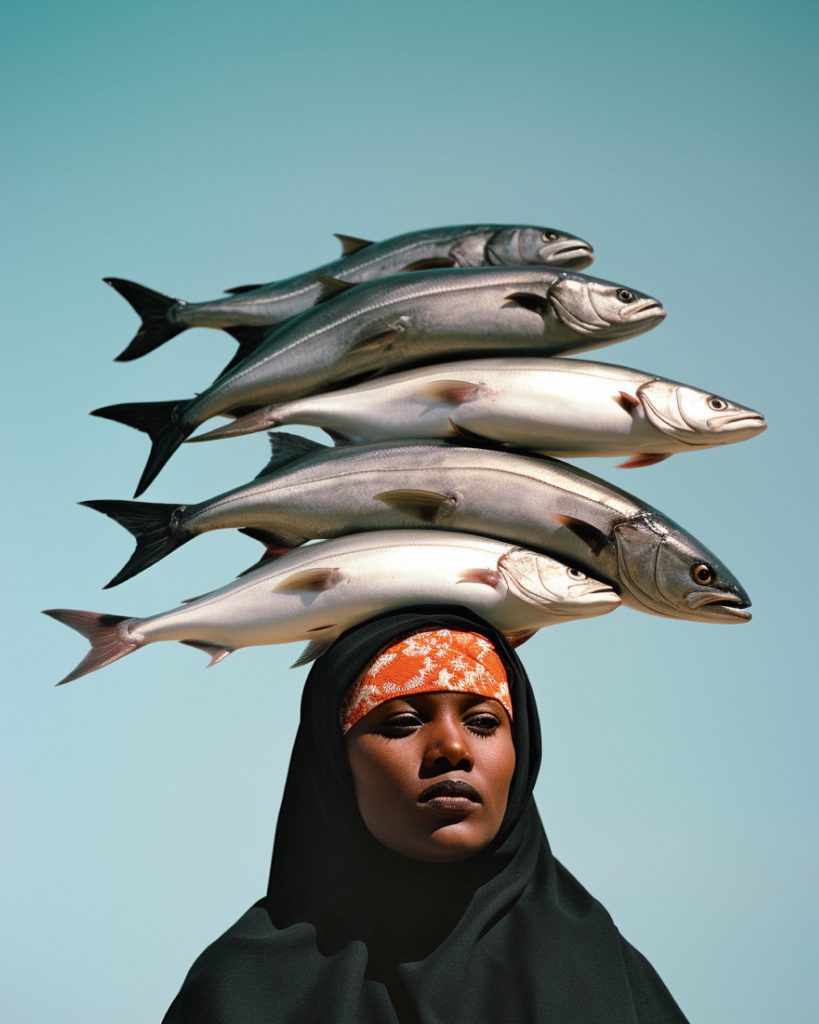
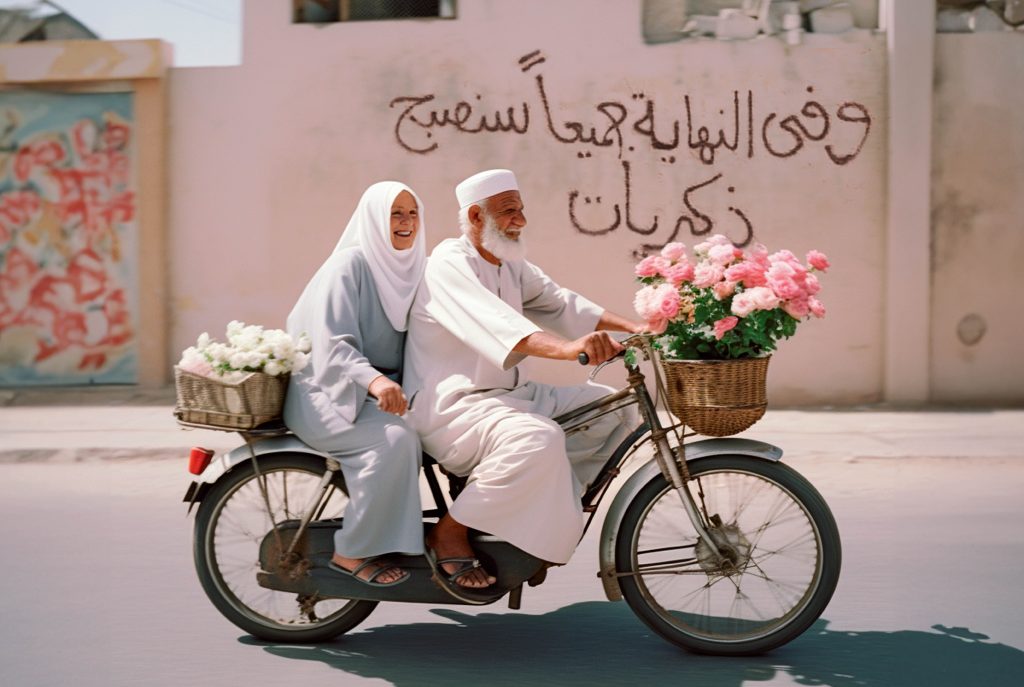
How has your work been received so far?
I have been receiving a lot of positive feedback, because the people that tend to like my art, and what makes it special, is that it’s more grounded in reality. It’s different. Most A.I. art is a bit dystopian, and colourful, they create worlds that do not exist, but mine is, I feel it’s more relatable because it’s like I’ve seen this place before. I know this emotion. There’s some sort of connection, and that’s what I aim for with my art – to connect to people as much as I can emotionally.
A judge in the US just recently ruled that A.I.-generated artwork is not eligible for copyright protection. What do you think about this decision?
I think it’s too early to have that conversation because it’s not black and white when it comes to A.I.-generated artwork and copyright. They have to give it a bit of time to marinate. I agree there are some A.I. artists that just create something that is remixed from other people’s artworks, but for people like me, I use my own photography. I go outside, take an actual photo, and then inject it into the system and guide the A.I. the way I want to. So I think this conversation will go on and they will come up with a solution. They have to get more A.I. artists to talk about it, and research more about it.
Is there something you want to emphasise about your work?
It’s very important for artists to mention that images are A.I.-generated and to separate them from certain crafts. Not only for photography but even when it comes to painting, because A.I. can do super realistic paintings. I clearly mention that they’re A.I.-generated. But a lot of people repost them, and on their pages, they don’t mention that they’re A.I.
From Harper’s Bazaar Arabia’s September 2023 issue
Images supplied.