

Kuwaiti Artist Monira Al Qadiri On Identity, Petrocultures and Growing Up in An Environment Brimming with Creativity

Bazaar Arabia sat down with the artist to discuss her craft, her relationship with the region, and why she’ll always feel like a bit of a subversive outsider
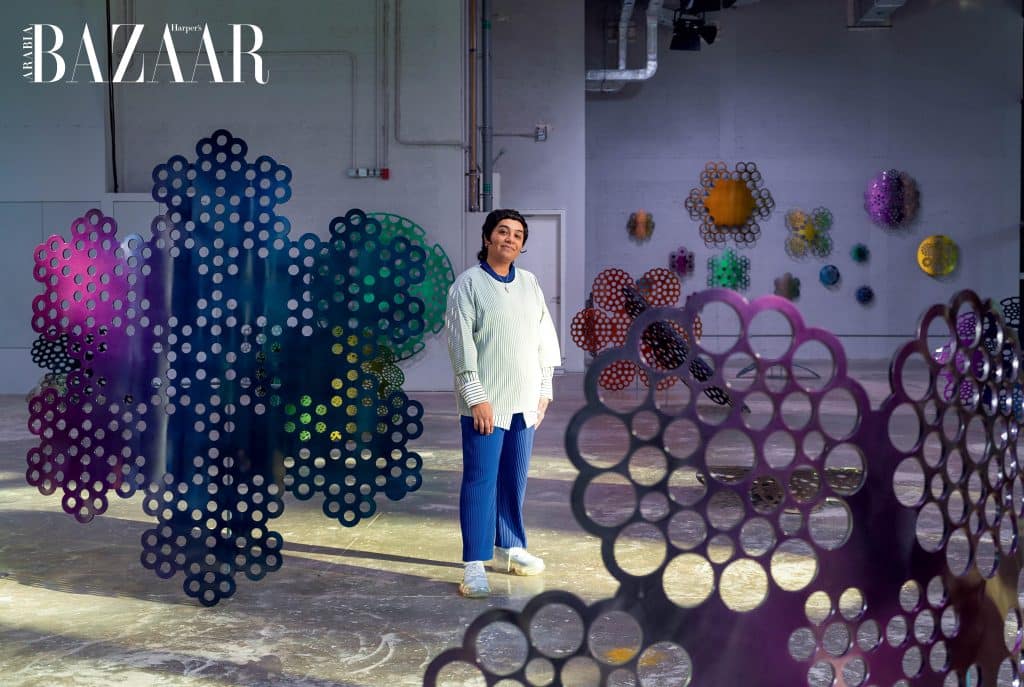
The fact that they are soaring towards the summit of the light-filled ICD Brookfield atrium is a good thing; because Berlin-based Monira Al Qadiri’s latest pieces, Floating World, are eminently tactile. All you want to do is reach to the skies and touch them. Luminescent, at first glance they belie the powerful underlying message about the fragility of fossil fuels. The fact that this bold installation is housed in the heart of Dubai – at the Dubai International Financial Centre – where the currency of petroleum reigns supreme, seems entirely apt. Benzene Float – five inflatable sculptures that depict molecular structures of petrochemicals – and Nawa, a series of metallic sculptures that reflect the processes of the oil industry, lead us to think about our relationship to energy. A fun fact: they are made of recycled swimsuit fabric.
Always thoughtful, Monira’s pieces are not just deeply contemplative but aesthetically arresting. A child would be drawn to them, oblivious to what they represent, while more serious thinkers would delve into their own personal reliance on the industry.
This Dakar-born artist – who is known for her multi-faceted work that spans video, sculpture and performance – is a unique voice, having grown up in Kuwait, but been heavily influenced by years spent honing her craft in Japan (where she gained her PhD at Tokyo University), before decamping to Beirut, Amsterdam and now Germany. We sat down with Monira to discuss her craft, her relationship with the region, and why she’ll always feel like a bit of a subversive outsider.
You grew up in a vibrant environment; was it a given you would go into a creative field or did you dabble with other careers before the artistic realm called to you? Even your sister Fatima is a conceptual artist and musician…
My mother [Thuraya Al-Baqsami] is an artist so I basically grew up in her studio. So it came very naturally to me to follow in her footsteps and become an artist. I never considered any other path.
Is there a work that you admire more than others?
My favourite piece of art in this world is my mother’s painting Flying Desire (1985) which I grew up with and always admired. Out of my own pieces, I would say my favourite is a small carved natural pearl called Wonder which is shaped into the form of an oil drill. It fits in the palm of my hand.
This installation is perfect for the space; do you tend to do site-specific work or do you create and see where the piece will find a home?
I would say I never make site-specific work. My work is very much a reflection of the past, either my own or the world at large’s and it imagines also an alternative future for itself. I would be happy if people dig it up from the ground 100 years from now and be perplexed by what it is.

How did you hone your style? What are the trademarks of a Monira piece?
The colour story of my work is a very integral element of my practice. Using iridescence as a narrator of the past but also the future at the same time.
Is it special displaying work in the region? Do you think regional players are drawn to particular styles or themes?
Yes my work is essentially about the Gulf and its history, so I really appreciate any opportunities to show my work in the region. I think the public relates to it in a deeper way.
Does artwork have to be aesthetically pleasing in your opinion to have an impact?
Not necessarily. But I believe art is more accessible when it has a visual story.

Is there a location that you love to have your artwork displayed in?
I am very passionate about showing my work in public spaces. I think there are more interesting interactions that occur when more people are able to see and spend time with it.
Do you find it easy to create? Do you have a method or way of creating that you can share?
I gain inspiration from my own life experiences, popular culture, and history. Its a chaotic process generally speaking. But I do a lot of research to arrive at new concepts and forms.
You must have also been influenced by the war in Kuwait. How does that inform your work, or does it only impact certain pieces like Behind The Sun?
It informs everything I do as a person. War changes your entire being, so it is an essential part of all of my works.
Where do you feel most at home, given you were born in Senegal, of Kuwaiti parents and lived in the Middle East, Japan and now Berlin?
I absorbed a lot of Japanese culture as I lived there for a decade. It influences my visual language as an artist. It is a place I am still most comfortable inhabiting. I am an alien wherever I go as I have no real cultural belonging to a single place. I enjoy being an outsider.
Your work also linked to pearls and oil; could you tell us a bit about that as they seem to form the cornerstones of the economies here.
Over 10 years ago I discovered that pearls and oil have the same colour scheme, they are just on lighter and darker sides of the colour spectrum. I feel that this colour encapsulates the story of the Gulf, and will transform into yet another form in the future.

You received so much critical acclaim – but when did you have that eureka moment, when you really felt that your artistic career was going to take off? Where did you get that validation from?
I think an artist’s path is like climbing a small mountain that you slowly and gradually build up towards. It’s a constant activity, a continuous struggle, but also there are moments where you can breathe and look back at your achievements. I still feel I’m midway on this journey.
Photography by Syed Humza. Special thanks to 25Hours Hotel.
From Harper’s Bazaar Arabia’s January 2024 issue.
