Power Of The Word: Group Exhibition In London Explores Identity, History and Displacement
Reviving the neglected art of handwriting, Richard Saltoun Gallery’s current exhibition reflects on issues surrounding gender politics and cultural heritage
Calligraphy has long held a powerful purpose in the Islamic world. Its origins lie in the preservation of the holy Qur’an and the Islamic conquests of the 7th and 8th centuries, which spread the Arabic language across North Africa and into the Iberian Peninsula, later flourishing into the Islamic Golden Age.
Since then, the visual art form has become intertwined with the Arab identity. An ode to its style and significance, the upcoming Resistance of Pen and Paper exhibition at London’s Richard Saltoun gallery will unite a group of artists hailing from North Africa and the Middle East, who use written language to reflect on issues of identity, gender politics, cultural heritage and displacement. The show takes a cue from Umberto Eco’s essay on handwriting – an Italian medieval historian interested in the revival of the lost art.
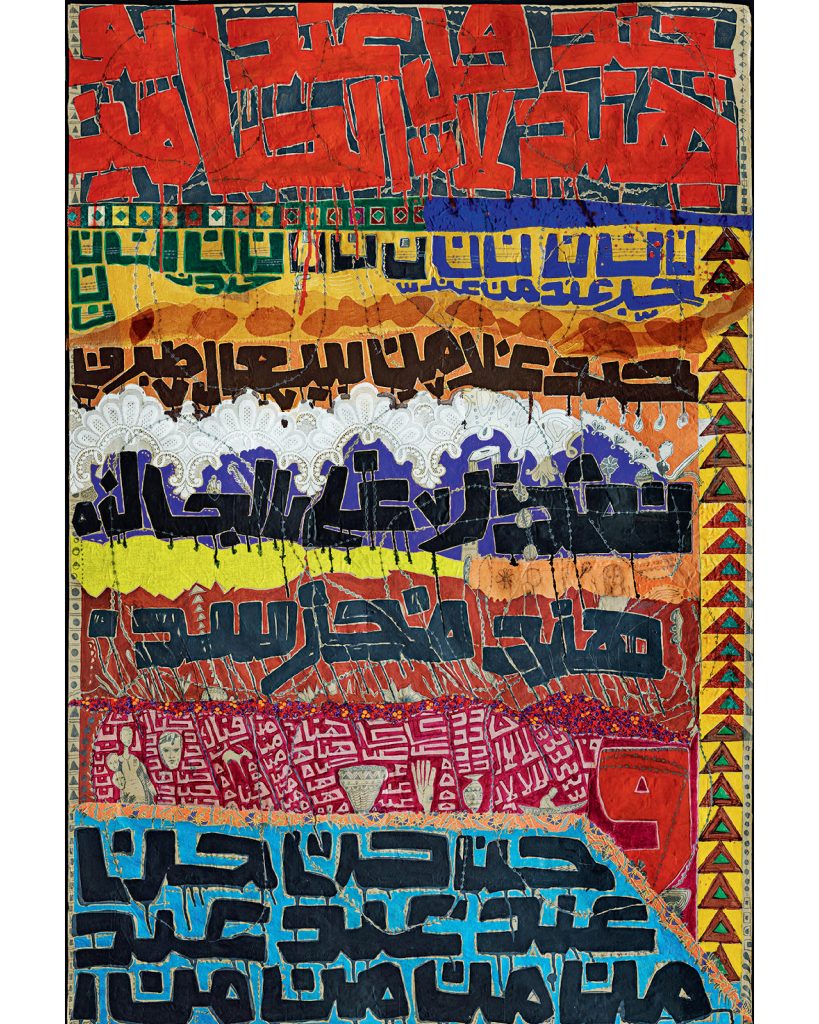
Spanning the central wall of the gallery is an installation by artist Bita Ghezelayagh, a series of silkscreen-printed calligraphic works on handwoven, antique textiles. Bita’s works are oft- influenced by her hybrid upbringing in Iran, where she experienced a French catholic school education during the day, in contrast to the bedtime stories rooted in Islamic traditions told by her grandmother. “I’m exploring the different possibilities for communication in our times using my cultural inheritance through the warp and weft of such ancient techniques,” she explains, adding that her art – a celebration of the word – touches on the intricate elements of life where literature, religion and the visual arts coincide with each and every knot of the textile.


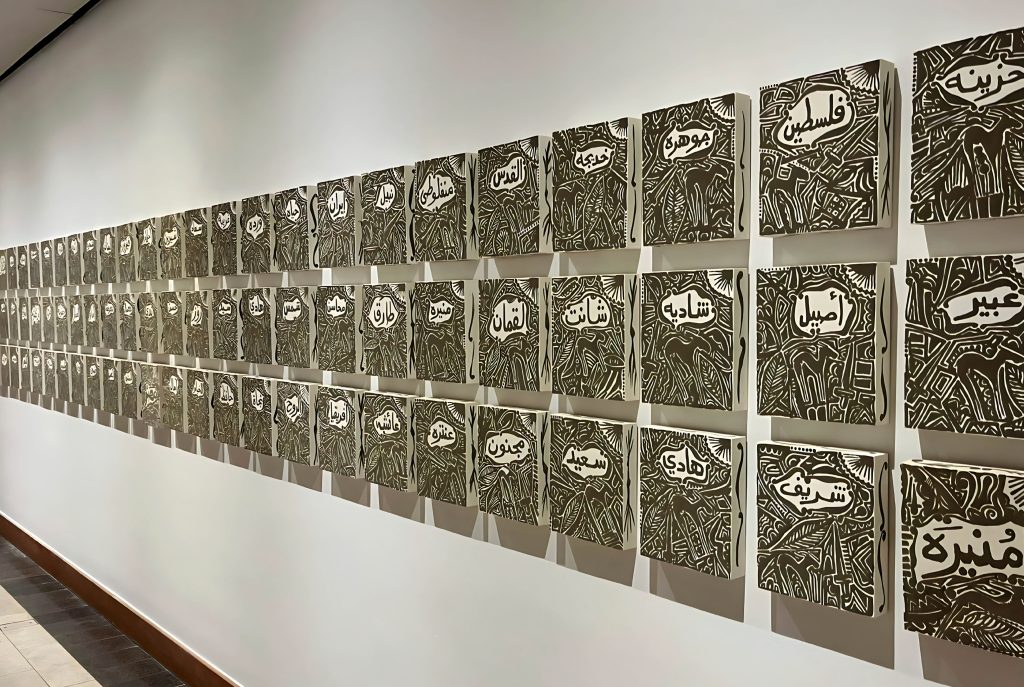
On display at the exhibition will be a new sculptural work by Bita made of glass and pen nibs collected from various second- hand markets in Tehran. “As an architect, I was always interested in glassmaking, another tradition rooted in the past,” Bita admits. “I find similarities between glass and textile, both materials appearing to be frail and fragile while underneath the surface there’s a stronger core: stubborn and resilient.” Elsewhere, Egyptian artist Fathi Hassan’s Rosario narrates his personal stories and influences. The installation comprises 99 individual pieces; their respective dimensions are the sum of the birthdates of loved ones and spiritual dates of prophets and saints, whose names are written across the works in Arabic script. The base is finished with stucco and glue, upon which desert sand is sprinkled. “This is a particularly special piece,” Fathi notes. “It depicts my personal journey and the people who have influenced me most throughout my life.”
Huda Lutfi’s Healing Devices is another highlight of the exhibition. Inspired by 12th-century Arab engineer and craftsman, Ismail al-Jazari’s manuscript The Knowledge of Ingenious Mechanical Devices, the ongoing series is an endeavour to traverse unvisited historical memory. “In this series, I am taking Ismail al-Jazari’s Mechanical Devices a step further, creating a variety of imaginary healing devices and textual formulas which negotiate notions of inner healing and repair,” expresses Huda. “In the face of subjective states of constraints and anxiety, the actual making of these devices brings about not only emotional relief, but also a playful and open practice spurred on by the surprises of experimentation.”
The exhibition bravely invites the viewer to revisit forgotten history – all the while capturing a beautiful rebirth of calligraphy.
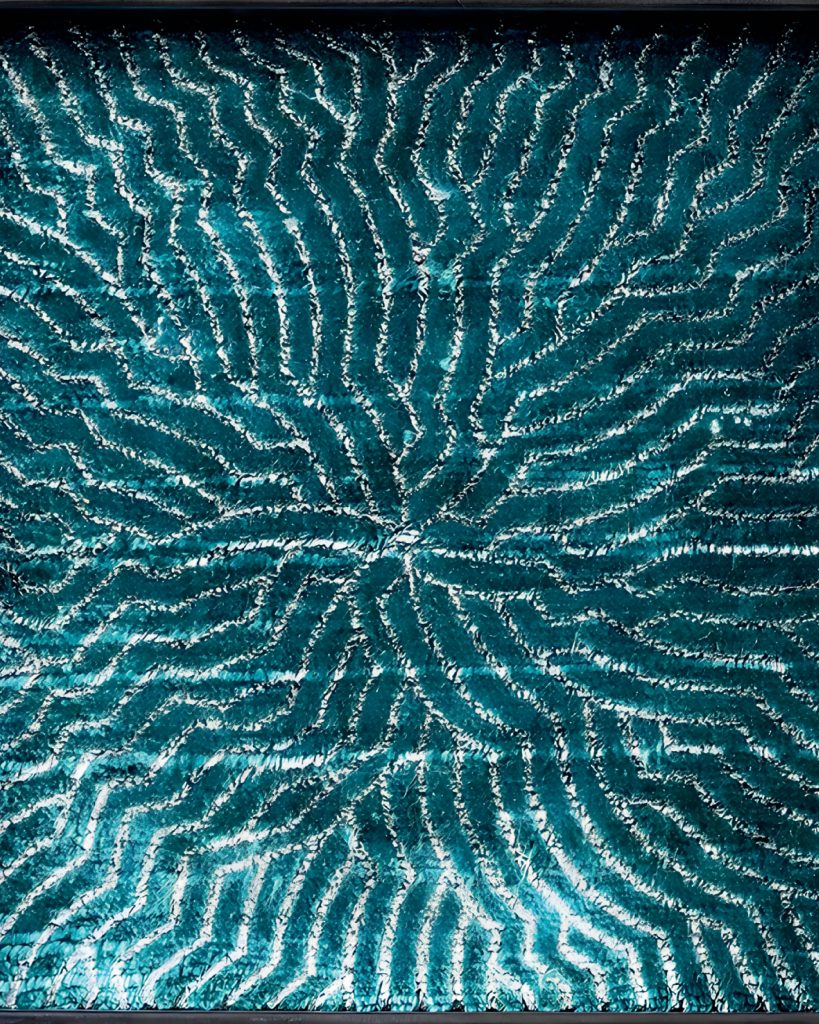
The textual formulas in Healing Devices are rendered intentionally indecipherable, hinting at a form of censorship entangled in a context of political and social restrictions. “Formally, I opted to work with the medium of painted paper collages as opposed to painting, so as to enhance the sculptural nature of the healing devices,” Huda continues. The subtle and layered colours of the works on paper reveal palimpsest traces; the rustic silver and gold backgrounds recall a version of the truth that might inspire the present.
Calligraphy has become intertwined with the Arab identity. An ode to its style and significance.
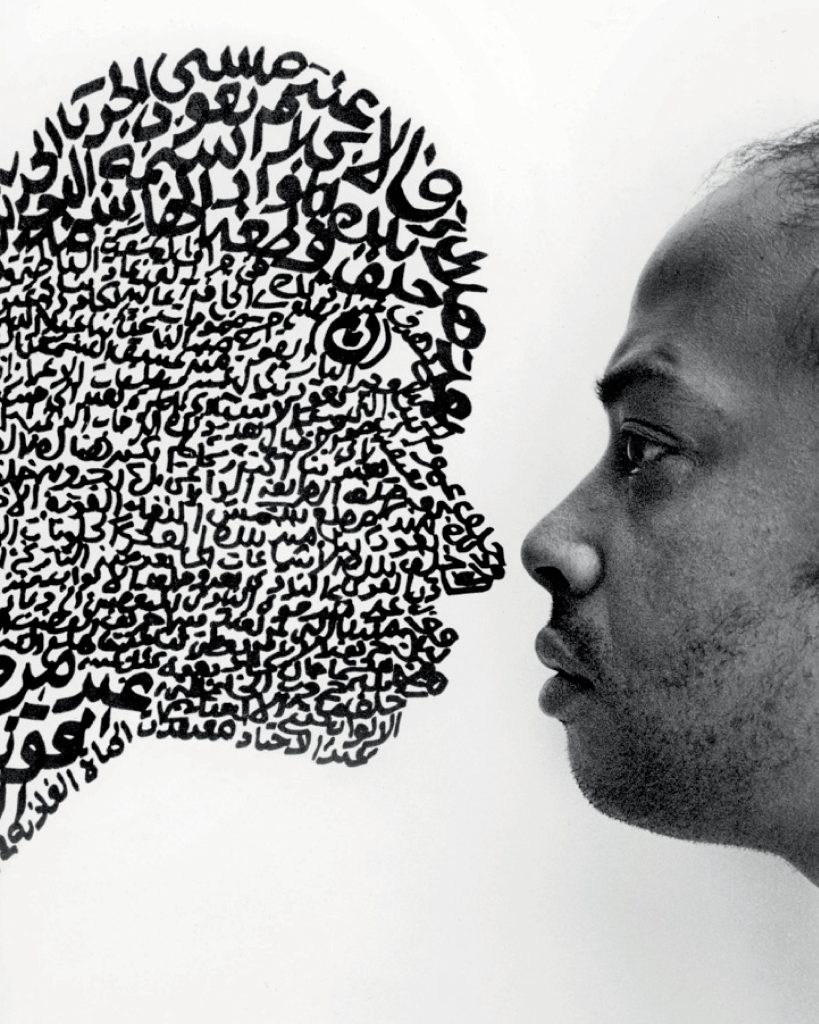
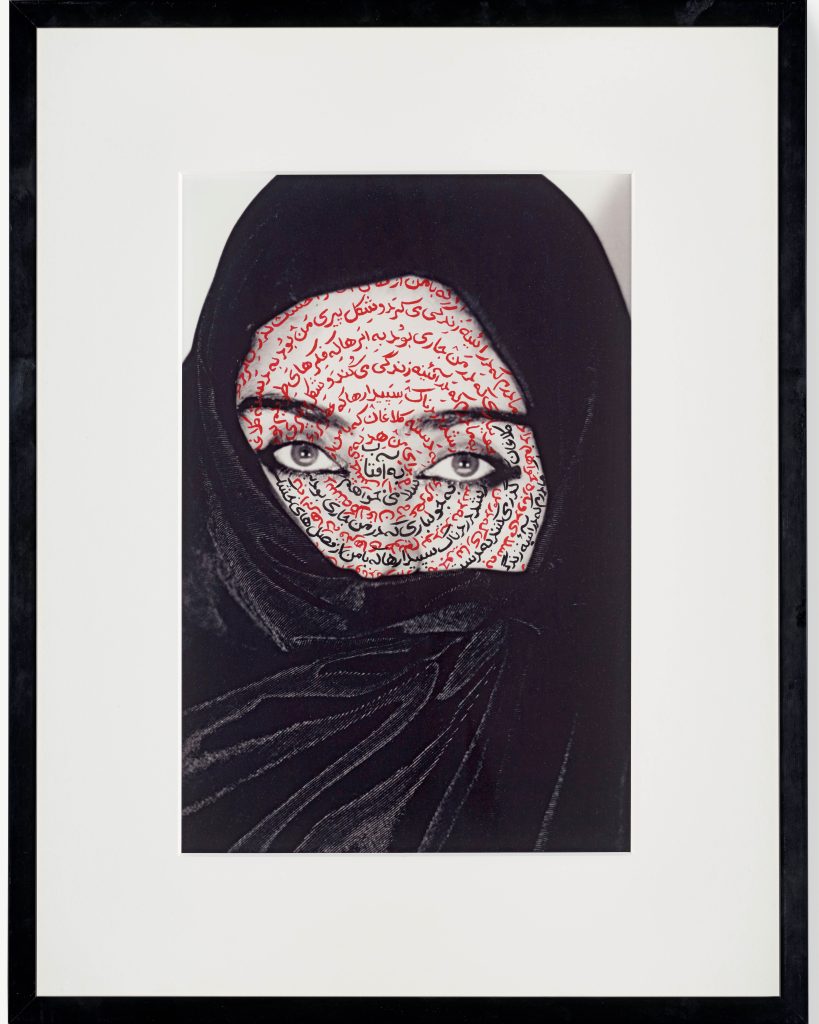
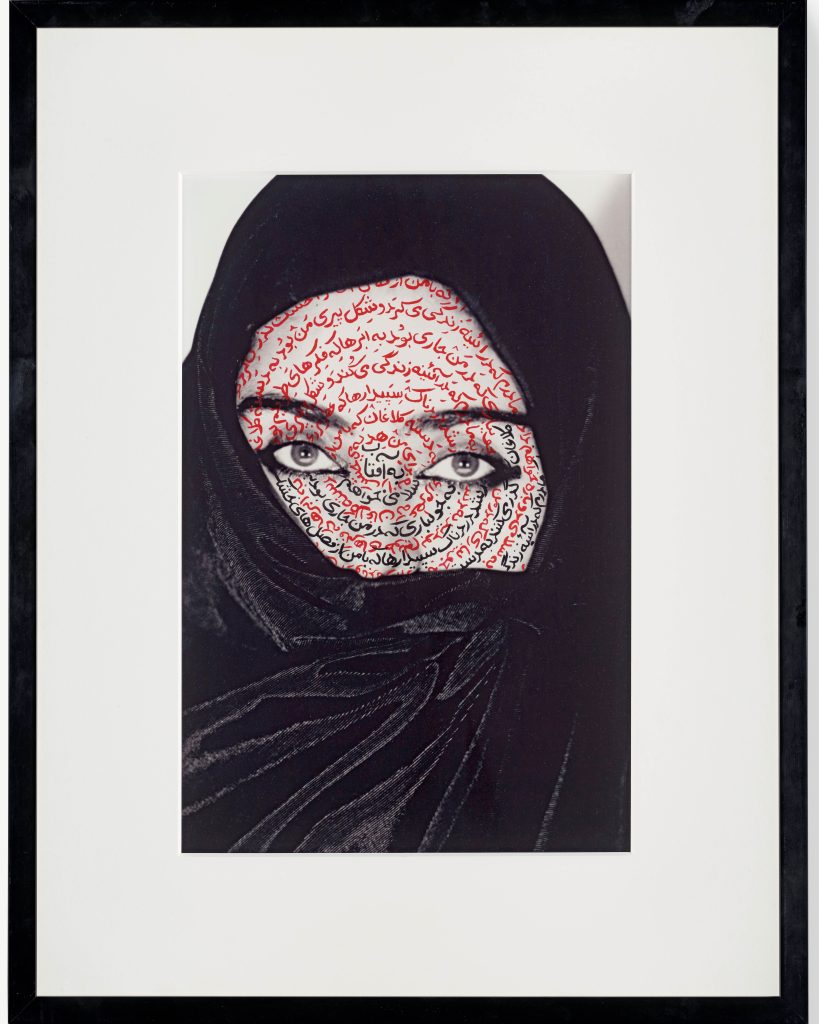
Works by Nasrollah Afjei, Maliheh Afnan, and Shirin Neshat will also be showcased. An ongoing fight against censorship and a simultaneous quest for a reality that remembers the true depths of the distant past, the exhibition bravely invites the viewer to revisit forgotten history – all the while capturing a beautiful rebirth of calligraphy.
The Resistance of Pen and Paper is on view at Richard Saltoun gallery from 26th September until 4th November 2023.
All Images Courtesy Richard Saltoun Gallery, London and Rome Copyright to the Artist/The Estate of the Artist
Lead image Shirin Neshat. I Am Its Secret (from Women of Allah series). 1993. Chromogenic print. 49.4×33.5cm. Courtesy of the artist