
Russian Artist Pokras Lampas’ Reinterpretation Of Calligraphy
Planted within a multicultural dimension, the artist takes us into the world of his new invented art form
According to the department of Islamic Art at the Metropolitan Museum of Art, calligraphy is principally a means to transmit text, albeit in a decorative form. Present for more than 3,000 years, this gestural art form has gone through numerous periods and regions, resulting in its current varied design.
Specifically, modern calligraphy is considered to be any form of calligraphy that doesn’t follow the traditional structural rules. Disrupting such norms is Russian calligraphy artist, Pokras Lampas.
Influenced by ancient, traditional, modern and innovative letterforms, Lampas has the goal of fusing alternative cultures, merged together by calligraphy art. His self-developed style is called ‘Calligrafuturism’, based on the artistic vision of multicultural calligraphy of the future and within modern Cyrillic and Latin calligraphy.

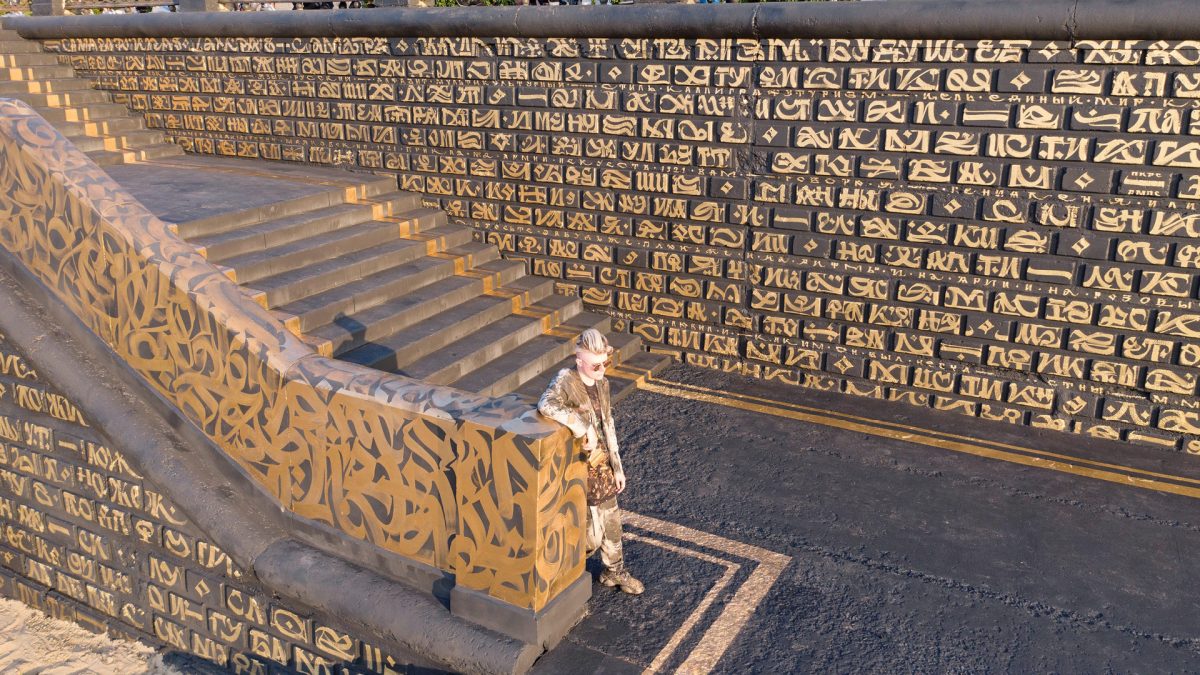
Installation views of Pokras Lampas. Mayakovskiy Stair. 2020.
Calligrafuturism’s main objective is to showcase the fusion of different cultures, merged together by this art form in balance and harmony. Invented by Lampas, the technique is classified according to some common distinguishing features in his significant artworks. In order to understand the basic rules of language, he deconstructs each word to the basic letters and letter shapes, then reconstructs this knowledge into a new letter shape from an alternative language.
His final pieces often refer to themes of dreams in the context of human memory and experience. The artist’s latest project is located on the embankment in Samara city, named Mayakovskiy Stair (2020) at the riverfront of Volga River.
The name has been inspired by famous Russian poet and futurism artist of the early 20th century, Vladimir Mayakovsky. Previously on this same location, Lampas used to write his work ‘Order No.2 to the Army of Arts’.
Creating 2,500 letters of his poetry, with each unique letterform referring to different traditional and modern calligraphy forms and styles, this piece represents his open library of Calligrafuturism knowledge and letterform research.

Aerial views of Pokras Lampas. Mayakovskiy Stair. 2020.
Lampas’ work has recently been showcased in many cultural institutions including museums, galleries as well as art projects in Russia, France, Germany, Italy, Portugal, South Korea, China, UK, USA and UAE. Dubai-based Opera Gallery has also presented several exhibitions by the artist, including ‘Calligrafuturism Vol.1’ and ‘Impossible Until It’s Done’.
So, is this a new world of modern calligraphy and, as such, the calligraphy of the future? With calligraphy’s balance between mastery and philosophy, equal visual parts and meaning, it may come as no surprise that, as the artist says, “Traditional calligraphy was called the art of beautiful writing. By breaking the standards of beauty, we change the idea of what calligraphy is and what its function is.”
From thin strokes on paper to the large letters on the city’s square, Calligrafuturism highlights global unity and the harmony of cultures, introducing a new way to experience modern calligraphy.
Lead image: installation views of Pokras Lampas. Mayakovskiy Stair. 2020. Courtesy of the artist
From the Autumn 2020 issue of Harper’s BAZAAR Art