
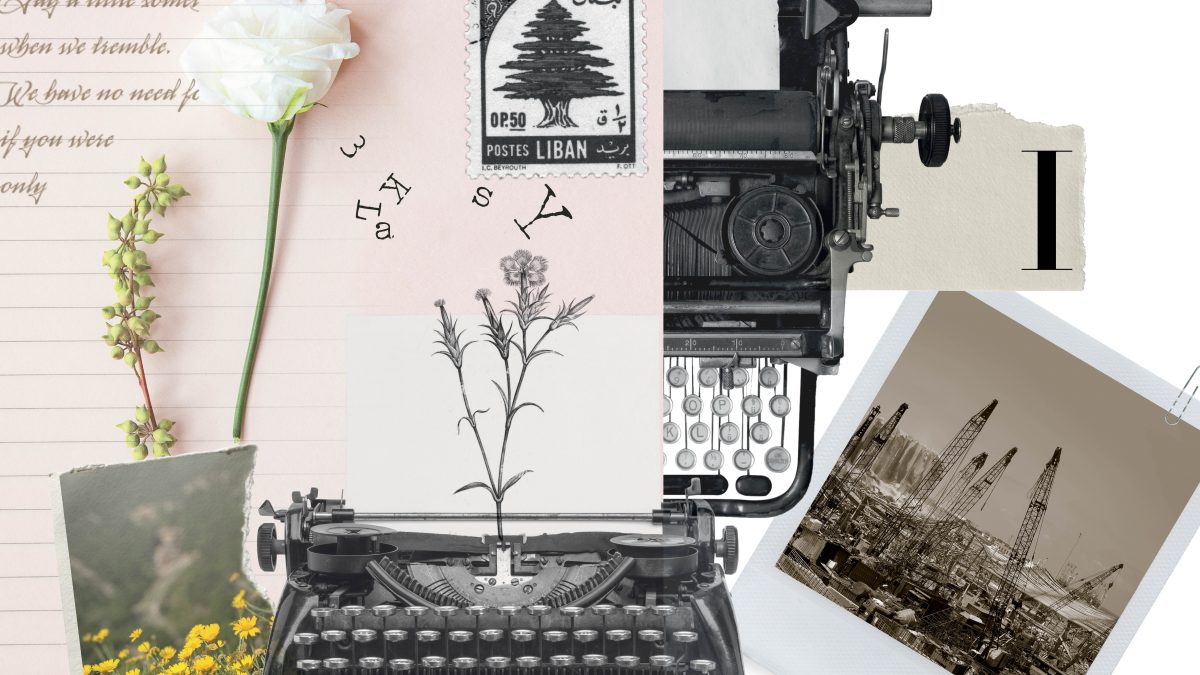
Why Telling Our Stories Is A Risk Worth Taking | MEPRA Youth Board Creative Writing Competition, Winning Article
Harper’s Bazaar Arabia teamed up with the MEPRA Youth Board to promote regional voices in its inaugural Creative Writing Competition. This year’s winner, Dana Cheaib, recounts in her first-place article the powerful role storytelling has played for every generation of her family…
It’s 6:01 PM and I am sitting alone in the far corner of my bedroom. I can hear my father’s footsteps in the living room, trotting towards the sofa as he puts on the news. Luckily, the sound of Lebanese politicians yelling over each other would mask my voice – I click the ‘Launch Meeting’ button. “I don’t get it. Why is that day still affecting me?” I finally ask my therapist.
It has been well over a year, and I still talk about the Beirut explosion in therapy; how flashes of memory come back to me unpredictably, and how the effects of my trauma still seep into new and unforeseen cracks in my life.
Much like therapy, my pursuit of a career as a writer has been difficult for me to talk about openly with my family. Pursuing a career writing poems and telling stories is risky, and my family, like most Lebanese families, are not fans of risk.
But they are fans of stories.
My maternal grandmother tells the stories of her youth obsessively. There is one in particular that always comes to mind. On her first day working as a secretary, at the age of 17, she was brazenly groped by her new boss, a highly regarded engineer. When she decided to stay home the next day, her mother (my great-grandmother) asked why, and after hearing about the troubling incident famously responded with a sarcastic remark, “Yi, poor you!”
My therapist believes that sarcastic remarks like this one have been ingrained in the minds of all the women in my family, making it hard for us to truly express our emotions. I had never believed this theory myself, until about a month ago, when I explained to my mother that the memory of the explosion still upset me and made me cry, and she replied, “Dana. Snap out of it.”
Had my wonderfully nurturing, inspiring mother effectively been silencing my sadness? And if so, could I blame her?
I am sorely aware of how much harder my parents have had it in life. I was raised in Dubai while they were raised in a war-torn Lebanon.
I happened to be on vacation in Beirut on that dreaded day, but they survived a multitude of explosions, and shootings, and missiles that nearly killed them, all throughout their youth. Could I really blame them for misunderstanding my pain?
My mother’s remark still managed to create an unspoken wedge between us, pushing me to distance myself from her for a few weeks while I explored more impersonal ways of sharing my experience. I decided I would attend a poetry night, alone, for the first time, to read one of my poems to an audience of strangers.
When I got on stage and looked down at my poem, my eyes were drawn to one of the lines; “Of all the people I’ve met in Beirut, how many are dead now?” I had read the poem so many times that I forgot what it represented until I was forced to share it. I rushed through my reading of the poem, ran off the stage, and found myself holding back sobs in a bathroom stall.
The first person I called was my mother. She offered to pick me up and kept me company for days. We made my favourite foods and watched my favourite movies. When I finally told her what had happened, we could not help but laugh about it. I felt liberated.
The women in my family may have different ways of coping, but we will always be there for each other. We may joke about our most terrible life events, but we will always show a genuine interest in each other’s stories, we will always listen. I must have heard the “poor you” story about a hundred times now, my grandmother’s Alzheimer’s having turned it into a mental fixation. But I made sure to record her story, and many others before her dementia could get worse. Perhaps I would share these recordings with a daughter of my own one day. Perhaps she, too, would learn the value of telling stories. After all, isn’t storytelling just another form of therapy?
From my grandmother who will be telling stories until her dying breath, to my 90-year-old grandfather who still writes poems for every occasion, we may not realise it, but sharing our stories can set us free. I merely hope that those who are listening, listen kindly and intently, so intently that they can no longer hear the sound of those yelling voices in the background.
From Harper’s Bazaar Arabia’s Feburary 2022 issue.