
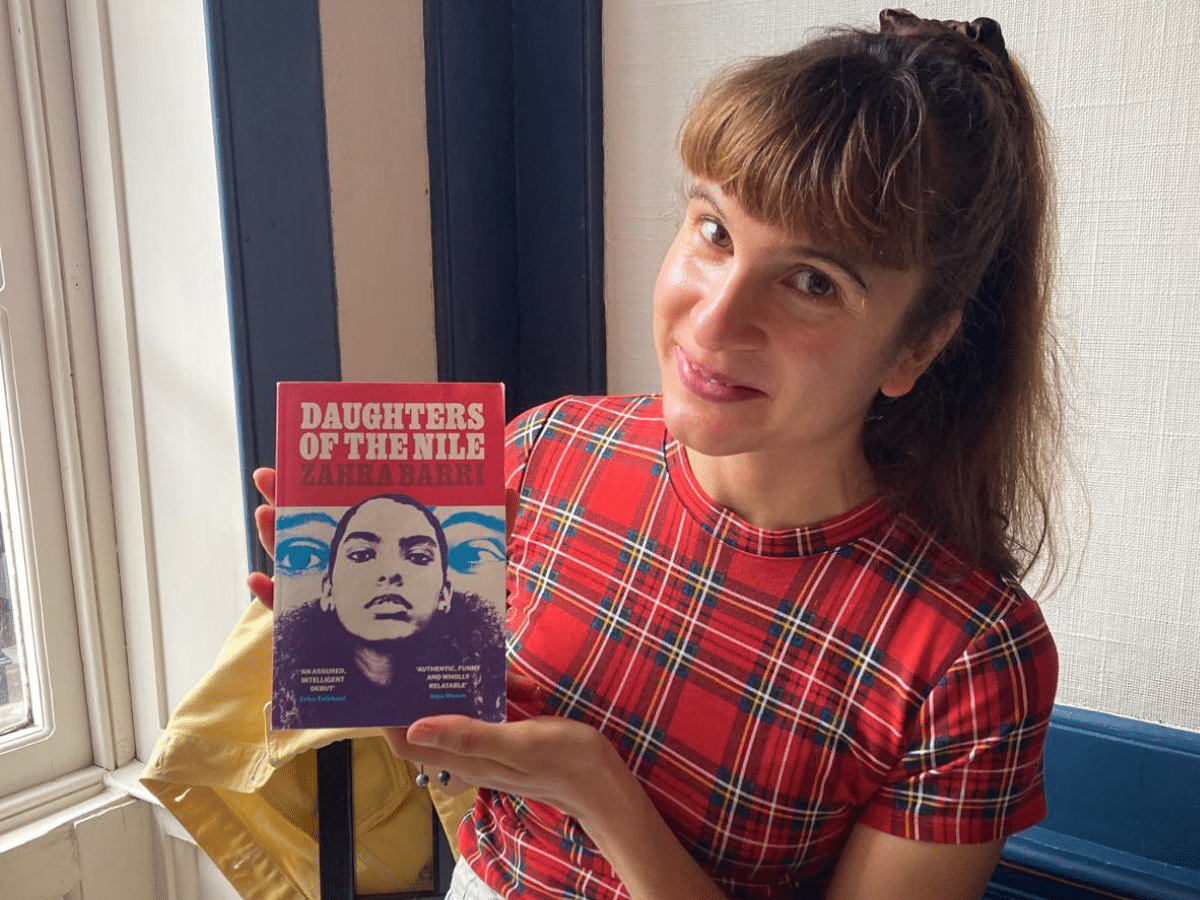
Daughters Of The Nile: Third-Culture Kid Zahra Barri’s Debut Novel Celebrates Feminism, Friendship and Feeling Out of Place
The Irish-Egyptian comedian shares why her book is “a real love letter to Egypt”
“I feel like I have to send my family an email to say, like, ‘Look, please don’t be upset,’” the Irish-Egyptian stand-up comedian-turned author Zahra Barri jokes when I ask how she’s feeling about the release of her upcoming debut novel, Daughters of the Nile. “It’s just so based on them, but then completely fabricated at the same time,” she expands. “And also, it’s quite a racy novel, and my dad is going to read it, so it’s strange.”
Like many third-culture kids, Zahra has long felt like she’s not quite British or Egyptian enough, perpetually code-switching, or letting down either one or other of her cultures, but there’s nothing more Arab than starting a conversation about your first published book by talking about what your family are going to think of it.
As with many immigrants, when her Egyptian father moved to the UK in the 1970s, his focus was on integration, something he imagined would be easier for his children if they didn’t speak Arabic. But identity is something that proved complicated anyway, Zahra says. “I feel like this book is almost like a compensation. It’s a real love letter to Egypt.”
And a love letter it is indeed. Following the lives of three generations of women from the Bin-Khalid family, starting in Cairo in the 1940s and spanning Saudi Arabia, Iran and almost present-day London, the novel touches on themes of feminism, female friendship, shame, identity, and beyond, in a powerfully nuanced reclamation of a history most of us have never seen or even imagined, other than perhaps in the wistful recollections of our grandparents.
After spending 11 years on stage developing her voice as a stand-up comedian, crafting relatable, funny ways to talk about such themes, Zahra began a PhD in creative writing, where she stumbled across the autobiography of Egyptian feminist Doria Shafik (founder of the 1940s magazine Bint Al-Nil, aka Daughters of the Nile, and one of the leaders of the women’s liberation movement, who worked to get Egyptian women the vote). All the pieces of the story came together, then.
Of particular inspiration were the forced false dichotomies between beauty and brains, Islam and feminism, that seemed a cornerstone of Doria’s life and work. “I loved that Doria was the first Muslim woman to do an Egyptian beauty contest,” Zahra explains. “She did a thesis on women’s rights in Islam, too, and was very much an icon of the West and the Middle East. She just seemed to represent everything that I wanted to represent in the book. I wanted to present Middle Eastern women and Western women, and how we’re actually very similar and we’re oppressed in different ways, but the same ways.”

Throughout, Zahra speaks to the many stereotypes, still prevalent, of what it means to be a Muslim woman. Wanting to debunk and complicate those assumptions was one of her primary motivations. Quoting the professor Martyn Amos, she says: “Writing is a campaign against cliché, and that’s what I want to do with my writing.
Indeed, feminism, despite what some may think, is not a Western concept, and it’s this that is made painstakingly, beautifully clear throughout the novel. “There’s a myth that Western feminism has always been more progressive than Middle Eastern feminism, and I really loved playing around with time and place, and how ‘progressive’ doesn’t necessarily mean Western and forward in time,” she says.
“What I liked about Doria Shafik’s magazine, was that it was very political, very feminist, it talked about colonialism and the Egyptian family and women’s rights in Islam while, during that same period, in England, women’s magazines were just like ‘How to please your husband,’ and things like that,” she expands.
“A lot of feminist asks, like equal pay, Huda Shaarawi was fighting for in the 1920s, when British feminists didn’t fight for that until the 1970s!” she adds.
Complicating assumptions and binary understandings are one of many things Zahra does brilliantly, with nuance and dark humour shining through with every turn of the page. “Two opposite things can be true, and that’s just exactly what my book is,” she says. “It’s full of opposites, but they’re all true.”
Writing the book has unleashed something of the spirit of the daughters of the Nile in Zahra, too, it appears. “Before writing this book, I didn’t trust myself with any decisions about my life,” she says. “I used to seek a lot of validation from other people. But now that I’ve written this book, I realised that I can make the decisions in my life. I wrote this book with just me in my head, and it’s worked out. So, I trust myself with my life, now.”
From Harper’s Bazaar Arabia’s June 2024 issue.