

Nooriyah On What Makes SWANA Music So Infectious
The DJ and radio host shares why reconditioning people’s ears to different musical genres is critical and how Jay-Z’s Big Pimpin’ helps serve as an auditory education…
Having grown up between Saudi Arabia, Japan and London, the Bahraini DJ, radio host and producer Nooriyah’s music tastes are as diverse as they come; as evidenced by the genre-defying, high-energy sets she carefully puts together and has become increasingly well- known for.
“I feel like I have this invisible suitcase with me, and in it are different ingredients from different places,” she says. On a mission to connect the dots between diverse global music cultures, she has spent the past decade championing sounds of the diaspora across radio, social media and nightlife, most recently through her Middle of Nowhere party series and viral Boiler Room set – the first ever with an all-SWANA line-up.
Having curated her own stage at Glastonbury earlier this year, she sees the festival as an opportunity to place the ladder to success she has built, rung by rung, within reach of those coming up behind her.
“Curating things is powerful because you’re able to not rely on other promoters who are [often] white and men,” she explains. “That’s the whole mission alongside me having my own music career is always putting people on.”
Here Nooriyah opens up about how she discovered her love of music, what sets SWANA (South West Asian/ North African) apart and her struggle against systemic sonic preconditioning.
Have you always loved music?
I remember driving in the car with Baba and listening to the radio; everything from classics like Abdel Halim to new things like Sherine and tracks by Louis Armstrong. That influenced me a lot. I didn’t think – like, zero per cent – that I could have a career in music [but] I was always creative. I started painting when I was little, playing the flute and learning the violin in school. But it always felt like this extra- terrestrial thing that happens away from me. I just thought I’d never have access to something like this, being where I’m from, and being who I am as a woman.
Was the fact that you didn’t see anyone who looked like you, doing what you’re currently doing, an obstacle to feeling like you could create a career for yourself in music?
Yes, but not in the way you might think. It was an obstacle in terms of feeling brave enough to play that sort of music in different spaces. In London, where I’m based, it’s so much easier to play things that people are familiar with; the pop stars and the local stars that people will vibe with and would love you [for] if you play. The lack of representation sonically was a big thing for me, and [taking] that step was difficult.
How did you first get into music and what made you feel confident and able to play the kind of music that you wanted to?
I started joining community radio stations to do voiceovers, and then I saw the decks. When I was little, I loved pretending I’m a cashier and I loved pressing buttons and I loved music [so] I was like, “Okay, that’s perfect for me.” This was maybe seven years ago… I just kept practising, and when I started getting gigs, I knew that I needed to put time into playing things that people would enjoy so [that] I can get more bookings. Eventually, I just started adding sprinkles, maybe two songs out of a two-hour set would be SWANA. Then I [saw] people vibing. Sometimes, if you sandwich it with familiarity, people are like, “Oh, this is so infectious also!” It kind of grew from there. I think we should give people and audiences more credit for their ability to be flexible.
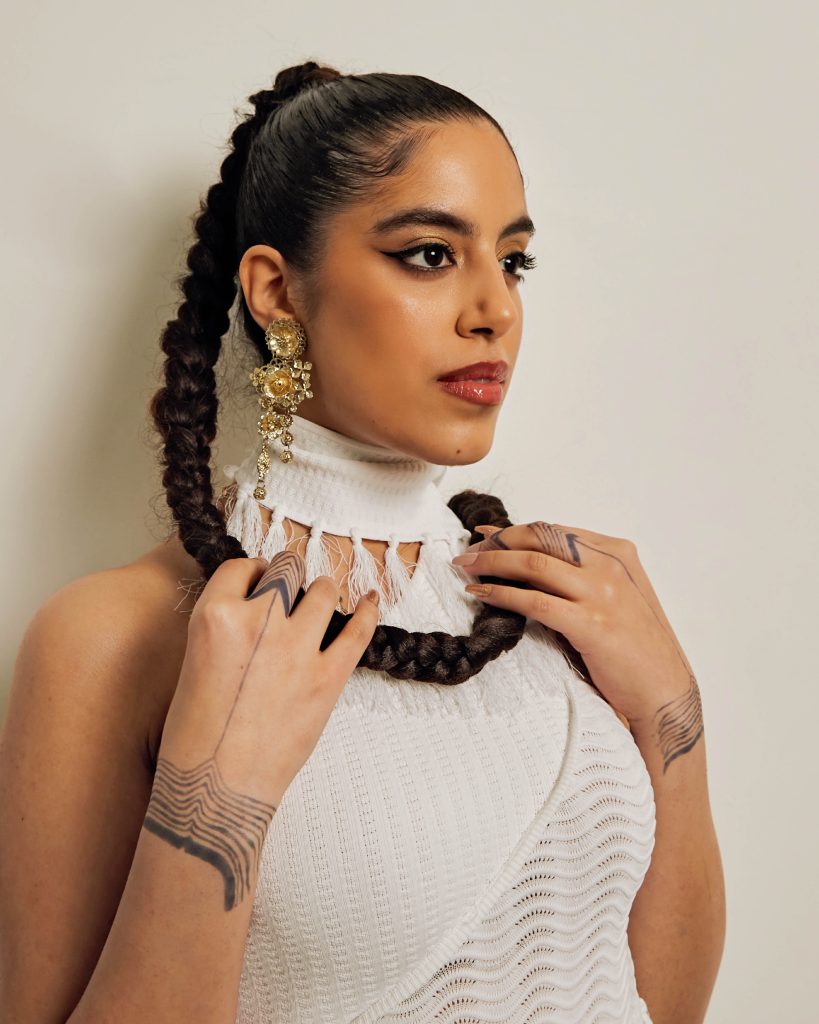
You recently produced a documentary for the BBC which looked into how our ears are conditioned to enjoy certain music over others. Tell us a little bit about this and what you discovered…
I spoke to different scholars and ethnomusicologists and their research shows that a lot of the traditional musical scales are slowly migrating to the Western scale to fit this pop norm. This is dictated by, for example, musical databases like Spotify and Apple, where they show you certain things based on popularity. [Also], the technology that we use now to create music, they’re not made for the producer to have a free canvas to create whatever they want; they prioritise Western scales. There’s that limitation already that discriminates. This amazing researcher [Khyam Alami] does a lot of work around this, and he would say there is a white supremacy, even when it comes to technology in music and how music is distributed overall. That relates, of course, to our music because any music that is considered ‘other’ is othered. [But] the ear can be reconditioned. A way we could do that is by continuing to stream and support artists in the SWANA community, [and] to share [music] with our friends. It’s really hard to fight an algorithm; it needs all of us.
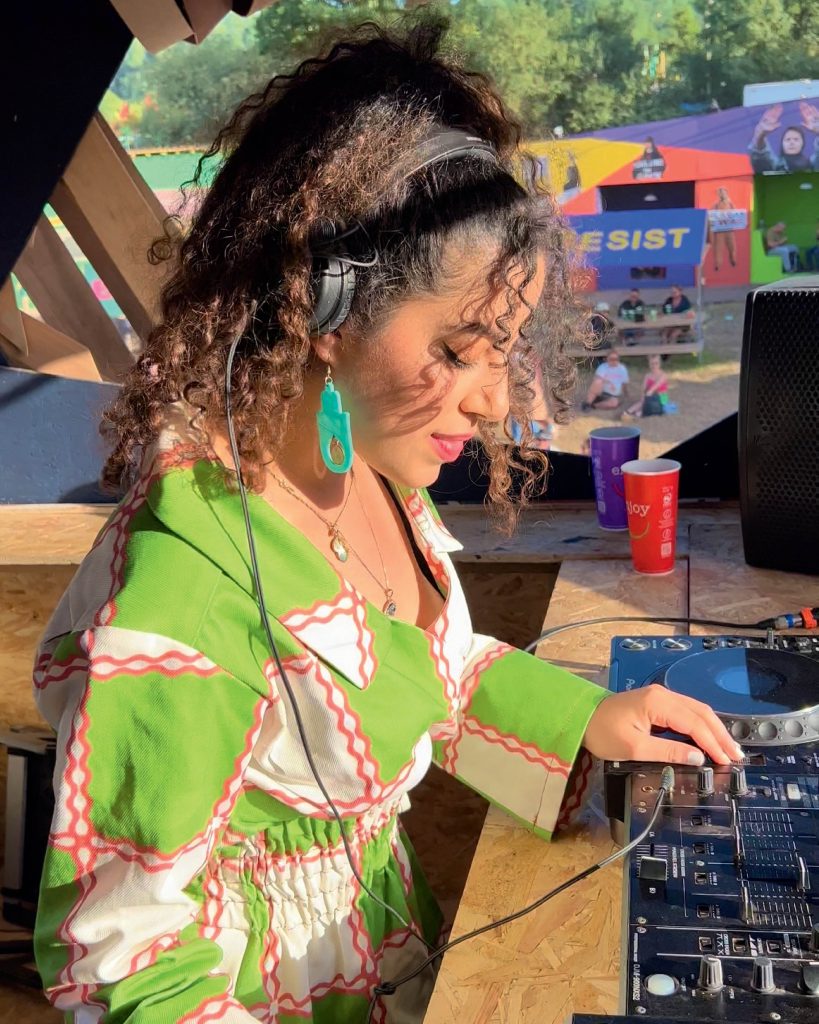
You’ve been doing a lot over the years to educate people on SWANA sounds. We love your Reels on Instagram where you show all the Arabic tunes that have been sampled by Western songs. Why was that important to you and how do you think social media has impacted and facilitated your journey?
It’s the easiest way to explain to people how infectious the music is. If [for example] you’re telling them that this huge pop song – like Big Pimpin’ by Jay Z – sampled a huge song from us. Social media allows you to communicate things in an effective, visual and simple way that, actually, in a lot of the tracks that you love very much, we exist. It felt like there wasn’t space for what I wanted to do – what I’m doing now – and I needed to create it. In order to create it, I needed to do that bit of education.
“Continue to stream and support artists in the SWANA community. It’s really hard to fight an algorithm; it needs all of us”
Alongside radio and your own gigs, you recently launched a series of collaboratives called Middle of Nowhere. How did that come about and what’s your aim there?
I created Middle of Nowhere because I felt like there were parties that happened in London that I’d be invited to play, but it would be like, “only play SWANA stuff”, or gigs [where] I would have to just play [other] things. I wanted a place where I can play anything that’s infectious; a space that represented what I listened to at home. For me, creating the space was never about creating something in silo- like, “Okay, this is a SWANA only thing,” because I don’t think that progresses the narrative at all in terms of music and us having a space [at] the grand musical table. Middle of Nowhere is about sound clashes. For example, we did the Latin and SWANA night; I want to do more explorations like that and I hope that [other music communities will] come and meet our community; bringing these whole different worlds together.
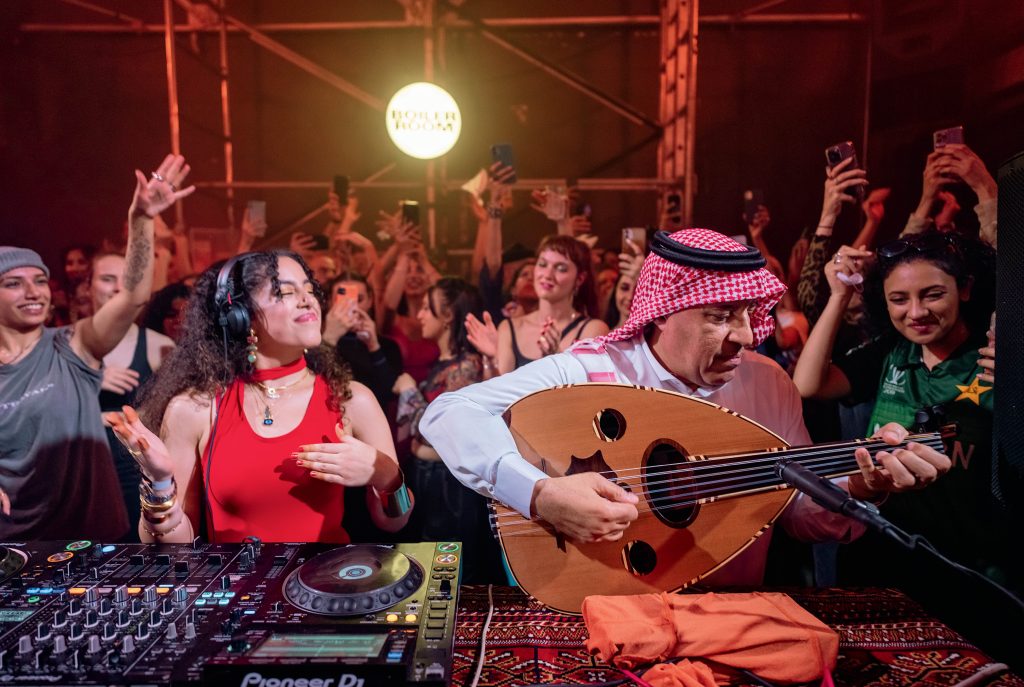
It feels like SWANA culture is increasingly having its time in the spotlight. What do you think it is about the current global landscape that’s facilitating this?
I feel like there’s some sort of cultural revolution [happening], where if you’re wearing your stripes loud and proud, it’s okay and it’s celebrated, across the board – not just SWANA. I think we have a lot to offer and we’re just stepping up to the plate – musically, artistically and in every other way. Similar to movements like Amapiano and Afrobeats and how global they’ve become, I feel like our sounds are equally infectious and deserve a space like that. As a DJ, I have all sorts of genres on my USB, but a lot of my peers have everything else but SWANA music – not because they don’t enjoy it, just because that work [still needs] to be done, where the music and they meet. That’s what I wanted to do, both [for] the DJs and the listeners; just making that gap a little bit closer.
From Harper’s Bazaar Arabia’s September 2023 issue
Images supplied.