
How Jason Seife Is Using Contemporary Mediums to Bring A Traditional Art Form To The Masses…
From his Middle Eastern-inspired carpet paintings to digital designs embracing augmented reality, the artist is embracing a new way of sharing his work with the world…
Jason Seife has a real skill. Apart from being a connoisseur of drawing, painting and graphic art, he’s a master at making anything and everything sound interesting, be that traditional Middle Eastern embroidery, the best way to make concrete canvases or the world of non-fungible token artwork (NFT). In fact, he’s so captivating, I barely say a word during our 80-minute Zoom call. Jason, on the other hand, is non-stop, and almost every word is linked back to his love for art. He does pause for about 30 seconds to mention that he also likes playing football, guitar and reading, and then it’s straight back to art.
“I fully fell in love with art as a kid and I would fantasise about being an artist – I didn’t even know what that meant at the time,” laughs Jason, who is of Syrian and Cuban heritage, and started out by drawing pictures of the Persian rugs that filled his family home in Miami. “I knew that it was something that I was good at because people would tell me so – so I set my sights on going to this art- centric high school.”
But Jason’s art career wasn’t a straightforward journey. “It was a very difficult school to get into, they only accepted 30 to 40 students, but I had built it up in my head that this is what I needed to do to be an artist, and through the sixth, seventh and eighth grades, I was working on a portfolio to apply,” remembers Jason. “I applied and I got denied. I was around 12, and I took it super hard. At that time it felt so finite, and I decided: I’m not going to do art anymore. I asked for a guitar for my birthday and started playing in bands through high school instead.”
Jason continued to take art classes at school because he was still getting good grades in the subject but the passion had gone. “I fully thought that I would never get back into fine art, it had left such a bad taste in my mouth.” But Jason didn’t completely forgo his creative side and found himself falling into the world of graphic design instead. “I was playing in these bands and I realised that people were getting paid to do the logos and designs for tour merchandise such as the band’s T-shirts, and I thought: I can do that,” says Jason, who taught himself how to use graphic-design software through YouTube tutorials. “I realised there was actually some money to be made, so I decided to quit the band, and with all the time on the road and sleeping on people’s floors, I started trying to do the graphic-design stuff.”
His contacts in the music industry proved fruitful, and Jason also started connecting with artists on social media. “I got some cool opportunities to do design work for some huge artists. I worked under Virgil Abloh who was Art Director for Kanye West at the time, I did some stuff for Pusha T, Nicki Minaj and Big Sean. I did a lot of work for people, and that’s what allowed me to get a studio to start making paintings,” explains Jason, who worked across album artwork, merchandise and jewellery design. “It was cool to be able to make money but at the same time, I was bringing other people’s ideas into fruition. I wanted to make my own work and I started painting and getting more confident, and realised that maybe there was a way for me to do fine art again.”
Jason applied to a number of leading art colleges and despite being accepted by every one of them, he decided to swerve a three- year course to paint in his studio and in 2015, he produced the first of the carpet paintings that he’s now world-famous for – pieces that collectors are willing to pay anywhere from $5,000 to $100,000.
“I had done some sketches of carpets through the years before this first piece, even through high school they really pushed observational drawing, and at home, the carpets were everywhere. I always looked at them and found them interesting in terms of the design aspect,” recalls Jason, who would also spot these Persian rugs at the nearby homes of his grandmother and aunt. “And venturing into graphic design made me appreciate them even more because it merged these worlds that I really liked, which was design, shape and form, and then also the ability to be able to take that and paint it.”
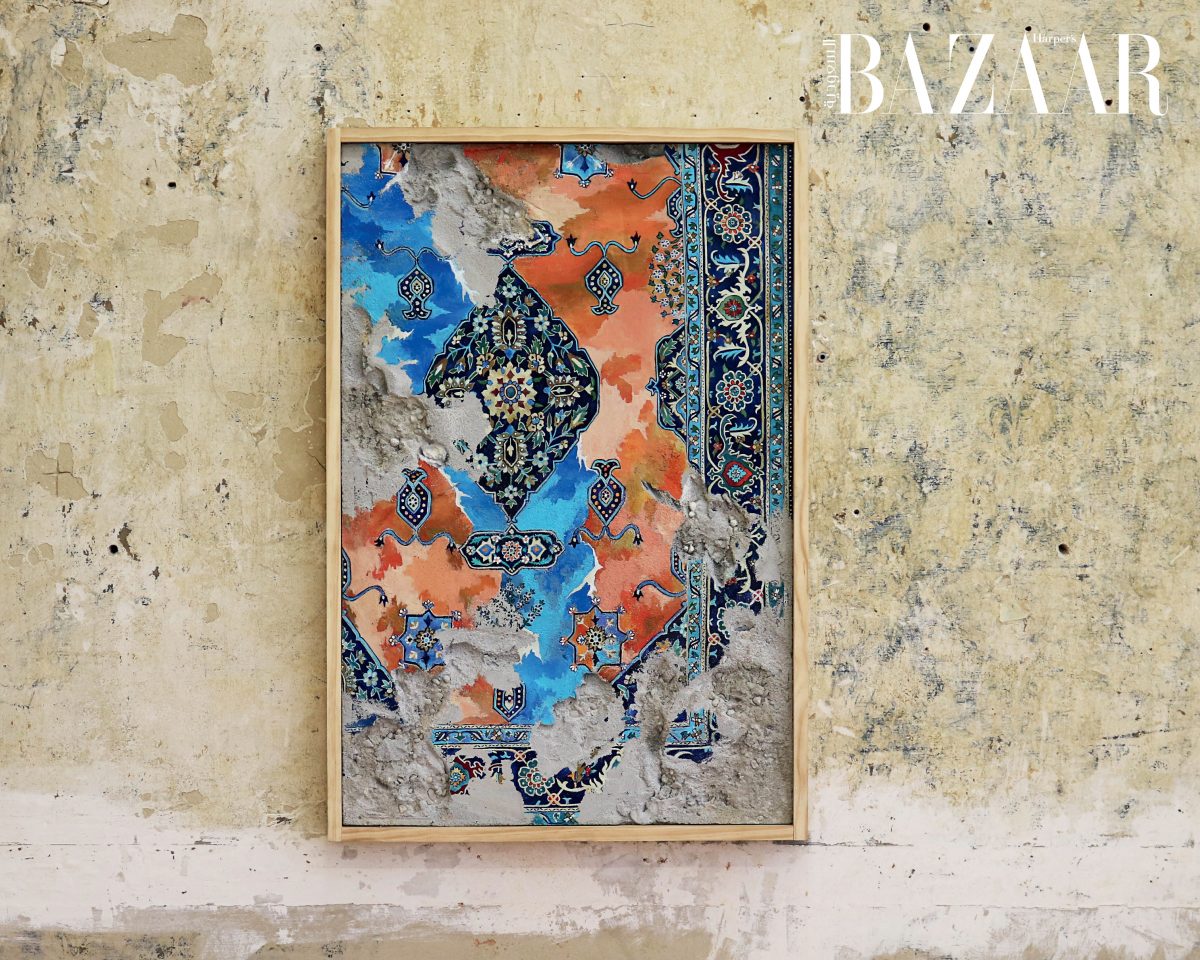
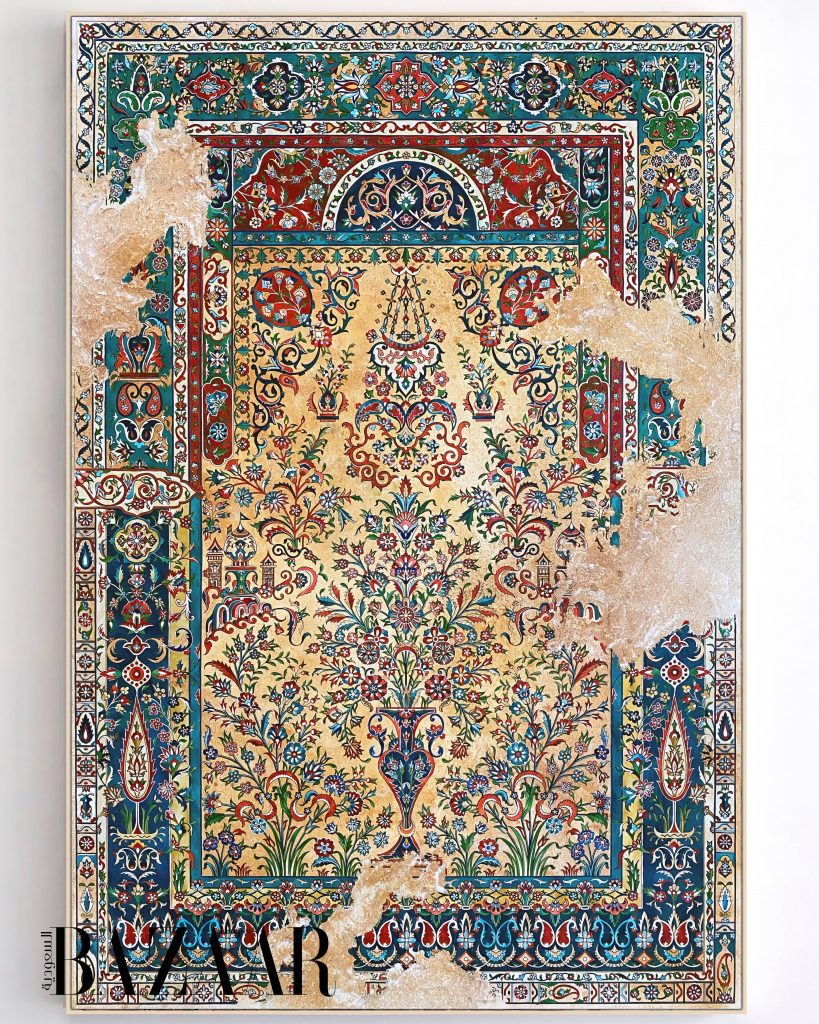
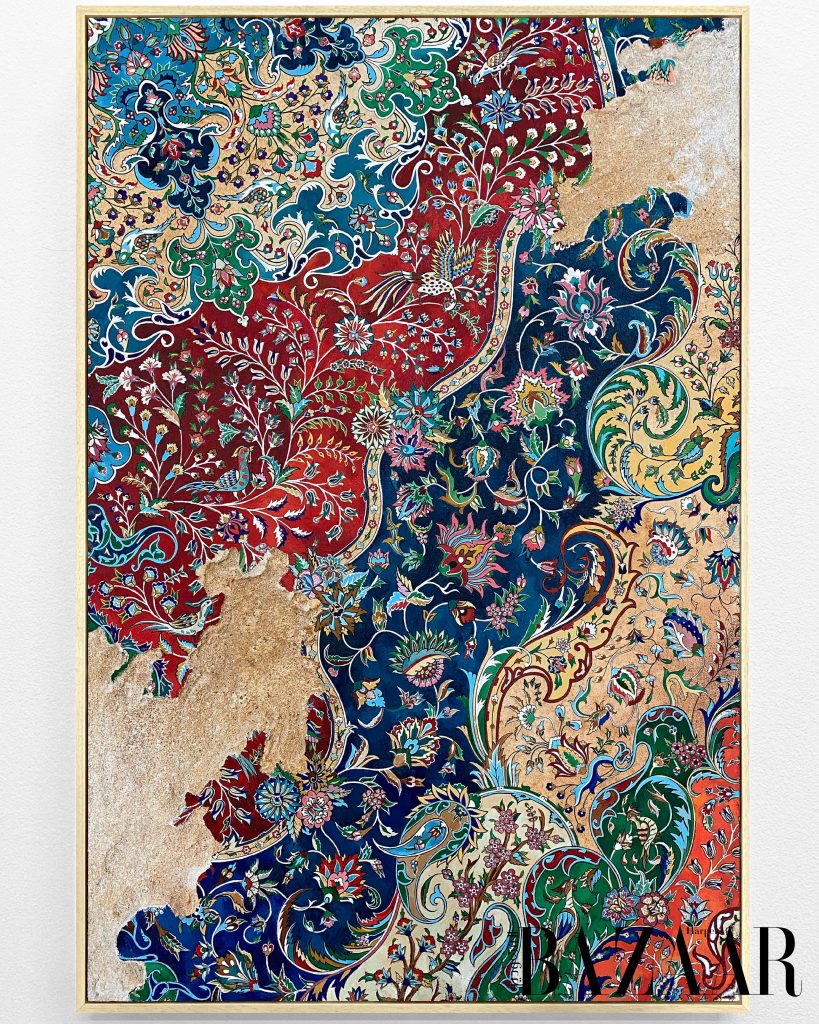
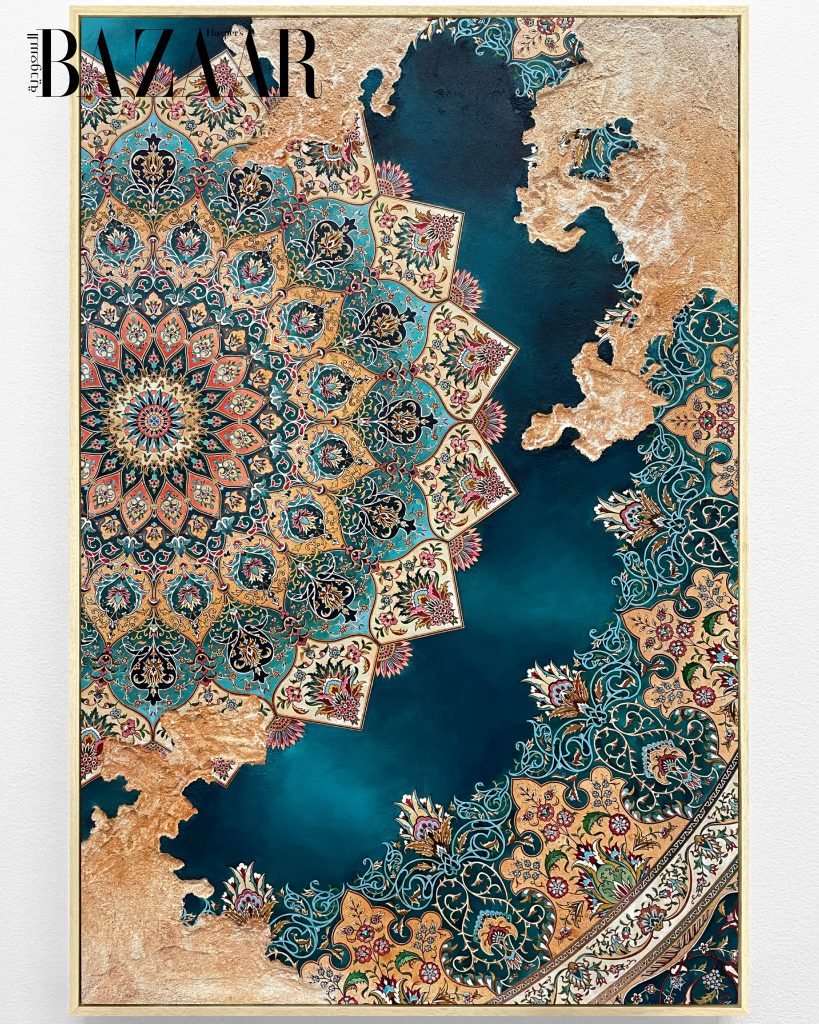
The first carpet piece was 150x100cm, and followed the process that Jason still uses today of designing one quarter of the carpet digitally (although in the early days, he would draw freely) before mirroring the pattern to create the full rectangular or circular rug design. He then transfers the intricate patterns onto canvas by hand, meticulously cross-referencing the digital design on his iPad, and finally filling the intricate outline with oil paints, ink and acrylics. The finished painting resembles a real Persian rug, sometimes complete with wear and tear and can take months to complete. Jason wanted his parents to be the first to see the inaugural artwork. “I had it in a frame on the floor of my studio and they thought it was a real carpet,” laughs Jason. “It was only when they got down that they saw it was a painting. It was such a cool reaction, especially from my mum who had always been my biggest supporter and critic growing up – always pointing out bits that could be better. It’s probably why I pay so much attention to detail now!”
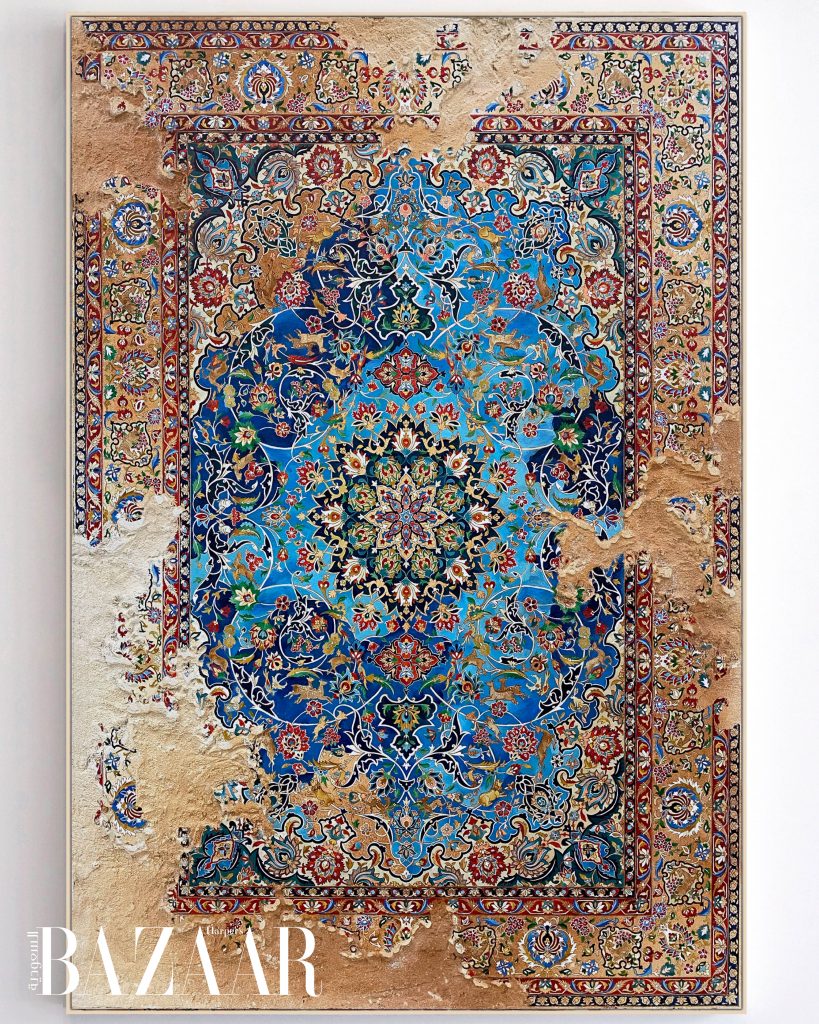
This spurred Jason on to create more of the carpet paintings and also to research the history, symbolism and pattern choices within traditional Persian carpets. “I was attracted to them, and I was getting closer to my heritage at the same time,” says Jason, who decided to visit Syria, where his father’s family originates from, as well as going to Iran, Turkey and Morocco for inspiration. He discovered that he had ancestors who had produced Syrian embroidery. “Some of their embroidery works are very similar to arabesque style, like the designs that you would see in the carpets, so it’s kind of in my DNA,” he laughs. “Next step was learning about how actual carpets are made and what’s the meaning behind them, so I spoke to many different craftsmen and weavers about their work, about what are considered ‘handicrafts’, but to me they are very much fine art because of the amount of time and mastery that goes into making them. I started understanding these rules that are in place, and why things are made a certain way. It was important for me to understand the rules and then I can know where I can bend and break them and try new things, and where I can make it exciting for my generation,” he explains.
Jason learned how to ‘read’ messages within the carpets from the choice of flora and fauna the weaver has decided to display. How to tell where a certain rug is from geographically and linked to which nomadic tribe, what use it was made for, whether it’s a floor rug or a hanging carpet by simply looking at the patterns and colours. “This was very interesting to me because as an artist, one of the hardest things for me was to find a practice that was both aesthetically pleasing and conceptually right,” explains Jason, who uses his own emotions at the time of creation to guide the patterns and colour palette of his work – to the point that looking at any of his finished pieces can take him back to the emotional state he was in while he was working on it, almost triggering a type of synesthesia.
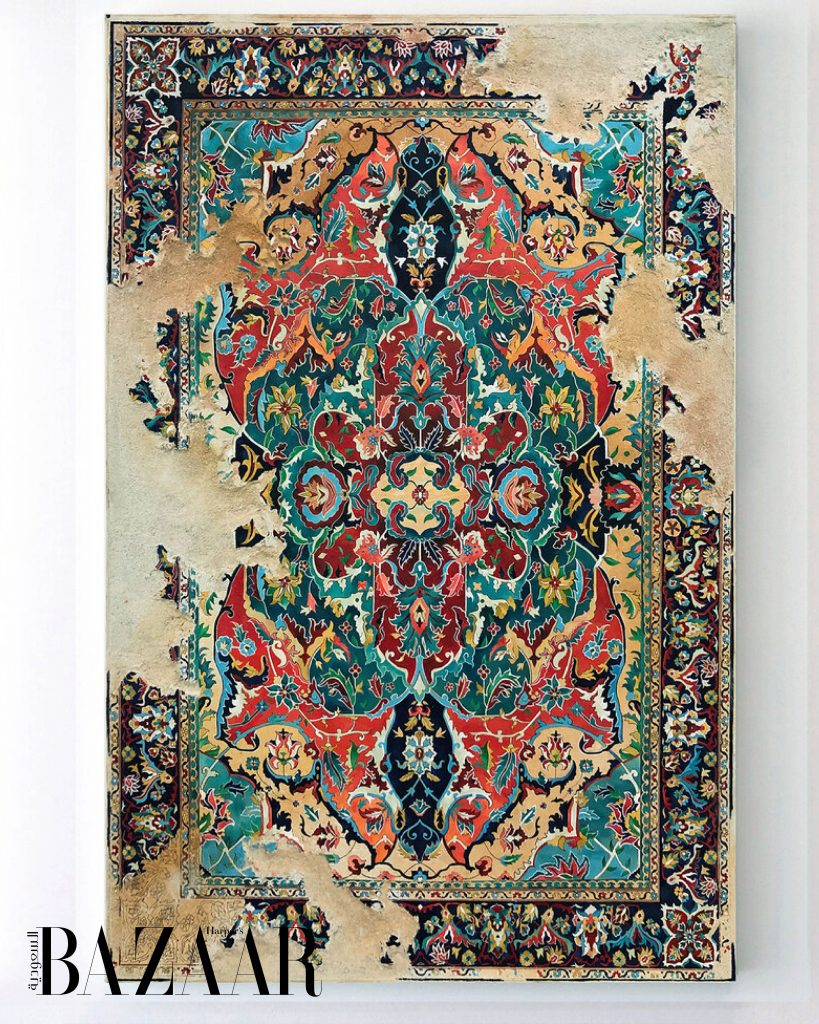
“I love process-based work so this is a way that I can draw people in with decorative ornamentation, which isn’t the most interesting thing from a conceptual standpoint, but then those that are drawn in can learn about the piece and its story. I mean, some collectors don’t care, they just want something that they like, but other collectors will love to hear that story and then we’ll look at some of the reference images together and I’ll share some things that inspired the piece.”
So, what do these traditional artisans he visited make of his work? “They’re just happy that it’s being championed by a new generation because there’s very little support for products like handmade carpets, weaving, tableware or ceramics now in some of the Middle Eastern countries that are struggling with sanctions and the like,” Jason explains. “There isn’t a huge demand, and the profit in the margins are getting smaller and smaller so younger generations aren’t learning these skills. What happens when this generation that has learned this trait stops making them? Are we only going to be able to see these items in museums? I’m very fortunate, that with all the interactions I’ve had, there’s been an overwhelming excitement for the fact that I’m interested in the craft.”
The visits to the region also inspired Jason’s decision to start using concrete as the base for his paintings. “In Tehran and in Damascus there’s all these tan concrete buildings and I wanted to recreate them as slabs and use them as the canvas for my paintings,” explains Jason, whose father helped him work on the perfect concrete base for the final works that give the appearance of the aged rugs he saw at the Tehran Carpet Museum. The concrete slabs have been followed by 3D surfaces including concrete cubes and ceiling drops.
Alongside the success of the trips to the region, came some emotional difficulties for Jason. “The sense of appreciation these artisans had for my work is very important because I did deal with an element of ‘survivor’s guilt’ after visiting some of the countries where the art and the people are struggling,” admits Jason. “It made me question my own success and think about why I’m able to make a living from this just because my family made a couple of decisions, or had the opportunity to move to the US. It’s a tough feeling, but I’m doing my best to educate myself about these places and help where I can,” he explains.
Jason does however see his early emotional and geographical distance from the region as a positive in the direction his artwork has taken. “I’ve noticed from travelling and meeting artists and friends from the region that they don’t necessarily make work that looks like what I make, because they are already surrounded by it, but being part of the diaspora, you tend to lean more towards things like that because that’s how I feel connected back to my heritage,” says Jason. This would also explain why early on, many of the collectors of his work were from the Middle Eastern diaspora, but of late, his audience has expanded to those from a multitude of backgrounds and he’s picking up a big collector base in the Middle East itself and in Europe – selling all the works in his first solo exhibition: A Small Spark vs A Great Forest, which was held at Unit London gallery at the start of the year. And the fact most artworks were sold before collectors could even view the pieces despite Covid-19 restrictions is testament to his popularity.

Jason has also been busy trying different mediums and taking on new challenges, designing and painting a number of basketball backboards and matching balls for the launch of the new Jordan store at The Dubai Mall in July. Adding to his links with the UAE – which has already seen his work displayed at Sharjah Art Museum – in 2018, his huge ceiling-suspended rug Nucleus, measuring 304x213cm, was showcased as part of the Sharjah Islamic Arts Festival. The last time he made a trip abroad was for the 2019 Abu Dhabi Art fair.
“I take so much inspiration from travel and a lot of my friends and creatives that I’ve met are overseas, so it has been a bit tough to stay motivated and stay creative,” admits Jason. “There’s so many random things that can trigger inspiration, even the way that certain colours are put together on a menu or a building.”
The artist’s latest venture into NFTs has seen his first digital-based work sell for $100,000. “This is something new that I’ve been exploring with a group of friends as a side project. Up until this point, all these digital renders that I had of my work just existed as reference images in my computer. Now, thanks to this new technology, there’s ways collectors can essentially purchase the digital artwork,” he explains. “With this last piece I’ve used animations, where it looks like a painting but then one of the birds in the painting actually comes to life in 3D.”

The piece is stunning and alongside the painting itself, the buyer will receive the lone rights to view the digital changes on the painting through his or her handheld device, which, when placed in front of the artwork, triggers the animations through the power of augmented reality. Jason is currently working on a second NFT piece, a concrete painting that will come with a digital interpretation that shows the artwork evolving over a ten-year period. He gives me the details – off the record – and it’s as political as it is both clever and inspiring.
“So the end format of what you see is a very distressed version of what it started like, and the physical painting acts a snapshot or like a timestamp of what it once looked like, so the artwork is almost like a performance piece that can only exist because of this technology,” he says of the work in process. “I’m challenging myself and trying new things, and I think it will be the first of its kind in that space, because there hasn’t been a lot of conceptual work with that technology.”

Jason is all about pushing boundaries. He talks about turning down hefty commissions where buyers have requested his pieces in alternative colour schemes in order to stay true to his process, and to allow him the time to concentrate on exploring new avenues. And it’s paying off, not just in financial gains but more importantly, in terms of his growth as an artist and his ability to break down the barriers between digital and fine art. Jason knows what he’s doing, and he knows what he’s talking about – and he makes easy listening for art connoisseurs and amateurs alike.
From Harper’s Bazaar Saudi Winter 2021 issue