

A sanctuary designed to be intentionally understated, Sonia West Sandfeur’s home embraces the beauty of natural imperfections
The true power of design lies in its ability to surprise and delight, to shift and transform spaces into something wholly unique. Which is what brought Sonia West Sandefur and her husband Matt to their Jumeirah Park villa – an opportunity to create a home that not only worked for them as a family of four, but gave them space to design something that spoke of their journey, their world.
After viewing countless other villas, it was happy circumstance that led to this one. “We had put an offer in a villa around the corner which fell through. In hindsight, it was a blessing. We landed on this particular villa purely because of its energy,” Sonia, a senior marketing and comms manager for Burberry, Middle East and India, explains. “It also had a lot of natural light, which was important to us. We knew it needed a lot of work from a design point of view, but it also had that instant ‘home’ feeling. It just felt right.”
Having lived in apartments throughout her adult life, having the space and freedom to design a home to call their own was “a dream come true”. Whilst the villa was in perfect condition, to create something uniquely theirs required significant work. The vision Sonia and Matt had meant it was more than just simple renovating – it was reimagining the space entirely. The vision? A family home with a very fluid, open-plan format and a design that blurred the boundaries between indoors and out. “It was my first renovation experience, and it was a very steep learning curve,” Sonia recalls. “I found demolition day very daunting. There is something very unsettling about destroying a perfectly working kitchen and bathroom. But we had big plans.”
Designing their home was “a deeply personal journey inspired by the places that have shaped our most treasured memories together as a family,” Sonia said of the starting point. Mykonos, where the couple got married; Bali, because they fell in love with the destination; Ibiza, which they call their second home. “We wanted to incorporate all the key characteristics of these incredible places – the Mediterranean rawness of Ibiza, the warmth and tranquillity of Bali and the minimalist and rustic charm of Mykonos – to create a portal to our favourite places in the world. Blending earth tones, raw textures and natural stone to reflect the organic beauty and grounding energy of the places we love.”
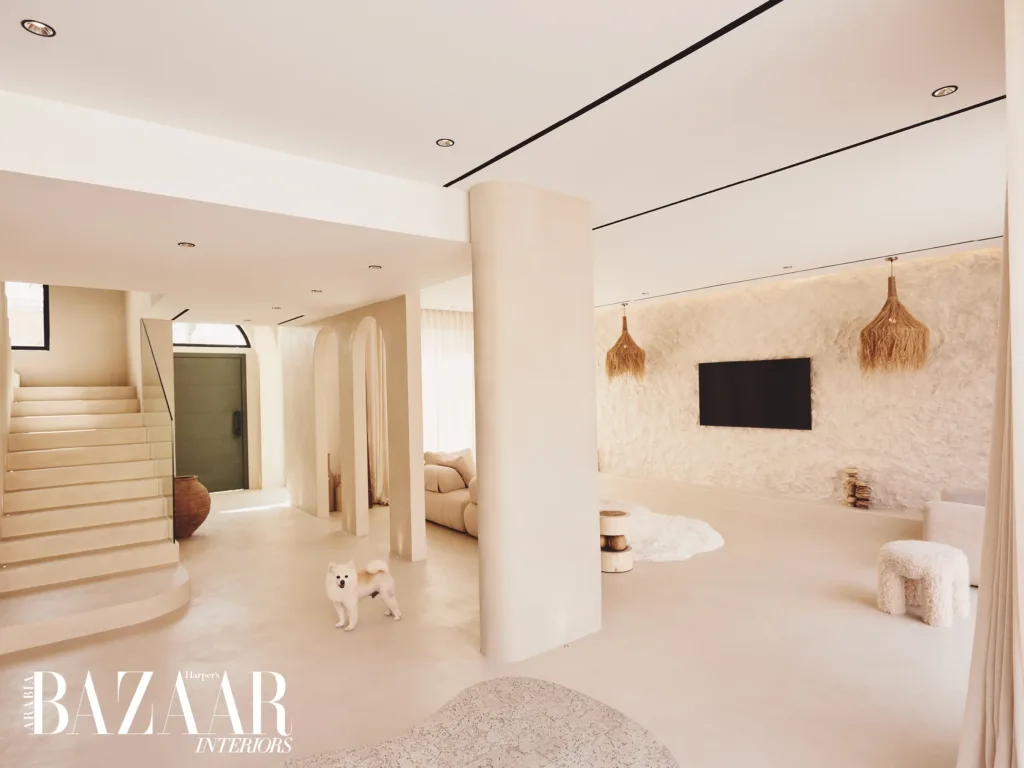
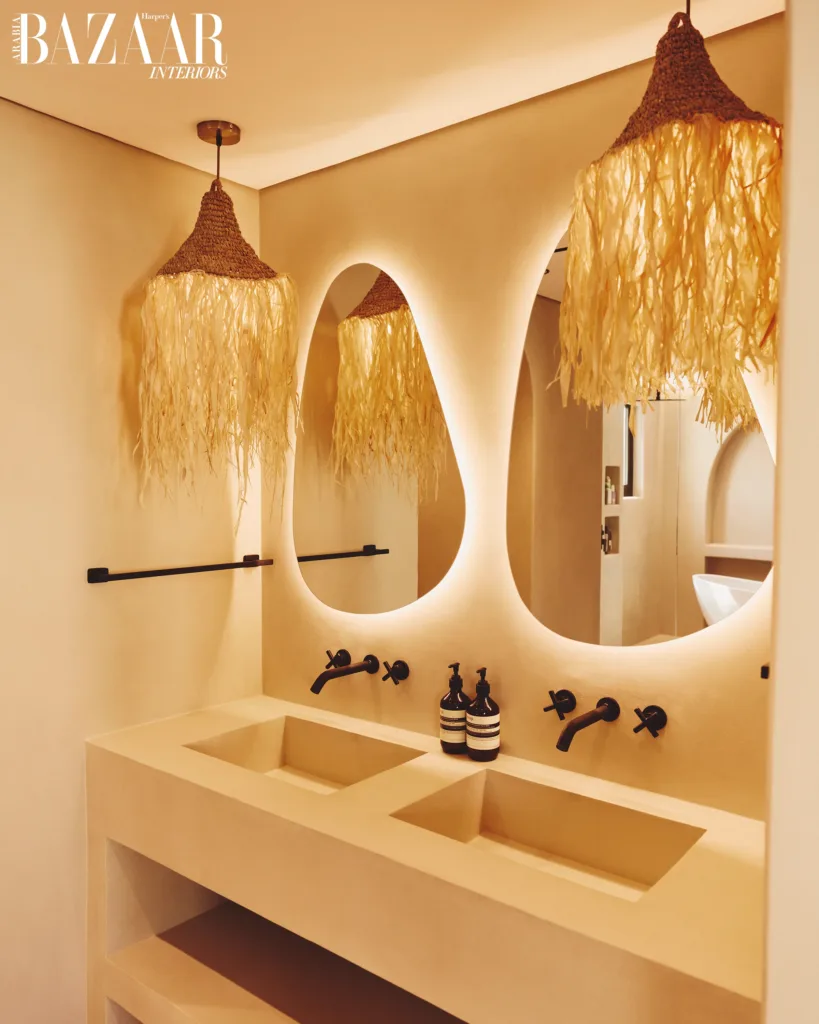
Minimalism, a neutral palette and natural textures were points of convergence, the couple drawn to the clean lines and functionality of Scandinavian design, paired with the raw, organic beauty of Japanese aesthetics, often referred to as Japandi style. To add depth and soul to the space, they also layered in elements of Wabi Sabi – a Japanese philosophy that embraces the beauty of a substance or being in its most natural, raw form. “We wanted the quiet elegance of things that feel lived-in and tell a story,” Sonia says. These influences didn’t just shape the villa, but its overall atmosphere. “Peaceful, earthy and intentionally understated.”
Each space was designed with clear intention, balancing aesthetics with everyday functionality that fit a family of four – and their dog, Rocco. “Minimalist design can be very challenging when you have young children,” smiles Sonia, speaking of her two children, three-year-old Gigi, and oneyear- old Cruz. “While we wanted a calm and uncluttered environment, it was also important to create areas the kids could play freely, be messy and be creative without boundaries,” she adds, referring to the understairs storage that was converted into a secret play den.
When it came time to start work, one contractor turned into four, as the couple quickly realised that the best results come from working with specialists in each area, which in turn also allowed for multiple aspects of the project to be worked on simultaneously. For the interior civil work, they partnered with Arctec because “they knew exactly what could and couldn’t be done from an architectural standpoint, which eliminated any unwanted surprises.” For the Mirocement that runs throughout the entire home – from the floors and walls to the kitchen island and dining table – they enlisted Horizon 7 who, Sonia says, “was instrumental in bringing our vision to life.” The concept for the interiors was all Sonia and Matt’s design, whilst working closely with Arctec to ensure their ideas were structurally sound.
The lower ground is now one unified space, with bi-folding doors across the entire back wall allowing for seamless connection to the pool and integrating an indoor/ outdoor living aesthetic. Many of the big features, from the walls to the kitchen island are finished in mirocement in a soft beige hue that Sonia deliberated over for months, she laughs. Unused space from the front porch and loggia areas was converted into extra living space, ceilings were raised to create an even greater sense of openness, and a challenging wall housing electrical wiring that couldn’t be moved was turned into a dual arch feature which has become one of the most poignant elements of the house.
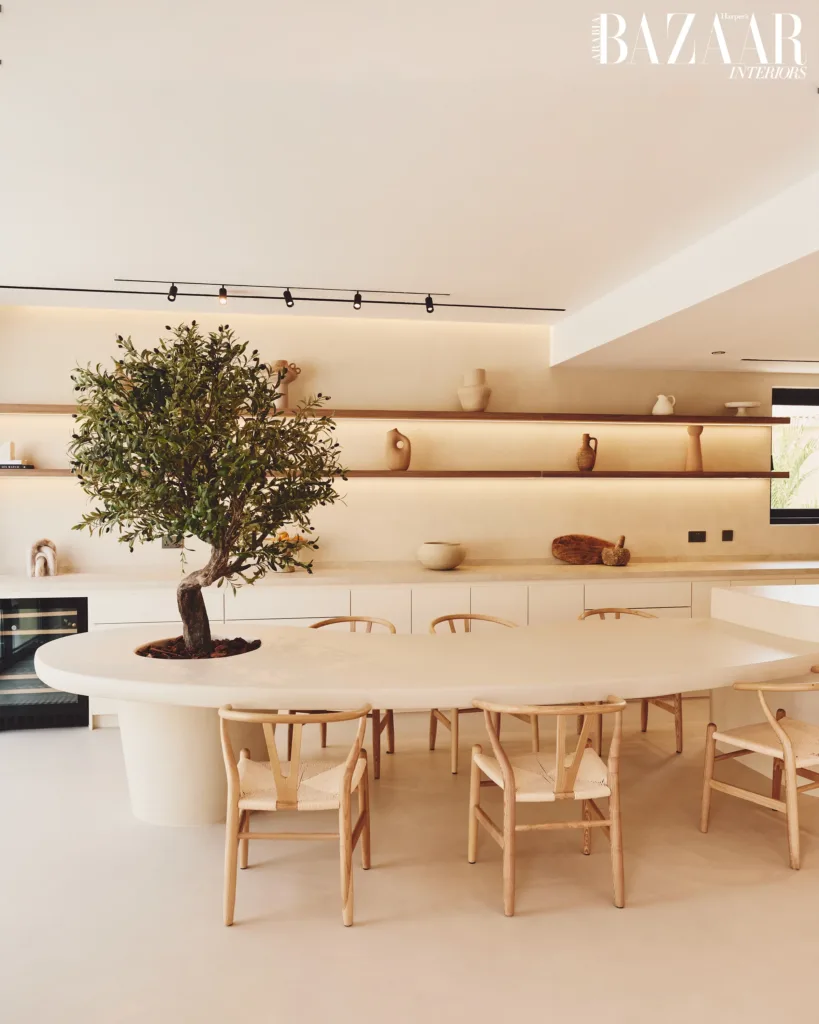
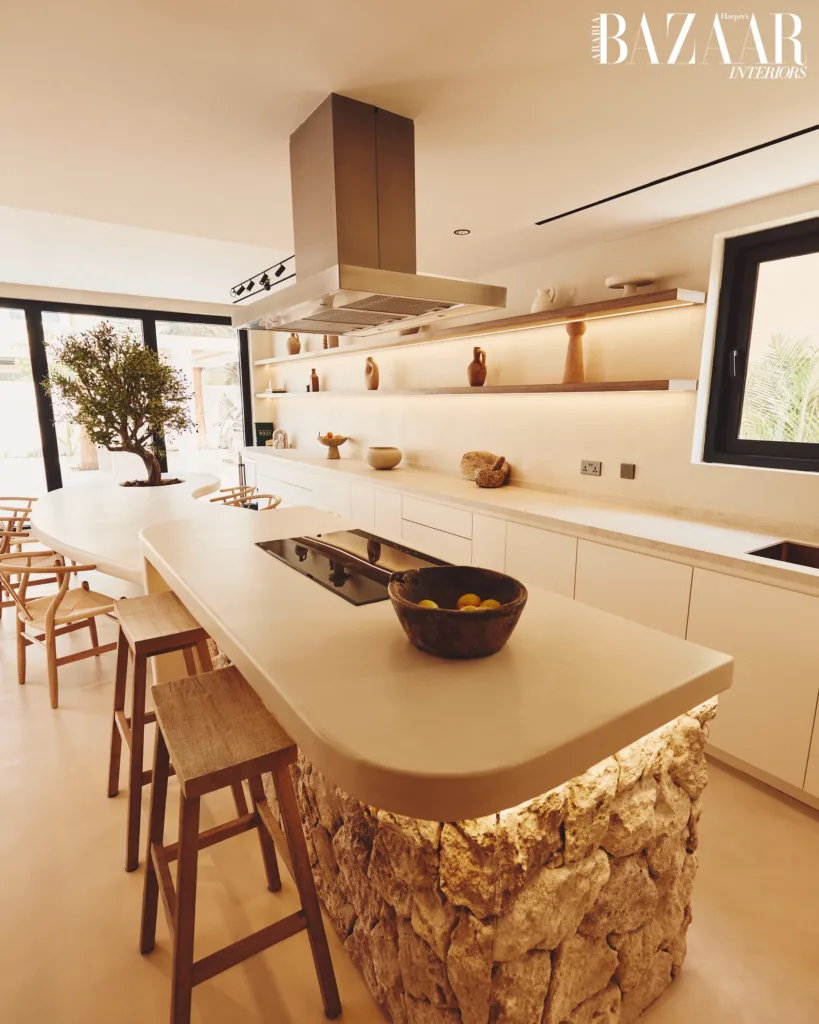
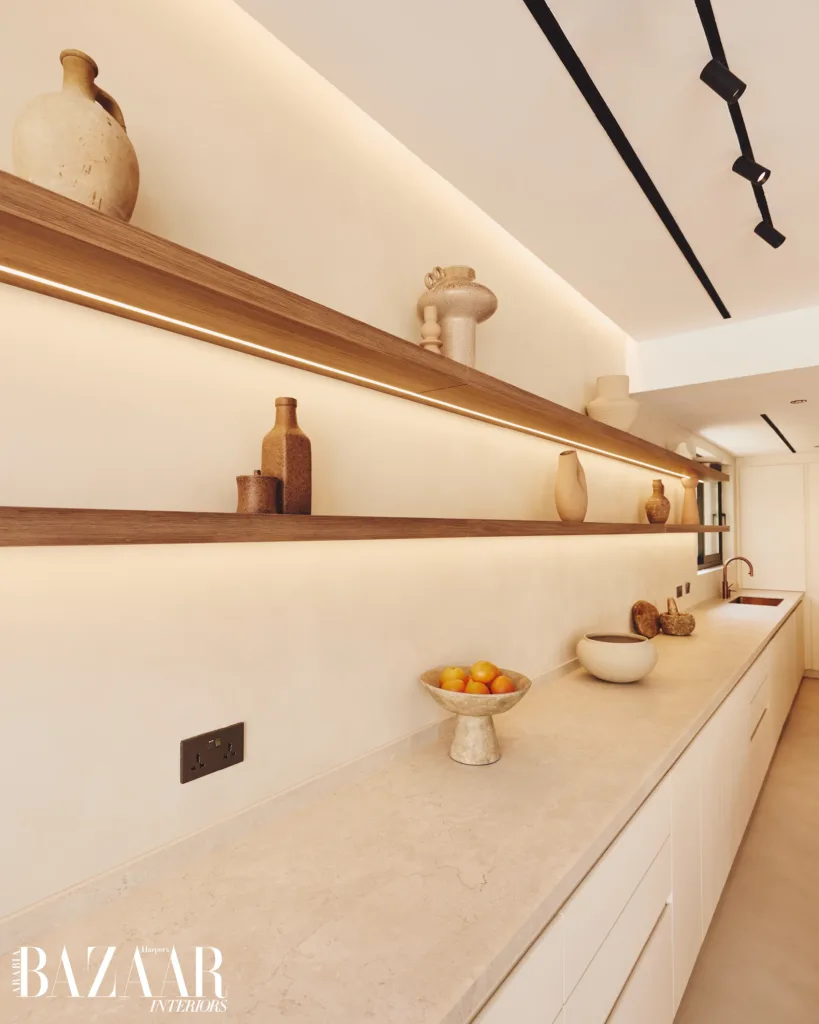
Soft curves, irregularity and asymmetry translate across each room – particularly striking in the kitchen, envisioned as the beating heart of the family home. “As a family who loves to entertain, we knew from the outset that the kitchen had to be more than just functional – it had to be a social hub,” Sonia asserts. “We designed it as an open cooking and dining space, centred around an eight-foot kitchen island with a built-in hob that seamlessly flows into a long, curved chef’s table. Its irregular silhouette brings a sense of fluidity and imperfection – very much in the spirit of Wabi Sabi.” It was here that the couple were most creative with their design with a result that feels “personal and distinctive.” Seven-foot-long wooden shelves hold a collection of antiques curated from the family’s travels. “Each one of them tells a story or evokes a memory and it makes the kitchen feel more than just a space, but a reflection of our journey.”
The kitchen island is perhaps the most striking of all. Clad with a contrasting dry stacked Bala Stone connecting the limestone rock feature wall of the living room to the kitchen it affirms the villa’s name, Casa Roca – ‘House of Rock’. A beautiful olive tree is settled within the island too, becoming “an unexpected focal point that feels both grounded and spiritual. It’s one of my favourite features in the entire home,” Sonia smiles.
The family moved into the villa in February after seven months of renovations. The journey was, as expected, one of both learning curves and surprises. “Nobody tells you that when you renovate you also have to become a designer, a lighting specialist, a civil engineer, a full-time project manager…” laughs Sonia. “But the biggest surprise was discovering that interior design is actually something I’m extremely passionate about.” Having started an Instagram account to track the journey of bringing their Casa Roca vision to life, the response – from friends, media and the design industry – has been overwhelming. Encouraged by the demand, the couple has since opened their home with Casa Roca providing a captivating canvas for hosting intimate brand events and private gatherings.
What started as a personal project has since turned into something bigger – a career pivot carved out of this newfound passion. “I’ve been fortunate to have received several design requests since Casa Roca was born, which has led me to take a big leap,” says Sonia. “I’m currently in the process of launching Casa Roca Studio, where I’ll be offering interior design services. It has been a surprising and exciting career pivot and I’m excited to see where the new venture takes me.”

Lead image: Sonia with her husband Matt and their two children, Gigi and Cruz. Sonia wears dress, Christopher Esber
Photography by Vladimir Martí
From Harper’s Bazaar Arabia Interiors Summer 2025 Issue.