
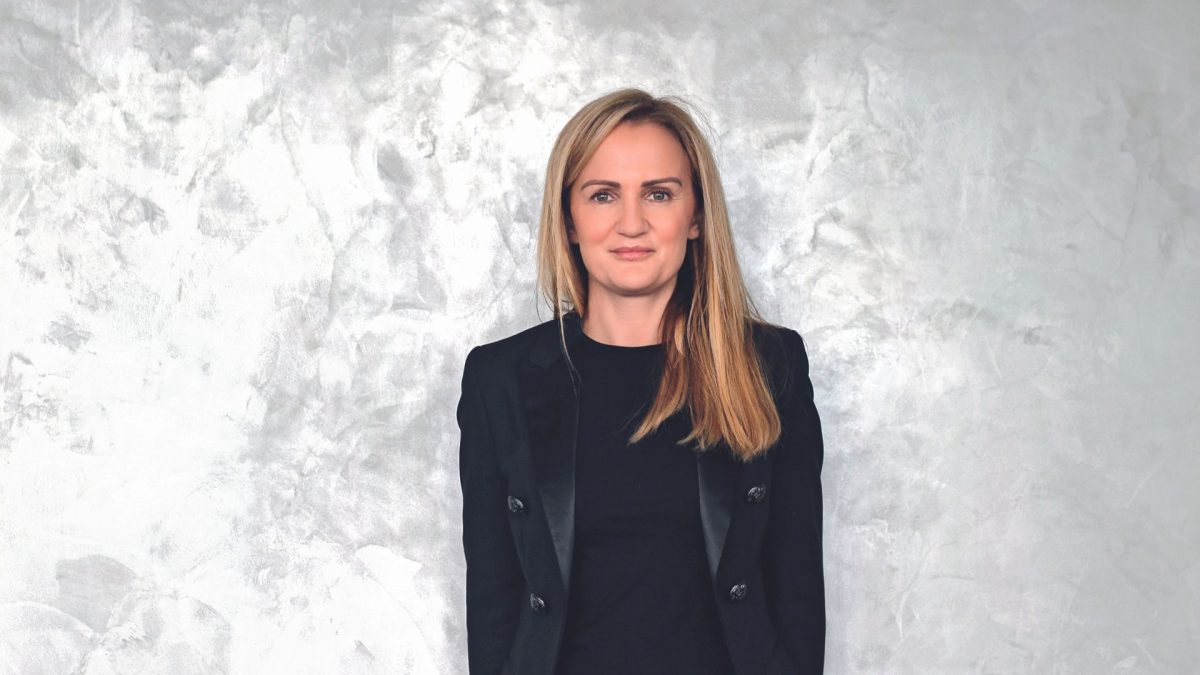
Lucy Goff Opens Up About IVF And Being a “Geriatric” Mother At 49
The founder of the holistic wellness-tech brand LYMA, speaks to Bazaar Arabia about the challenges of being pregnant late in life, the stigma around IVF and more here…
Honestly, I’d be hard pushed to remember a time I wasn’t scaring myself and wondering what on earth I’ve got myself into. I seem to operate better when the odds are against me and I’ve never been limited by other people’s perceptions of what’s possible or normal. Right now, my friends are all planning 50th birthday celebrations in exotic far-flung destinations but I’m not going to be part of any of that because I’m looking ahead to the imminent birth of my second child. Aged 49, I’m two weeks away from giving birth, which some would say I deserve being committed over! I’m joking, but at my age and having just taken my LYMA well-tech business global, it’s easy to see why I’m considered a somewhat unorthodox new mother.
Having a baby 20 years later than the average woman in the United Kingdom, I’m under no illusion of how unusual my situation is, what it’s taken to get me here and the demands that still lie ahead. What’s more, I’ve been here before; nine years ago, with the birth of my daughter Zarah – an experience not without its fair share of drama. I went into labour at the hairdressers with pre-eclampsia, dashed to the hospital with soaking wet hair to have an emergency c-section and Zarah was rushed into the special-care unit because she wasn’t breathing. The drama didn’t end there. Within a matter of days, I had developed septicaemia from complications through mastitis that wasn’t treated properly. The reality is that I almost died.
Finally discharged from hospital after six weeks, still profoundly weak, yet with no further treatment plan, the medical world didn’t know what to do with me. The feeling of panic hasn’t ever left me: I found myself begging Harley Street physicians to inject me with energy so I could care for my baby, to function as a wife and a human. So far as the medical world was concerned, the infection had been treated. They advised me to eat a good diet, take a multivitamin and give it time. But this was already six months after being discharged, and I still felt as wretched as the day I left hospital.
My mum whisked me off to a spa in Geneva, which no one realised at the time, would change my life forever. A chance meeting with Dr Paul Clayton, the world’s leading expert in the fast-developing science of preventative health, who happened to be in Geneva at a conference, gave me insight into the astounding health benefits of the hidden category of medical-grade supplementation. He sent me a concoction of ingredients to take and less than a month after taking my first pill, I was back at work. I felt myself again. In regaining my own health, I founded LYMA and we developed the industry’s first medical-grade supplement, so that others could be empowered to do the same.
I’m sure many people couldn’t fathom why on earth I’d want to have a baby at this point in my life, especially after such a traumatic experience the first time, but it’s remained part of my plan for years. I come from a big family and my husband Simon and I always wanted a sibling for Zarah, but the years flew by and LYMA became our focus. It wasn’t really until I hit 47 that the feeling of regret started to set in, that I had become so swept up in the success of LYMA, it had been at the detriment of having another child.
At our first IVF appointment the doctor gave me a less than one per cent chance of success. He also said that anyone over the age of 45 who claims they fell pregnant unaided is probably not telling the truth, so all those celebrities who say they didn’t undergo IVF are doing women a great disservice. There’s still a stigma around IVF which I wish would go away, because science has moved on so much in the last decade and it’s entirely possible to prolong your health span and maintain your fertility – I’m proof of that.
He didn’t mince his words, telling me candidly the treatment was highly unlikely to work, but my follicles were encouragingly young for my age and by way of a miracle I responded well. The doctor still warned us that the chances of anything resulting in a chromosomally healthy embryo were next to zero, and we shouldn’t get our hopes up. I went into this whole process with no expectation, ironically, the antithesis of how I approach every aspect of my glass-half-full life.
I never allowed myself to feel excitement when I was told we created three embryos, knowing they would likely not result in a viable pregnancy. I was preparing myself for failure, to feel blessed with the family I already have, to feel proud that we would have tried to grow our family, and that whatever the outcome, I would never have to live with the cancerous notion of regret.
The weeks that followed are already a blur. The nurse calling me to tell me that one of the embryos was viable. The faintest pink line that materialised when I did my first pregnancy test. Hearing a heartbeat. The NIPT test confirming the baby was chromosomally normal. It wasn’t until I had reached the 20-week scan that I allowed myself to even vaguely go to the place that I was actually going to become a mother again, and here I am, two weeks from my due date, still not having purchased a single item in the desperate hope not to jinx anything.
I’m aware I come across to others as confident, but in truth that’s something I work hard at to protect both myself and my baby. My choice to have a child later than most has not come without multiple doses of external judgement. My medical team keep referring to me as a ‘geriatric mother’ and every single scan has started with the question “is the baby biologically yours?”
I think it’s vital that I maintain mental resilience throughout my pregnancy and stick to a positive mindset. No, it’s not a donor egg. No, this baby is not a mistake. And yes, I’m well aware I will likely be the oldest mum in the playground. But I simply don’t believe we need to be slaves to our biological clocks or limit ourselves to a small fertility window anymore.
All the same, we’ve kept this pregnancy very private and not posted pictures or told too many people outside of our immediate circle because we’re acutely aware there are too many variables. Though actually, I suppose that’s gone out of the window now!
Life has many moving parts, so I’ve had to plan extensively and think far ahead. It’s obviously different the second time around and many years later but I’m not planning on pressing the pause button. With Zarah I stopped work at 21 weeks, but that’s not possible with this pregnancy and nor would I wish it to be. I’m planning on working right up to the birth and then I’ve allowed myself four full weeks of recovery before stepping back into the boardroom. This helps me to relax because I’ve got a clear plan in place for the birth and I’ve got a great support network lined up for afterwards. Very little is being left to chance with the birth this time either; I’m having a planned c-section at the Lindo Wing, St Mary’s Hospital in London Paddington. I know there will undoubtedly be unexpected twists but I’m older now and with that comes recognition of my capabilities and knowing how much I can manage. It will be different from the last time, but every pregnancy and birth is unique no matter who you are. Oh, and I’m having a boy this time around – did I say that?
Lucy’s son was born happy and healthy on 14th June.
Photography by Paul Zak
Harper’s Bazaar Arabia’s July/August 2022 issue.