
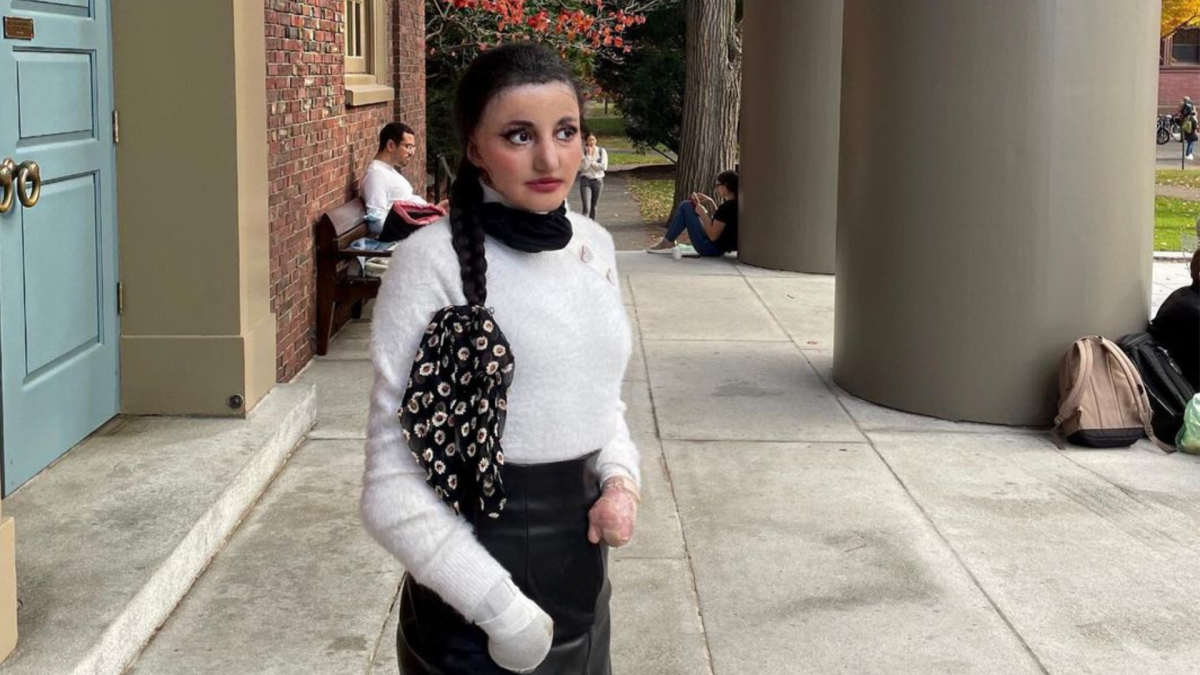
Beyond Skin Deep: Myra Ali On Living With Rare Condition Epidermolysis Bullosa
In an industry that can be all about appearances, being a journalist with a rare skin condition has created a unique path for the writer…
For the last 34 years, I have been living with a rare skin condition called Epidermolysis Bullosa (EB) – which causes second-degree burn-like blistering, wounds and scars to appear all over my body. In the United Kingdom where I’m based, only 5,000 people have it. There is no cure. All I can do is continually treat the effects of the disorder through things like bandaging irritated areas and pain management.
Most people who meet me think I have burns, which is understandable considering that I’ve had skin grafts and surgeries like people with burns. My plastic surgeon Demetrius Evriviades, who is currently working at King’s College Hospital Dubai, successfully used an innovative technique to heal my very damaged hand quickly. It’s a specific skin graft traditionally used with burns patients, but that is where the similarities end. At some point the surgeries and skin grafts that burn victims have to go through will eventually finish. But for me, there is no end. I have to have repeated surgeries every couple of years and it will be that way for the rest of my life. Surgeries that range from skin grafting to eyelid surgery and hand surgery. Then there is the issue of scarring, which can affect these areas. To maintain dexterity, my plastic surgeon then has to go in and perform more extensive surgeries on me so I can live as independently as possible.
Despite my serious health condition, I graduated from university and currently work as an entertainment journalist. I have interviewed some of the most prominent Hollywood celebrities in the world, from Tom Holland and Samuel L. Jackson to Jamie Foxx. I’ve even interviewed A-list Turkish stars like Akin Akinozu during my career. For all the negatives my skin brings, it has also given me the advantage of standing out in my field. I can’t deny this is a real benefit when you are one of many journalists vying for the attention of a publicist to land an interview with a lead actor.
It helped to secure my interview with Timothée Chalamet, who wasn’t due to pass through my press area at a red-carpet event. However, when his publicist saw me and noticed that I looked different, she approached me with a chance to interview him separately. I was so happy to be the only journalist in my area to land that interview; my job has empowered me and made me feel that you can achieve your dreams with hard work, determination, and gratitude.
So, does my health condition impact my work? My EB doesn’t affect my ability to do my job. I have been told repeatedly by editors and many Instagram followers who watch my interviews that, on the contrary, I can bring out the best in an otherwise very private, media-trained actor. It is because whoever I am interviewing knows just by looking at me that I have my own story and struggles, and this often makes them more inclined to open up about theirs.
Like anyone with an online presence, I have had some comments where people ask me what happened. Most people will ask politely, and I am always happy to educate someone who wants to learn more about me and EB. Naturally, not everyone will be courteous, and with the odd trolling comment, I either block or leave my very supportive followers to respond to them! I understand that many people are interested in both the interviews I do for my job but they are also intrigued by the unique life I must lead.
For example, I recently interviewed the actor Tom Holland, but two weeks before I had some skin grafting on my eyelids. So, on the day of my interview, even with make-up, I knew my eyelids looked a little puffy as they were still healing. So, to avoid answering people’s questions about how I looked, I put a pinned comment on my video, which told whoever was watching I’d just had surgery and I am still recovering. Other journalists without health conditions do not need to think about these aspects of life, which have become normalised for me in my career.
I don’t get annoyed or frustrated by this. I focus on the bigger picture – I bring real diversity to entertainment journalism. People are becoming used to seeing more disabled women on screens in Western media. But in regions lacking visibility, I know conversations about diversity are being encouraged. I’m hopeful with my background, I can help enhance changes and show that Muslim women in the media with disabilities are not defined by their health condition. Rather our differences are assets that break traditional views of women in the entertainment industry.
Lead Image Courtesy/@myraaliedit on Instagram