

“Women Respond to Trauma With Resilience, Not Violence”: How Zainab Salbi is Continuing Her Commitment To Amplify The Global Female Voice
Marie-Claire Chappet speaks to the Iraqi born humanitarian as she discusses her latest endeavour, Daughters for Earth
There is an African folk tale that the humanitarian Zainab Salbi keeps close to her heart. During a forest fire, a little hummingbird tries to temper the blaze by flying back and forth, bringing a droplet of water each time. “The other animals all laugh at the bird,” Zainab tells me. “They say, ‘What can you do with those tiny drops?’” She replies, ‘I’m doing everything I can do to help; why don’t you join me?’ And they put the fire out together, inspired by her efforts, however small.
This is one of Zainab’s guiding principles. It forms the backbone of her latest endeavour, Daughters for Earth, which she founded in 2022. Its latest campaign, The Hummingbird Effect, spotlights women across the globe – from those saving the mangroves in Brazil to a group in Bosnia protecting the local river from waste dumps – who are fighting to put out the ‘forest fire’ of climate change. More than Dhs5.12 million was raised for 50 female-led projects across two dozen countries in its first year alone.
The notion of the cumulative effect of individual actions having global consequences was also the central tenet of Women for Women International (WfWI), the not-for-profit organisation Zainab created in 1993 when she was just 22, and from which she stepped down as CEO in 2013. It offers micro-credit and on-the-ground support to women in war zones and, since its founding, has provided practical aid for over half-a-million survivors of war across 17 conflict zones.
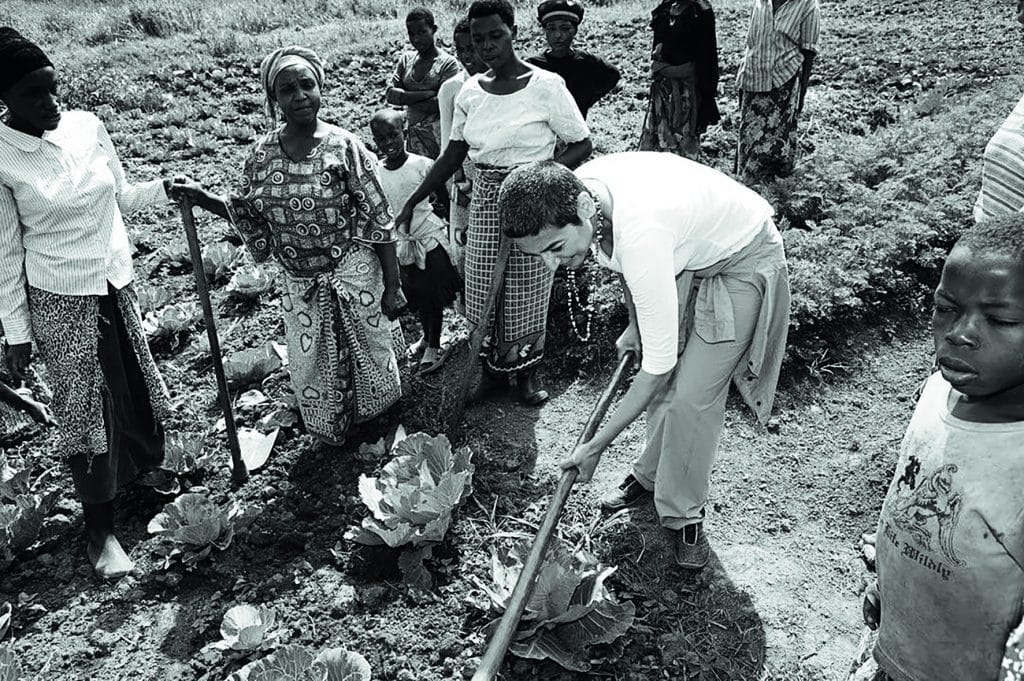
Both organisations are rooted in the belief that not only supporting women but operating like them is the key to social progress. “I don’t want to stereotype, but I think there is something about our emotional intelligence that is different,” she says. “I’ve seen it in how women keep life going in war zones; how we respond to trauma with resilience and care for our communities instead of violence.”
She tells me about a couple she met in Gaza in 2009. “The husband would not stop screaming and being aggressive and the wife was just stoically rebuilding their life and family,” she recounts. “I asked her if she was OK, and she just said, ‘Oh, ignore him, he’s been like this since our house was destroyed.’ The difference in their responses was remarkable. But I’ve seen it over and over again. I think we can learn a lot from these women and actually start leading with these feminine values. It does not, and should not, exclude men; rather, it invites those who don’t operate in this way to take on these ideals instead.”
Zainab’s faith in the future is remarkable when one considers the countless atrocities she has witnessed. She was born in Baghdad and lived through the Iran-Iraq war, where she spent her childhood in close proximity to Saddam Hussein, for whom her father worked as a pilot. “I’ve seen corruption up close,” she says. “I often wonder if much of my life has been spent making up for that.” To avoid the dictator’s predatory advances, which began in her late teens, she accepted an arranged marriage organised by her parents, which took her to the United States. The union was abusive, and she left her husband soon after.
She subsequently married the Palestinian-American human-rights activist Amjad Atallah (whom she divorced amicably in 2007) and enrolled at George Mason University in Washington. There, her political consciousness was heightened, and her horror at the slow international response to the rape camps during the Yugoslav war is what led her to found WfWI, approaching all her contacts for funding to assist the women victims of war. Her work took her from Bosnia to Rwanda to Afghanistan, and her extraordinary positivity derives, one realises, from knowing the importance of finding hope in the wreckage.
“Something about our emotional intelligence is different. Women respond to trauma with resilience, not violence”
Zainab Salbi
“I was in Mosul,” she tells me. “Everything was destroyed, and the people I spoke to said, ‘We need a new value system. The old ones of money and power have failed us. We must do things differently.’
“I saw this during Covid, when leaders were using words like connection and love as a means of uniting people,” she continues. “Look at what happens when we don’t lead like that; look at Ukraine and Gaza. It will take discipline and patience to change our mindsets, but I truly think doing so is the way forward.”
Zainab regards her unwavering belief in the potential of humankind to do better as a form of useful naivety. “If I had known how hard it would have been, I might never have started,” she says, laughing. “Instead, I just called everyone I knew back in 1993, asking for support for my idea. I even borrowed my father-in-law’s briefcase for meetings so I would look more ‘official’.”
She became a CEO, she says, ‘by accident’ and she developed a complicated relationship with leadership. “Suddenly I had 700 staff members and was running a Dhs126 million annual budget,” she remembers. “I realised too late that you don’t have to change who you are to be a leader. I listened to everyone who said: wear a suit, sit at the head of the table. I regret that. You can never succeed by being anyone but yourself.” She no longer dresses in stereotypical ‘male’ professional garb, nor feels compelled to operate along those prescribed modes. “When I’m fundraising now, I’m just completely transparent. Why would I need some sort of business-speak tactic?” she says, laughing. “I need money to help people. That’s it.”

Zainab left WfWI in 2013. Since then, she has written five books about listening to the stories of women and hosted a talk-show on the TV channel TLC Arabia, The Calling, which led to her being dubbed the ‘Oprah of the Middle East’.
In 2016, The Zainab Salbi Project debuted on the Huffington Post, and she presented a five-part series, #MeToo, Now What? on PBS in 2018.
The crux of all these shows was bringing previously unheard voices – predominantly women’s – into the spotlight, to accelerate change through empathy. Her modus operandi is perhaps best described by the title of her 2012 book If You Knew Me, You Would Care.
“I have interviewed so many people across various industries about what they would like to see change about the way we work, and I think it is bringing more love into our boardrooms. That means generous listening, engagement with different perspectives, patience and compassion,” she says. “Don’t forget, I am a witness to the power of women in the most terrible of circumstances. I know what we are capable of. I know what can happen when we mobilise.”
For more information on Daughters for Earth, visit daughtersforearth.org.
Lead image Richard Hall.
From Harper’s Bazaar Arabia’s March 2024 issue