
Around The World In 80 Years: Marion Kaplan On Documenting The Region’s Transformation
The UAE was in its infancy, but like the rest of the region, it was quickly entering an era of growth and development. Brilliantly for posterity, the photojournalist was there to document its transformation, and indeed the rest of the world’s too…
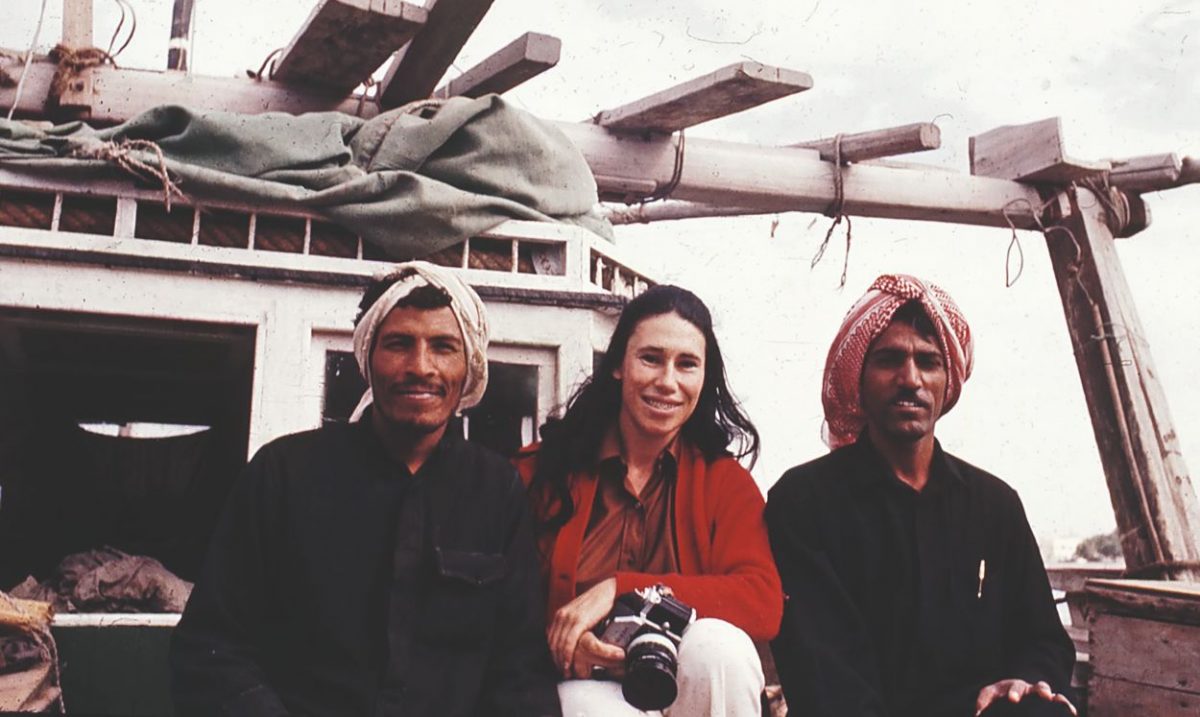
For many of us, it’s hard to imagine what the Arab world was like pre-tourism, skyscrapers and the solid infrastructure we enjoy now, but Marion Kaplan has managed to capture some of that insight in her early photographs of the region. The London-born photojournalist has been travelling around the globe since the 1950s, reporting on the traditions, cultures and development of countless destinations from the Arctic to the Sahara, and for some of the world’s leading publications including Time, Newsweek, The Observer and The Times. Marion, who lived in Africa for 20 years, has travelled extensively across the MENA region, from Turkey, Tunisia, Israel, Afghanistan and Kuwait, with longer trips including a two-year solo hitchhike from South Africa to Morocco in the early 1960s and an epic five-month voyage in an Arab dhow from Dubai to East Africa on assignment for National Geographic in 1973.

In 2009: The sail-shaped Burj Al Arab hotel
Now, the memories from these expeditions, and many others, have been carefully catalogued in a comprehensive new book called Marble And Mud – Around The World In 80 Years, archiving pictures and words into chapters that cover the seven continents. Bazaar caught up with Marion, now in her 80s and living in France with her cat Rafiki, to hear about her wonderful life of travel…
How did you get into photojournalism?
In 1965, Zimbabwe (then Rhodesia) was run by white settlers who declared their own illegal independence – it was a world story. My then-fiancé was a Time correspondent who needed a photographer. I went on to work for Life and many other magazines. We never married but stayed together for 35 years until he died.

Iran, 2016: A family’s ‘wedding room’ contained a big bed, tinselled walls and decor prepared for the just- married couple
Do you remember your first-ever trip abroad as a journalist?
Like every young person, I wanted to live life. Barely out of my teens, I went from London to South Africa where I had relatives, and got a job as editor of a house magazine but also a part-time job with a newspaper with an African readership. But this was the late 1950s, apartheid times, and my relatives were nervous. I decided I needed to know more about the ‘real’ Africa’ before I went home and headed to London overland. It took me more than two enthralling years, hitchhiking most of the way, to get there. I saw East Africa, the Congo (via third-class riverboat), Sudan and the Nile (another ropey riverboat), West Africa and travelled across the Sahara by truck, taking in Morocco, and then finally home, where – as I had met my loving, funny English journalist en route – I turned around and went back to Africa.
 The live-fire cook box at sea, 1973
What are your earliest memories of visiting the Gulf region?
I was in Kuwait, Dubai and Oman in 1973 to do a story on the ‘twilight’ of the Arab dhows; graceful wooden ships that had changed hardly at all in 2000 years but speedy freighters and containerisation was pushing them off their trade routes. In 2016, I travelled in Iran, where a filmmaker got me together with the younger members of my 1973 crew. By then I had forgotten much of the Swahili we had used to communicate. Swahili I knew from living in Kenya, and they knew it from voyaging and trading. I also learned a little Arabic too.

1973: Carpenter working with an adze tool
How did this assignment come about?
I was based in Nairobi, Kenya in the early 1970s and I did a couple of local assignments for National Geographic. Then, in 1973 they assigned me to do the story I proposed on the last days of the great trading dhows, which were a grand sight in the Old Port in Mombasa every year. With a history centuries-long, the big sailing dhows were fast disappearing as modern ships took over. I aimed to be aboard one of the last trading dhows to sail from the Middle East to the African coast – in practical terms, from Dubai to Mombasa. But first I was looking into Kuwait’s dhow history, and then planned to get myself, by dhow, to Dubai. It was a notion that shocked officials [in Kuwait]. “Don’t you realise,” one said to me, “that most sailors have never seen even the finger of a woman. Why don’t you fly?” In the hotel where I stayed, staff called me ‘Sir’.

Iran, 2016: Rihanna, a young modern Iranian woman tries on the burghu facemask that older women still wear
With a little help, I found a small dhow in Seif harbour – lenj or lansh as they are called – and was accepted as a passenger. Her (the dhow’s) name was Aziz and her cargo included high-piled crated air-conditioners and refrigerators. Both the captain and crew spoke Farsi and Arabic.

A seaman praying aboard a dhow
What was Kuwait like back then?
Very small but already worldly in trading. For my ocean voyage I bought everything I needed from a mattress and a sleeping bag to a bucket, a mug and an English-Arabic phrasebook from the shops in the souk – everything I bought was imported from a different country.
In Kuwait City I found it had an eclectic ambience compounded of Islam, oil and a great deal of money. Foreign-born residents far outnumbered Kuwaitis – and still do.
What are your memories of the UAE?
It was newly (since 1971) the UAE, but was still often thought of as the Trucial States. I had to convince Nat Geographic to spell it Dubai not ‘Dabbai’ – as their maps still showed. The grandest feature of Dubai was the Khor, or creek, which was where every ship, wooden like the dhows (which were beginning to be motorised) or speedboats, frequently used to smuggle goods, especially gold. Once I was accepted as a passenger in Dubai by the nakhoda (captain) of a Mombasa-bound dhow, I got to other parts of the UAE including Sharjah only because I was on board. But I rarely went far from my ship. The Dubai that I saw in 1973 was worlds away from the sophisticated Dubai of today with its ultra-tall hotels, shopping malls and skyscrapers which I saw when I was back in Dubai to do another story in May 2009. I loved its bazaar-like quality back in 1973.

The Khor (creek) full of dhows in 1973 in Dubai
And this same trip would take you to Oman?
My dhow; Mihandust, meaning ‘I love my homeland’ in Persian, had a lot of cargo to unload in Dhofar, Oman, including four cars, wooden shutters, sheets of corrugated iron, bags of onions, cans of ratatouille, American dishwashers, South African ‘Groovy’ cola, Iranian rosewater, endless bags of Finnish cement and many bags of sugar – which prompted much dipping and licking of fingers. But Dhofar had no proper port yet, so everything had to be unloaded by small stitched boats (sewn together with no use of nails). It was an interesting time, when an active war was being fought between the new ruler of Oman, aided by British officers, against leftist rebels, who were ultimately vanquished. It was hard to tell who was who, more than one turbaned soldier who visited the dhow proved to be a friendly British officer – helping improve my image with my nakhoda when the British bought several of the Persian carpets we carried, without bargaining.

A seaman praying aboard a dhow
What’s your favourite part of the world?
I’d have to say France because I live here. But not Paris or any other city. I live in a rural corner in the southwest where on a clear day I have the Pyrenees in view, the Atlantic and the Med not too far, small farms in all directions, great food at hand and decent neighbours who keep a friendly distance. When I was new here I had ducks, which I loved. My mother in London – mad at me that I hadn’t made her a grandmother – whenever her bridge friends showed off photos of their grandchildren, would produce photos of my ducks.
The Journey Of A Lifetime
The lengthy postscript for Marion’s book comes courtesy of actor, comedian, writer and television presenter, Sir Michael Palin, renowned for his captivating travel documentaries. Here’s a short extract of what he had to say about her…

“The scale and scope of her 80-year journey is breath-taking. There are photos that bring back powerful memories for me – the eye-catching decoration on the buildings of Bhutan, the boatyards of Iran and Kuwait where sturdy dhows are still constructed as they have been for hundreds of years, the massive, thrashing waters of the Iguazu Falls. And there are tantalising glimpses of places I haven’t seen but still hope to. The Galapagos Islands, the mini-Manhattan mud towers of Sana’a in the Yemen, the remote beauty of South Georgia with its ice-covered mountains and long beaches on which colossal numbers of penguins gather shoulder to shoulder, staring out to sea as if waiting for the end of the world.
Binding all these images together, and making them all relevant, is Kaplan’s sense of history, her view of the world as an ever-changing place of marvels and mysteries, of human mess and natural beauty side by side.
There is a sense that she is comfortable anywhere in the world, and that 80 years of travel has not been too much for her, but too little.”
Marble and Mud is available now. For more pictures of Marion’s travels visit: marionkaplan.com
From Harper’s Bazaar Arabia’s May 2021 Issue
