

The Glorious Spectacle of Fashion: A Look Back At The Most Memorable Runway Shows
In the spirit of this issue’s theme – Main Characters – Bazaar Arabia remembers the surreal, the sublime and the style spectacles that will go down in history as the industry’s most memorable moments
What do a shaman, Chanel-themed groceries and Lady Gaga all have in common? They’ve all been involved in the making of some unforgettable runway shows. In the spirit of this issue’s theme, we’re looking back on the moments that will go down in fashion history, from internet-breaking, meme-making stunts to unbelievable feats in set design – and the downright magical ways designers have manipulated nature.
“I love the spectacle of an elaborate show – the atmosphere it creates, the suspense, the ‘how did they accomplish that?’ moment,” states stylist and creative consultant, Nathalie Riddle, “All of which creates memorable collections that live on in our minds long after the season has ended.”

The Start of the Spectacle
The seeds for the modern fashion show were first sewn in Paris. It was the mid-1800s and renowned British designer Charles Frederick Worth started using live models to showcase his designs. This was a unique concept as until then, couturiers had exclusively used mannequins. The rest of the world followed and by the early 1900s, ‘fashion parades’ began taking place in London and New York. Just like the presentations in Paris salons, these shows were intimate events aimed at buyers, not press. In fact, photography was usually banned to reduce the chance of counterfeit designs.
American department stores did things a bit more theatrically. Wanamakers’ 1908 show was a re-enactment of the court of Napoleon and Josephine, complete with a child dressed as one of the emperor’s pages. These shows introduced the idea of a raised runway, which was considerably more stage-like than had ever been seen before.
The idea fashion shows as visual spectacles for publicity was crystallised in 1947 by Christian Dior. The French couturier not only reinvented the era’s silhouette – ushering in the New Look with his waist-cinching, dramatically full skirts – but also the rules of fashion when he broke with tradition and invited photographers to the unveiling of his Corolle collection.
Still, fashion shows were hardly radical happenings – that is, until the 1960s, when a handful of designers transplanted their presentations from the usual stuffy salons, ballrooms and hotels to unexpected locations. Pierre Balmain hosted his Spring 1965 presentation in a cellar, while Paco Rabanne showed his 1966 collection at Paris’s Crazy Horse cabaret.

Going Global
Today, many designers continue to dream up out-of-the-box locations at which to present their collections. Arguably, one of the most astonishing was Fendi’s 2007 show at the 2,000-year-old, 1,500-mile-long Great Wall of China – though, luckily for the 88 models involved, the runway only occupied a relatively small section of the wall. Taking a year to plan and costing $10 million (Dhs36.7 million), the fashion feat was beheld by 500 guests. Reportedly, it was so difficult to secure the relevant permissions, the entire spectacle took place semi unofficially. Sadly – or not, depending on your social media stance – Instagram didn’t yet exist, so the event was mostly recorded by TV crews.
This wasn’t the case for Jacquemus’ Spring/Summer 2020 and 2021 shows. Set amongst fields of lavender and wheat respectively, these perfectly photogenic events were Instagrammed prolifically by the invitees, who included Camille Charriere and Anne Laure Mais.

On July 12th 1998, long before the advent of social media, Yves Saint Laurent staged a show that would reach audiences far beyond the fashion press when he set it in a sold-out stadium during the World Cup final. The show, which was watched by 84,000 football fans and 1.7 billion television viewers, featured the designer’s most iconic creations, from his Le Smoking suit to the Mondrian dress.
The Dreamweavers
Sara Blonstein knows a thing or two about making the impossible, possible. As founder of renowned creative agency Blonstein, she and her team have produced some of the most memorable shows in fashion history, for the likes of Hussein Chalayan, Molly Goddard and Richard Quinn, to name but a few. Blonstein is a long-time collaborator of Roksanda, for whom the agency has produced some of its most ambitious shows to date.
“We have shown five times in the Serpentine Pavilion – a yearly changing architectural sculpture that we transform into a runway every time,” she reminisces. “For Autumn/Winter 2019, as part of a collaboration with art trio Troika, we laid five tonnes of salt inside a disused hotel. Another season, we counter-weighed Rana Begum’s huge fluorescent sails in the magnificent Dunbar Hall – a hidden governmental space opposite Downing Street.”
Chanel’s late creative director Karl Lagerfeld created his own show sets within the same venue – Paris’ Grand Palais – which included a carousel, an airport terminal and even a supermarket, complete with Chanel-branded groceries.

“The incredibly lavish and often eccentric sets dreamt up by the late Karl Lagerfeld at Chanel were often as anticipated as the collections themselves,” enthuses Nathalie.
(Not) Blowing the Budget
Memorable fashion shows don’t always require an extravagant budget. When Martin Margiela presented his inaugural Spring/ Summer 1989 collection at Paris’s Café de la Gare, he painted the soles of the models’ cloven-hooved shoes (his now-iconic Tabi boots) with red paint, marking the canvas runway beneath them. Two seasons later, he staged a show in a kids’ playground. Children, who’d been invited to watch along with their parents, ran onto the catwalk and beautiful chaos ensued. Those who were there – including a young Raf Simons, who was an intern at the time – consider the 17-minute show to be a seminal moment in fashion.
It’s Raining Fashion
When staging a show outdoors, one is at the mercy of the weather – well, unless you do it like Nicolas Ghesquière, who hired a shaman to stop the rain for Louis Vuitton’s Cruise 2019 show. Other designers have done the opposite, conjuring rain indoors. “I was stunned by the way that water fell like tears onto the moving bodies at the Alexander McQueen Spring 1998 show,” remembers Suzy Menkes, podcaster and leading fashion authority, about the designer’s infamous Golden Showers collection.
Transcending the Catwalk
Considering so much effort goes into a single fashion show, it seems a shame that so many are over in less than 15 minutes. Thankfully, some designers have extended the life of the spectacle by turning it into a full-blown performance. See John Galliano, who presented Dior’s Haute Couture Spring/Summer 1998 show upon the marble steps of Paris’ Palais Garnier opera house, complete with an orchestra and tango dancers. The theatricality of the event seemed in-keeping with the spirit of those early 1900s department store shows.
Fashion shows with a theatrical element are having a renaissance, observes Sara. “A grand master of this is SS Daley, whose shows we have produced for the last few seasons and counting. First, we brought in the National Youth Theatre to create a play around the collection which we then seamlessly integrated into the show, and this season we had Sir Ian McKellan deliver a soliloquy at the top end of the show before walking first.”
Liane Wiggins, Head of Womenswear at Matches Fashion, was front row for the show’s surprise performance. “It was innovative, creative and incredible,” she enthuses.
Harris Reed also surprised show-goers with a piece of spoken word – delivered by current darling of the silver screen, Florence Pugh. “All the world’s a stage,” she quoted. “Embrace the lamé and sequins of life.”

Musical Interludes
If you’re invited to a fashion show, you may just find yourself treated to a surprise concert. Nine minutes into Chanel’s aquatic-themed Spring/Summer 2012 show, a giant clamshell opened to reveal Florence Welch singing her aptly named song, What the Water Gave Me. For Gucci’s Spring/Summer 2019 offering, the house’s former creative director Alessandro Michele employed the sonic talents of Jane Birkin. And most recently, Spanish singer-songwriter Rosalía delivered a live performance for Louis Vuitton Men’s Autumn/Winter 2023 show, staged at the Louvre.
If there was an award for the designer with the most in-show musical performances, Burberry might just win it. The British label has put the likes of Benjamin Clementine, George Ezra and Tom Odell in the spotlight. “Alison Moyet performing Only You for Burberry 2016’s show with a live orchestra was a very emotional moment,” Lianne tells us. “Live music at shows is always an amazing privilege to hear as it reflects the total creative process that the designer has worked through and the way they envisage the collection being seen, worn and experienced.”
For Roksanda’s Autumn/Winter 2017 show, Sara Blonstein and her team tapped Oscar-winning composer Michael Nyman to play live. “Just him and his piano for Roksanda,” Sara exclaims. “A total moment!”

Star Power
When it comes to those walking the runway, a lot has changed since the first models of the 1850s. Having chosen his wife as his first live model, Charles Frederick Worth named all subsequent models ‘lookalikes’, selected for their ability to showcase clothes rather than their star power. These days, it’s not an unusual occurrence to see an A-lister walking the same runway as supermodels, though it always ignites delight and sometimes breaks the internet.
Since the ’90s, the commercially savvy Miuccia Prada has enlisted the likes of Elle Fanning, Uma Thurman, Chloë Sevigny, and, most recently (for Autumn/Winter 2023), Mia Goth and Emma Corrin to walk for Miu Miu. Tom Ford also understood the power of celebrity; the American designer launched his eponymous label in 2010 with the help of Beyoncé and Julianne Moore, and even created a music video with Lady Gaga for his Spring/Summer 2016 line.
Fashion isn’t always a serious business, as this somewhat meta moment at Valentino’s Autumn/Winter 2015 show proves. “I was in the audience when Ben Stiller and Owen Wilson walked the catwalk as models, causing much confusion and bemusement amongst the fashion editors and buyers watching,” says Nathalie. “It was later revealed that they were in fact filming a scene for Zoolander!”
Seal of Approval
VIP guests don’t come more important than the late Queen Elizabeth II, who attended Richard Quinn’s Autumn/Winter 2018 show at London Fashion Week. “It was Richard’s first show and we knew he was receiving an award. But we all had no idea who was giving it,” says Sara, whose team produced the show. “That was the deal with the palace. It had to be secret. I was told two hours before and given the task of announcing her! The whole show space of 500 capacity literally went silent as Her Majesty entered and sat next to Anna Wintour. Then, in true Richard Quinn style, girls in huge floral dresses with masks, strode through the space to thrash metal! The Queen loved it.”
Meta Moments
It would be remiss to talk about fashion shows and celebrities and not mention the ‘Green Versace dress of Jennifer Lopez,’ which was so voraciously Googled that it earned its very own Wikipedia entry. Google’s president Eric Schmidt credited the plunging, palm-print dress, worn by Lopez at the 2000 Grammy Awards, with prompting the creation of Google Images. Donatella Versace made it a full-circle moment when she got Lopez to close the label’s Spring/Summer 2020 show in a replica of the iconic gown.
Just as dresses have influenced the evolution of the internet, the internet has influenced fashion shows, with designers attempting to chase elusive virality. “It is obvious that brands are resorting to these big impactful moments for social media to create sales of shoes and handbags,” says Suzy. “I just wish that they would channel this in the direction of raising awareness of sustainable fashion – and use their clout as a platform for saving the planet.”
“Viral moments are part of the fashion industry landscape and controversy is increasingly used as a tool to increase brand presence and generate publicity – good or bad,” says Nathalie. “I think a genuinely provoking moment is just that, as opposed to a shameless publicity grab that will only ever feel contrived. Personally, I prefer the clothes to do the talking!”

The Provocateurs
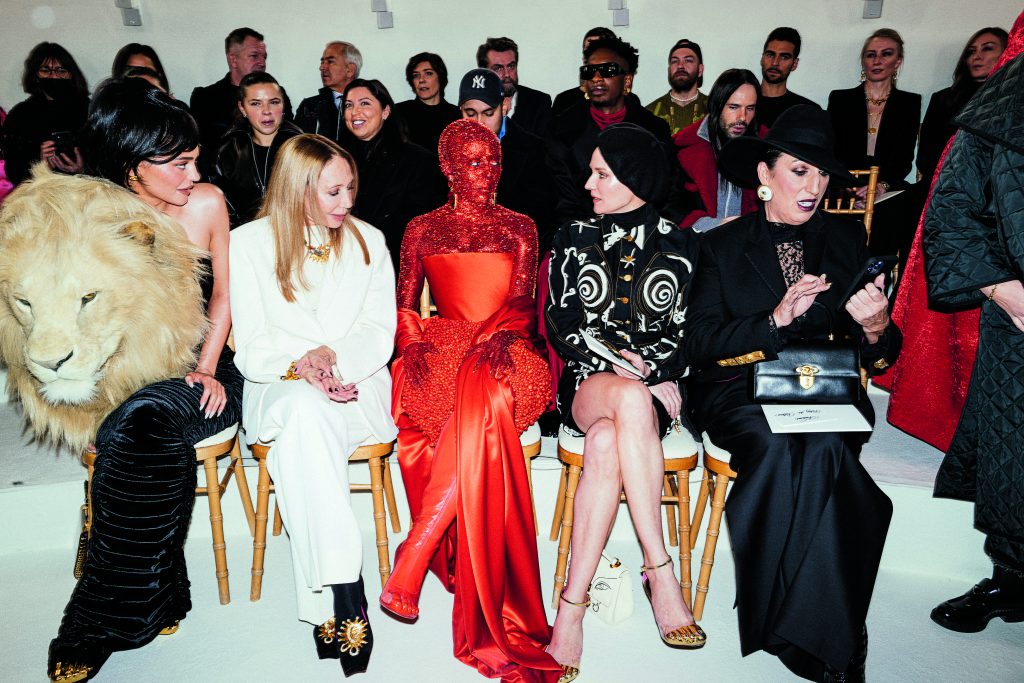
Whether you deem it provocative or shameless, there’s no denying that Schiaparelli’s Spring 2023 Couture show did what many designers dream of doing: it didn’t just break the internet, it smashed it to smithereens. But people weren’t talking about the impeccably sculpted hourglass silhouettes (designed to emulate the shape of the bottle of Schiaparelli’s Shocking perfume) or the optically alluring pinstriped suit, but rather the eerily realistic animal heads affixed to coats and dresses worn on and off the runway by Naomi Campbell, Shalom Harlow, Doja Cat, and – the second most followed person on Instagram – Kylie Jenner. Despite the craftsmanship that went into these fake taxidermy pieces, and creative director Daniel Roseberry’s rationalisation that the animals were inspired by Dante’s Inferno, the general consensus on social media was that the show glamorised trophy hunting.
Severed heads had caused less of a furore at Gucci’s Autumn/Winter 2018 show, where they were 3D-scanned and modelled from silicone and resin by Italian visual-effect company Makinarium to perfectly imitate those of the models carrying them. Jared Leto carried (and later, lost) his own version to the 2019 Met Gala.

Future Perfect
Technological advances can create magic at fashion shows. Take, for example, the two robots that spray-painted Shalom Harlow’s dress for Alexander McQueen’s Spring/Summer 1999 – a concept that was built upon 24 years later by Coperni, who defied belief by concocting a dress from spray-on fabric for Bella Hadid before the audience’s eyes. Nathalie was in the audience of McQueen’s Autumn/Winter 2009 show, when the designer unveiled the now-iconic ‘Illusion of Kate Moss’ hologram: “As a young fashion editor bagged a ticket to The Widows of Cullode runway show at Paris Fashion Week, where an art-piece hologram of Kate Moss closed the show,” she recounts.
The hologram has been analysed as a memento mori, a reminder of the inevitability of death – especially poignant, given McQueen’s own premature passing. Regardless, the designer is often considered a future-seer and certainly, he was a proponent of fashion show theatrics long before they could ‘break the internet.’ Had Instagram existed, his stunts surely would have.
Considering that the digital gathering and dissemination of visual content shows no sign of waning, it’s safe to say that fashion shows designed to shock and awe will likely be a mainstay of fashion week schedules for many years to come. After all, as the great bard Florence Pugh once said, “All the world’s a stage.”
From Harper’s Bazaar Arabia’s June 2023 issue.