
The Future Of Fashion: How The Way We Shop Has Forever Changed
Welcome to 2021: where artificial intelligence, virtual reality and gaming are powering the digital sprint to the checkout
Imagine sitting in your living room, putting on a headset and being transported to your favourite luxury store. There you browse the latest collections while a shop assistant carefully talks you through the textures and feel. You pick a dress that you loved from the brand’s virtual catwalk show earlier in the year, and take it to the changing room.
Here, the mirror is already programmed with all your measurements and preferred fit from previous visits, and it reflects an image of you in the item without you having to put it on. You purchase the dress in the suggested size, as well as a clutch the mirror insists would look great with the dress because an algorithm has remembered it’s in your favourite colour. You pay for the items from the comfort of your sofa and they arrive later that day. This is the future of shopping.
Exciting for the consumer? Yes.
But can the fashion boutiques that fill the Middle East’s many malls compete with this tech?
The State of Fashion 2021 report, released last month by Business of Fashion and McKinsey & Company, predicted a global fashion-sales decline of 15-30 per cent in 2020 compared with 2019, stating it will take at least two years for industry revenues to recover to 2019 levels, at the earliest, in Q3 2022. But there have been some winners, and it’s those with a strong digital presence.
Online sales saw spikes due to Covid-19, amounting to 29 percent of total revenues this year, which according to Business of Fashion and McKinsey & Company, is the equivalent of six years of growth in only eight months. These hugely sobering statistics have forced many brick-and-mortar brands to sit up and take note, but it’s not enough to just move online, the competition there is even fiercer than the one for footfall in the mall, and this is what has made the use of AR and machine learning as much a pressing matter for stores as it is for e-commerce. And with many changing rooms across the globe still off-limits, AI and AR tech has moved from being a luxury add-on sometime in the future, to an immediate must-have.
“AR technology that enables customers to virtually try on clothes from their smartphones or desktops has helped bridge the gap for retailers dealing with store closures,” explains Lisa Perrone, co-founder of Stylyze, a cloud-based SaaS platform that delivers enterprise solutions to fashion retailers. “Even as stores reopen, virtual fitting rooms, whether offered as hardware in stores, or via smartphone apps, will enable retailers to provide this service to customers amidst smaller store footprints and tight restrictions on interpersonal interaction.”
Store retailers are rushing to adopt and adapt a number of fit-technology options that are already available online.
Most popular are companies such as Fitanalytics and True Fit that use AI to build a unique personal profile for each customer by collecting data before and after every purchase. True Fit, which has over 180 million registered users, asks for the shopper’s height, weight, gender, age, information about body shape as well as their preferred fit in other brands they already wear. As the customer begins to shop across the global brands that use True Fit, their behaviours are captured and learned to make better size, fit and preference suggestions on future purchases.
“The recommendations are AI and ML [machine learning] driven, and come from our own database – the largest database in the retail industry called the Fashion Genome,” says True Fit co-founder Jessica Murphy, whose global clients include Levi’s, Ralph Lauren, Kate Spade and UGG. “Using AI and ML, we’re able to map style attributes and t to an individual’s personal preferences, giving accurate recommendations that drive higher AOV [average order value] and revisits-to-site rates and lower item return rates.”

Fit:Match goes one step further and is helping brands including Ted Baker and Bloomingdale’s to combine AI with 3D body scanning to pick up on individual body shape to provide even more defined data. The catch? You need to go to a Fit:Match U.S. location to get the scan. Footwear, however, is easier to tackle; the Nike Fit app, now also being used in-store, works by scanning your feet using your smartphone. Team that with the Wanna Kicks augmented reality ‘try on’ app or a number of Snapchat affiliations – that let you view new sneakers on your own feet – and your footwear issues are solved without leaving your living room. But what about the rest of the body? Fit-tech company Meepl, whose apparel clients are spread over 27 countries including Bahrain, Saudi Arabia and Qatar has the answer.
“Meepl is one of the most accurate smartphone 3D body scanning technologies,” explains CEO and founder Ferdinand Metzler. “And it has the full suite of services: made-to-measure, size recommendation and virtual dressing room.”
What makes Meepl an even better prospect is that despite offering more, it’s simpler to use than its competitors. The Meepl app needs just gender, height and two full-body pictures – one from the front and one from the side. Machine learning algorithms then calculate a unique, personalised 3D avatar of the consumer, who can then try on different sizes and fits in real-time.

On app DREST, users can dress models in shoppable new-season items
And Meepl’s reach has extended beyond the traditional western wear that much of the current fit- tech offering is aimed at. “Within the Middle East region, we see a large demand to produce customised traditional robes; so-called thobes,” explains Ferdinand. “During Covid-19, this contactless way of measuring consumers gave businesses relying on body measurements a powerful tool to maintain their business. One example is Bahrain tailoring house, Al Shakar – using the made-to-measure and body data sharing services.”
For those who still find all that measuring too laborious, shopping and virtual fit has moved into the gaming sphere for an added element of fun.
DREST is
an app where users can adopt the
role of a fashion stylist and dress
native avatars, or the choice of five
supermodels including Irina Shayk
and Imaan Hammam, in daily
photoshoot and mood-board
challenges, with every fashion
item featured fully shoppable in
real-life either via Farfetch or the
brand directly. The virtual fashion
edit comprises over 200 of the
world’s leading luxury brands including Gucci, Prada, Versace, Off-White and Fenty, and DREST is even working on offering selfie avatars of the actual player later this year.
So, with this growth in fit-tech, fashion as gaming and the advances in virtual reality that could see consumers shopping rails stacked with product, aided by virtual shop assistants in their own living room, using VR headsets, Apple Glass or similar innovations, is in-store shopping becoming obsolete?
“What is not possible is experiencing the touch and the haptics of the fabric a garment is made of, limiting virtual dressing rooms to fully be on par with an in-store shopping experience,” admits Ferdinand. “Brick-and-mortar stores should be seen as ‘destinations’ offering consumers more than just a shopping experience. In the future, consumers in-store will be able to receive size recommendations and virtual fit feedback on their mobile devices, skipping the dressing room queue and having more time to shop for other articles.”
In other words, the in-store experience needs to up its game.
Immersive changing rooms could be one way to do that. “Fashion innovation hubs are harnessing AI in changing room mirrors to recognise what shoppers are wearing,” explains Jamie Davies, Head of Innovation at experience agency Amplify.
“AI mirrors can suggest similar styles and colours and automatically alert shop floor staff to bring the suggested items to the changing room. All the shopper has to do is say ‘yes’ or ‘no’ to the mirror. AI mirrors can even predict a shopper’s sizing and can remember loyal customers from previous visits, using earlier data to make new recommendations.”
And these advances in tech are already translating to the Middle East market. “We are heavily investing in AI capabilities that allow us to create more personalised experiences, from finding to fitting clothes,” says Ryan den Rooijen of regional luxury goods retailer Chalhoub Group. “You can find our iMirror in Tryano, and make use of Intelistyle (AI-powered fashion chatbots) at Dolce & Gabbana and Max Mara. We are also using AI to better understand our customers, recommend products they might like, and become smarter in how we purchase and price our products.”
And the group, which is the largest retail operator in the Middle East, plans to expand on its offering inline with the region as a whole. “Over the next 12 months, a lot of our efforts will be focused on infusing this intelligence into our stores,” explains the Group Head of Data and Analytics. “In terms of its AI ambitions, I believe the UAE is one of the leaders. While AI capabilities are not as well-developed yet as in other markets, the investment in local talent by both the public and the private sector is working as an effective catalyst. The next five years will see a lot of change.”
Ferdinand agrees: “Brick-and-mortar stores will still be there,” he concludes. “There will be less of them and they will play a different role. They will become an experience platform to communicate the latest fashion trends and fabrics. Digital and physical content will be combined with the latest technology to engage consumers by blending the digital and real world.”
Ryan also sees a new hybrid store experience: “Retail stores will become less about storing than exploring products,” he says. “And artificial intelligence and augmented reality will make it easier than ever for people to and clothes they love and to discover how they might look wearing them, without ever having to go near a changing room.”
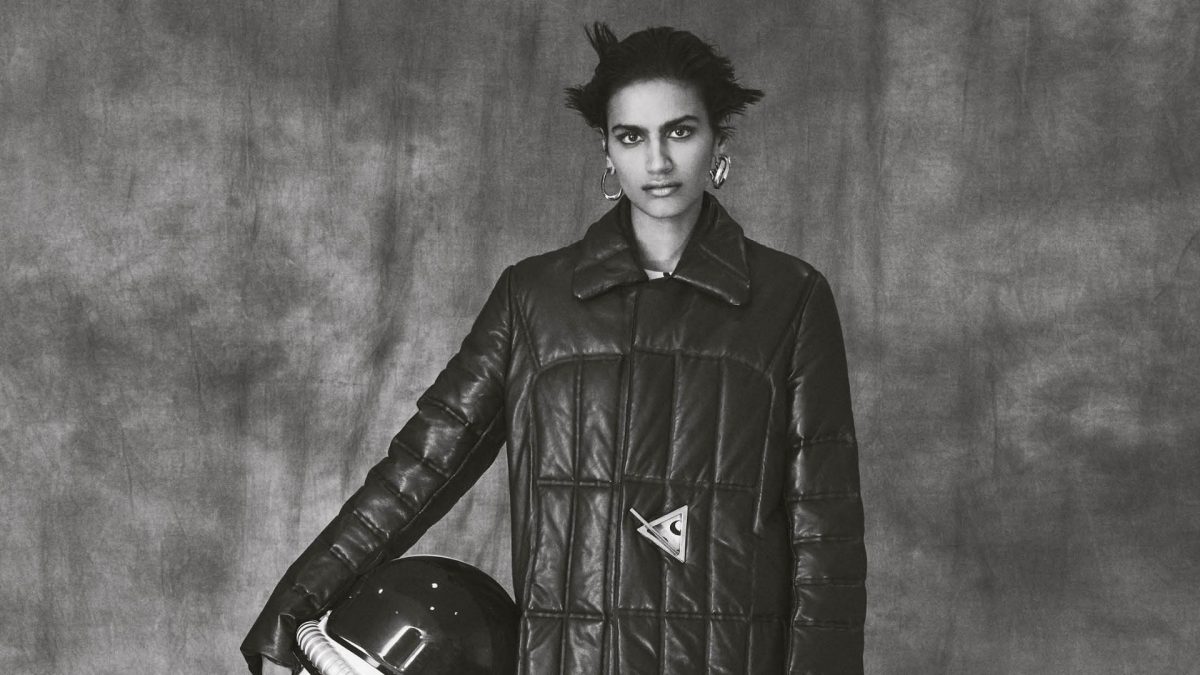
Photography: David Reiss. Styling: Kelly-Ann Hughes.
From Harper’s Bazaar Arabia’s January 2021 issue