

Balancing Act: A Glimpse Inside Prada’s “Garden” Factory
The secrets of the Italian fashion house aren’t where you’d think. Instead, they’re hidden in a graphic, Tuscan ode to contrariness. The most Prada factory imaginable…
They call it a ‘garden factory’ – and the incongruity of it is Prada all over. Indeed, the brand has built an empire on the concept of unexpected juxtaposition; things that shouldn’t work together but always do; the weird as wonderful; the jolie laide. Remember those chandelier sandals from SS10, dripping with crystals but festooned over a chunky, rivet-stamped heel? Or how about SS11’s cartoon monkey print spliced against those bold deckchair stripes –the season that launched a thousand eBay resale searches. Thirteen years on, some of us are still looking for those banana earrings.
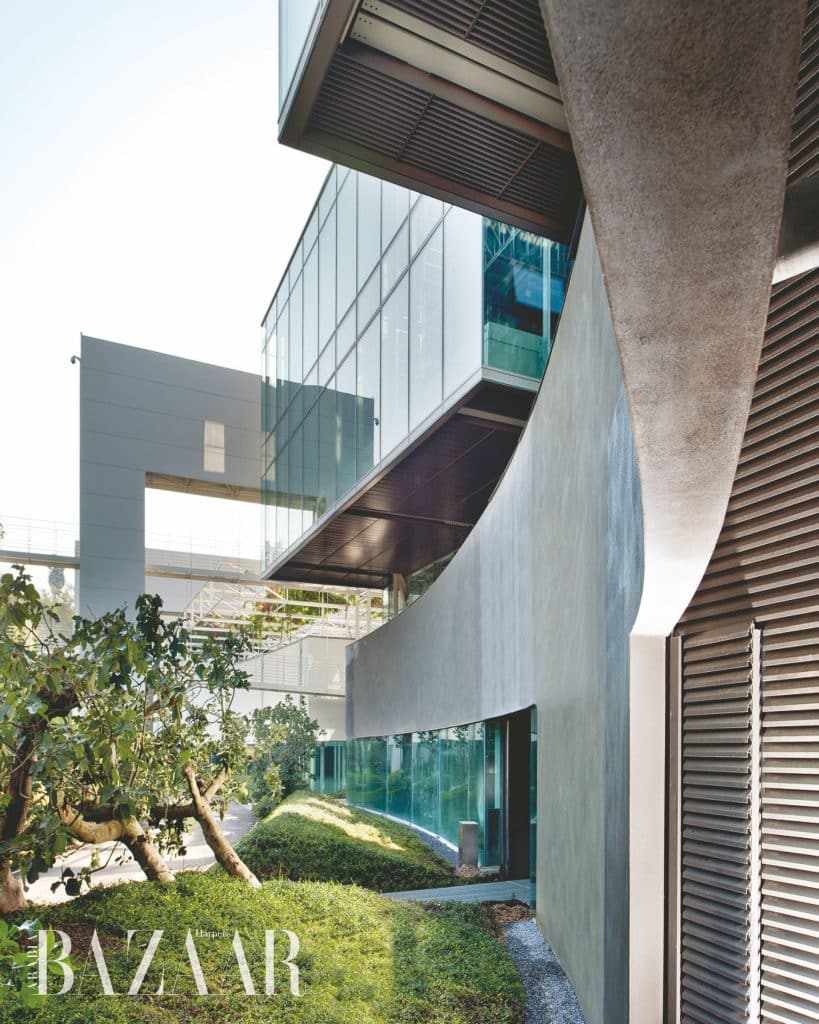
All of these iconic, palpitation-inducing pieces, by the way, are meticulously stored in Prada’s temperature controlled archive in said garden factory – a glorious, industrial love letter to contrasts set in the verdant hills of Tuscany’s Valvigna. Conceptualised by renowned Italian architect, Guido Canali, the building is vast, graphic, rigorous… everything you would expect from the industrial headquarters of one of the world’s biggest fashion powerhouses. However – as is also now expected from such a brand – a more mindful, ethical approach to all its endeavours is par for the course.

What does that look like for Prada? A space designed to mitigate the impact of buildings on landscapes, to encourage a dialogue between man and nature, and to create an environment that puts workers’ mental health at the forefront. To wit; suspended roof gardens, places to rest, pergolas shaded by grapevines, stretches of water, and enormous glass ceilings that flood the entire space with Italian sunlight. The Prada Group even went one step further, acquiring the surrounding land and reclaiming it to ensure its natural beauty remains preserved. A commitment to sustainability before it became a bandied-about buzzword.
The complex is award-winning, having been recognised by the National Council of Architects for being an “expression of great respect for nature… as well as for work, to which dignity and value are attributed.”
It’s a very Italian principle, which we could probably all do well to borrow from. “A workplace where wellbeing is combined with productivity in a natural equilibrium,” according to Guido. The brand continues, “The underlying inspiration is the conviction that workplaces should not respond only to the demands of functionality and productivity, but must also be human places, made for humans.” With such a philosophy at its core, it’s little wonder that beauty blooms among the glass and vines. It’s allowed to.
Take the brand’s Galleria bag, for example, that begins life in Valvigna. Somewhere between the historical leather-goods archives and the raw-material warehouses, this most classical of Prada beauties is crafted. A fashion icon in itself, the 17-year-old accessory has recently been the recipient of various dramatic makeovers; from the crystal-studded to the Pop Art-inspired, now decorated with whimsical, three-dimensional floral appliqué.
Named after the brand’s flagship (and first ever) store in Milan’s mosaic-dotted 19th-century shopping arcade, Galleria Vittorio Emanuele II, the neo-classic is enjoying some renewed time in the sun – no doubt aided by a panoply of celebrity fans including Kate Middleton, Rihanna, Gigi Hadid and Katie Holmes. A broad church – but one that speaks to its universal appeal.
To see all 83 individual pieces being painstakingly put together in an exceptional location (each letter on the triangle logo, for example, is placed one by one), embodies Prada’s entire ethos. Craft. Heritage. Environment. Detail. And a dedication to beauty so strong that even peeking behind the curtain is extraordinary to behold.
Images: Supplied
From Harper’s Bazaar Arabia’s June 2024 issue.
