
Untamed Nature: Discover Boucheron’s New Histoire De Style High Jewellery Collection
Boucheron’s exquisite new high jewellery collection, untamed nature, draws inspiration from the wild beauty of the botanical world
In a greenhouse-like room overlooking Paris’ storied Place Vendôme, Boucheron’s creative director, Claire Choisne, is talking through her designs for the maison’s latest high jewellery launch. “This piece we imagined as an homage to the huge corsage brooches of the last century. It’s segmented, so you can separate it into smaller pieces and wear them all separately,” she explains, of a trailing, diamond-encrusted stem modelled after a lingonberry branch. Then she laughs: “Not with scissors, of course, you just detach them with your hands!”

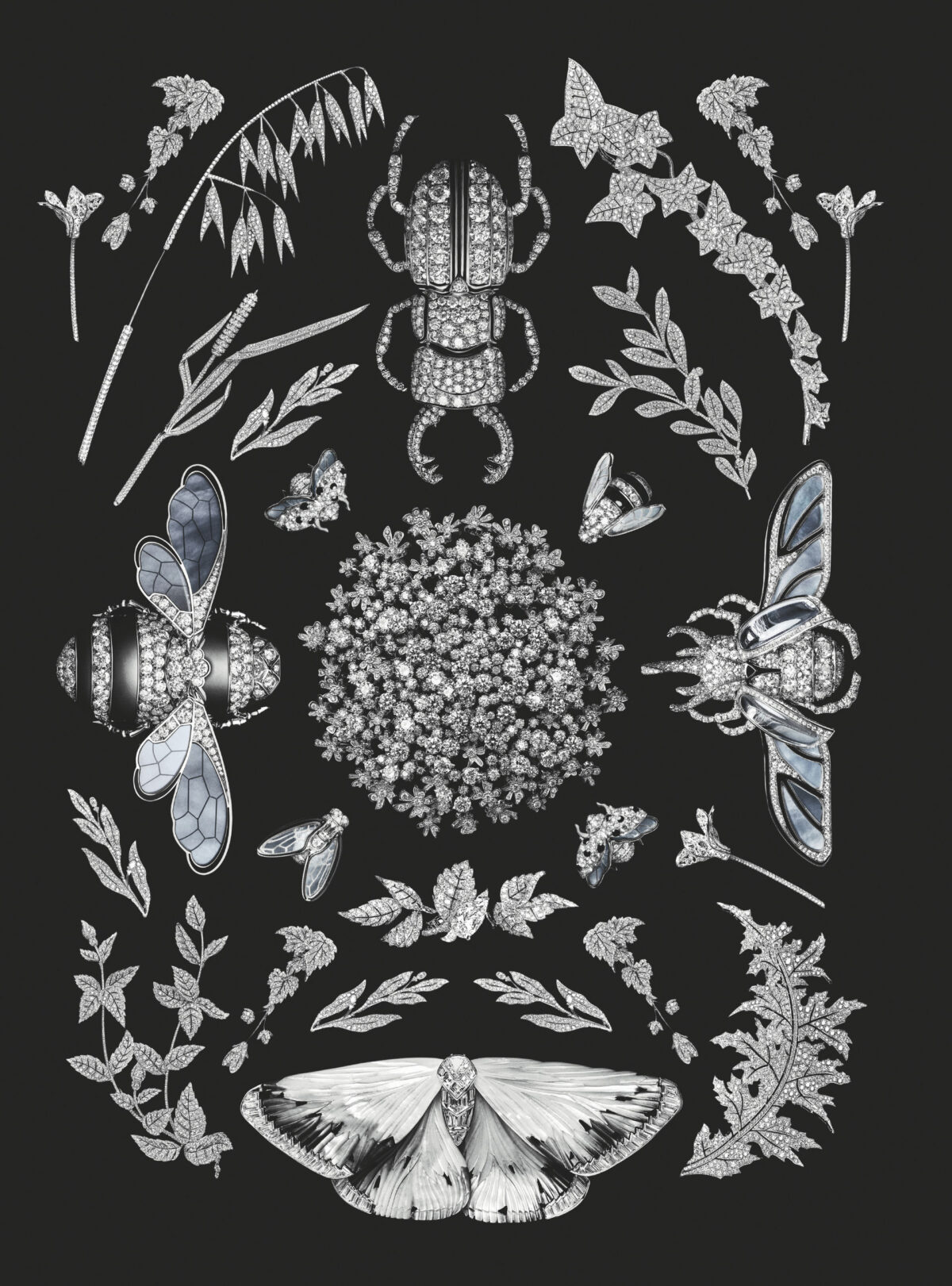
So extraordinarily realistic is the lingonberry jewel, however, one could (almost) be forgiven for reaching for the pruning shears. Each of its 84 handcrafted white gold leaves is snow-set with tiny diamonds that gleam like dewdrops, while its articulated stem gently meanders across the body, as if growing towards the light. Indeed, all of the 28 new creations that make up Boucheron’s new Histoire De Style collection, entitled Untamed Nature, are intended as a celebration of the beauty of plants, particularly the undomesticated species (and the insects that lived on them) that were admired by founder Frederic Boucheron. The archives of his eponymous jewellery house are replete with sketches of diamond set plants and vines, stretching all the way back to 1858, when Boucheron drew inspiration from the ivy that rambled along the arcades of the Palais-Royale, where he established his first boutique.
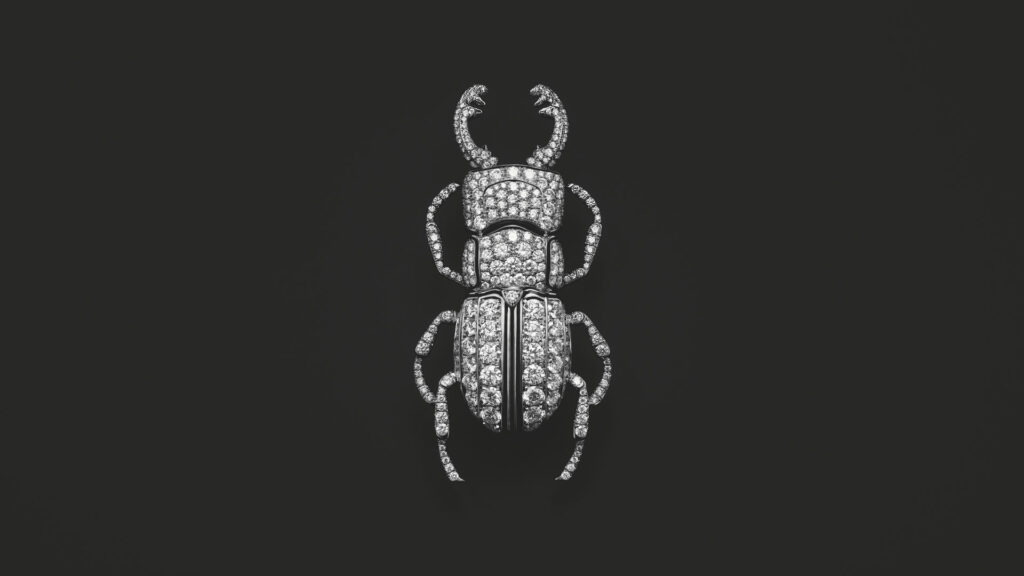
While his contemporaries crafted bejewelled likenesses of exotic flora and fauna, such as orchids and panthers, Frederic Boucheron became fascinated with unassuming European wildflowers such as thistles and daisies, and humbler (but no less interesting) beasts like beetles and dragonflies, and he compiled a personal library of over 600 works, including great scientific treaties, in order to be able to study them in exceptional depth.
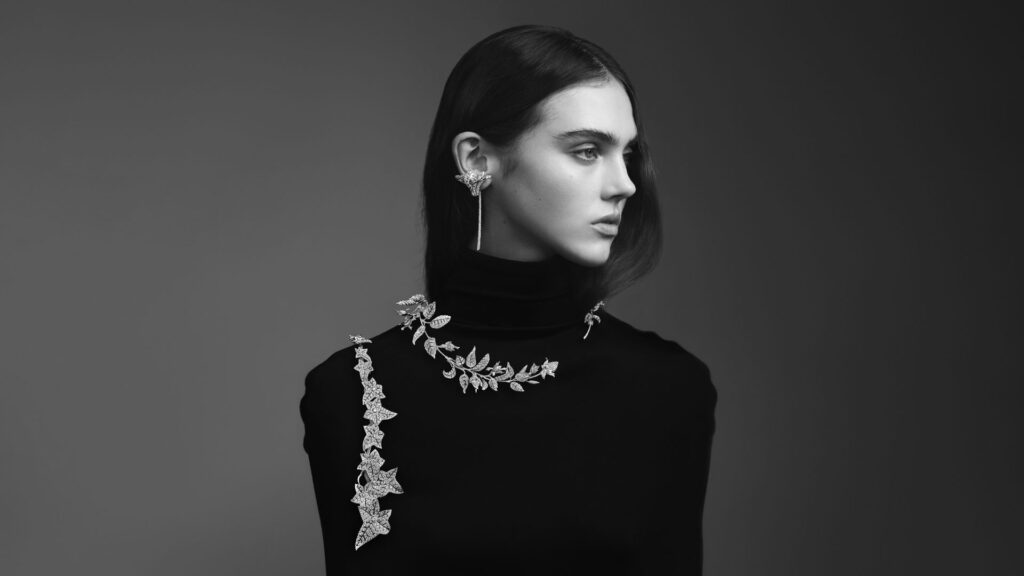
“Looking at Frederic Boucheron’s work, it’s obvious that he took time to really observe plants and insects because his jewellery designs are so realistic. He didn’t try to romanticise nature, he copied it, down to its twisted leaves and wilted flowers, which he replicated in diamonds,” says Claire. “For this Histoire de Style collection, which is always inspired by our archives, I wanted to remain true to that. I wanted to keep Boucheron’s life-like volumes and his monochromatic colour scheme and push the level of the detailing that we could achieve.”
It’s a feat that took Claire and her team of in-house artisans roughly three years to achieve. The multi-wear Chardon (‘Thistle’) brooch, inspired by an archival design from 1878, for example, reinterprets the prickly plant as a curving multi-wear piece for the lapel or the hair. Computer-aided design was deployed to reproduce its spiky-looking contours and an openwork lattice inserted into its reverse, ensuring the sparkling jewel was light and comfortable to wear – a task that required over 1,000 hours of work.
The ‘fluffy’ appearance of another multipurpose piece, the Fleur De Carotte (‘Carrot Flower’) pin, belies its technical complexity – its myriad diamond blossoms were each painstakingly angled within the cluster, using three different varieties of setting and bezel. The shimmering wings of a moth brooch were created using intricate marquetry of grey and white mother-of-pearl, to imitate the velvety-looking texture of the nocturnal creature, while the iridescent wings of a bumblebee pin were achieved using a single, transparent layer of mother-of-pearl, hand-engraved with veins and topped with clear rock crystal.
By far the most complicated piece, however, is a necklace resembling the curved off shoot of a wild rose bush, featuring three diamond buds (weighing roughly eight, four and two carats) nestled amongst white gold foliage crafted with the ancient lost wax technique – representing 2,300 hours of work in all. “I love this piece because there’s a balance between the delicacy of its details, which are of a level that’s almost impossible to find nowadays, and also its power. You can really feel the strength of nature within it,” muses Claire. “With this collection, I wanted to really say something, to give a message around nature. It’s always a beautiful thing, but it’s tough and asymmetric and wild, too, and it should be appreciated, not locked in a safe and forgotten.”
Imagery supplied