
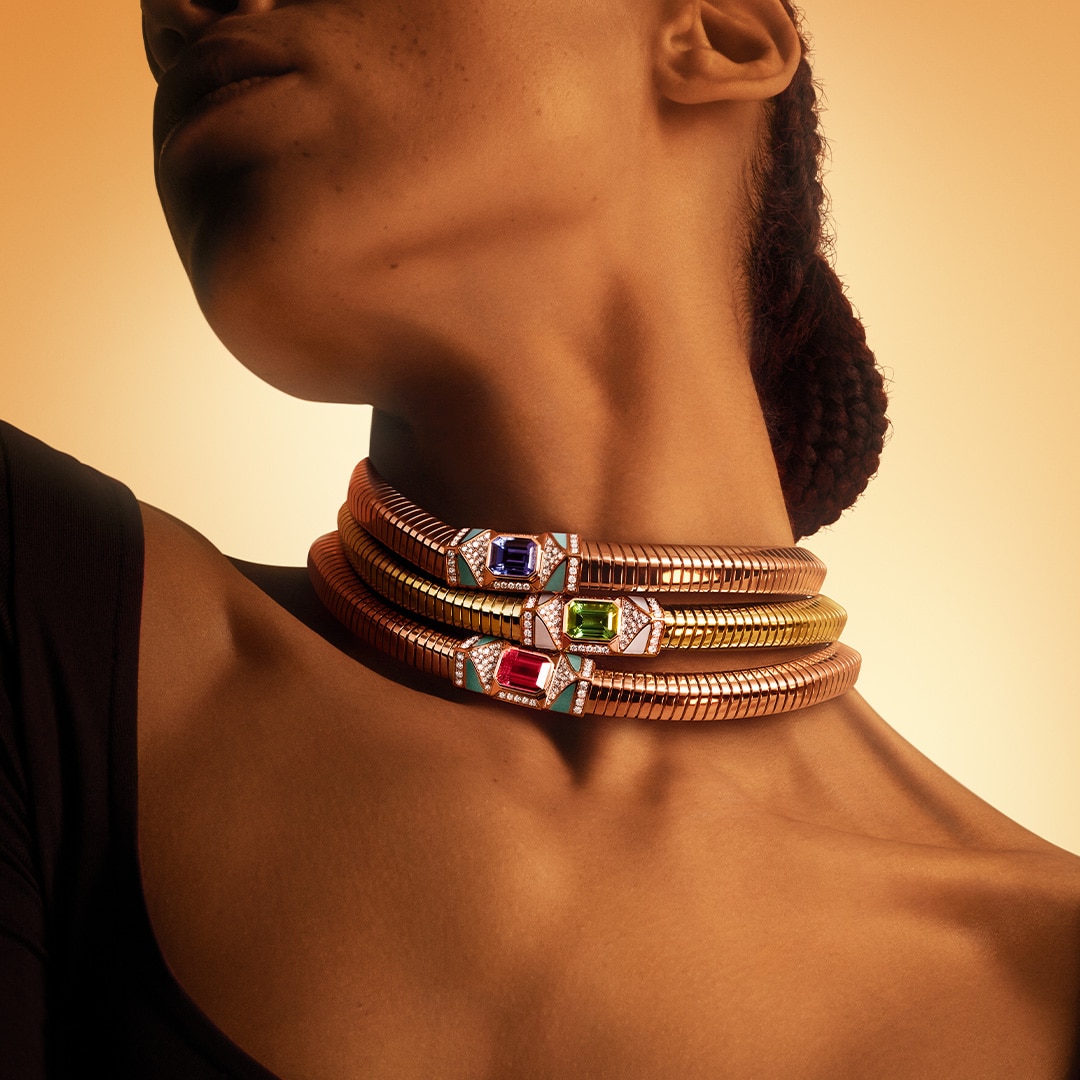
The New Bvlgari Tubogas Jewels Are The Ultimate Modern Heirlooms
First conceived in 1948, Bvlgari’s Tubogas design is an icon of 20th century fine jewellery design, reimagined once more for a new, bold and daring collection
In the post World War II era, as a semblance of normal life resumed, gleaming pieces of jewellery were pulled out of safe-keeping and a sea of Art Deco platinum designs re-emerged. This had been the dominant pre-war aesthetic—cool tones, straight lines and architectural silhouettes were de rigueur. It was in 1948 that the Bvlgari Tubogas disrupted the design scene; a supple, spiralling bracelet that blended beauty with function—its avant-garde artisanry conjured the luminous warmth of Italian landscapes through its opulent yellow gold.
The name ‘Tubogas’ was borrowed from the gas pipe used to transport pressurized gas in the 1920s, and like many other of the most iconic jewellery designs of the 20th century, its utilitarian design codes underpinned its appeal. Gone were the organic floral motifs of Art Nouveau, gone was the stately symmetry of Gatsby era jewels; there was a new, audacious aesthetic and it was set to shape jewellery-making history forevermore.
The Tubogas concept was initially explored through the bracelet of the very first Serpenti jewellery watch, but it was in the 1970s that the concept took hold and began to permeate through other Bvlgari collections. Now, the technique is an instantly recognisable signature of the maison and is often paired with Bvlgari’s iconic, signature styles—Monete, Serpenti, Parentesi and Bvlgari Bvlgari—always bringing its sublime modernity and ingenious engineering to add a pinch of pizzazz. The Tubogas has come to symbolise the very spirit of the maison, and is now celebrated with a new collection of 16 pieces—each bestowed with its gleaming coils.

From plain pieces that allow precious 18-karat gold to truly shine, to embellished creations that marry the Tubogas’ versatility with bold, unbridled gemstones—another distinctive design code of the maison—there is a piece to suit minimalist and maximalist sensibilities alike. Bracelet designs include a classic 18-karat gold style, a mixed metals version, and one set with sparkling diamond studs; each can serve as a stand alone statement piece, or be mixed and matched to make maximum impact. The collection embodies several other of the maison’s calling cards, including its signature Parentesi design—a geometric motif inspired by Roman pavements which references the Tubogas creations of the 1970s.

There are also showstopping pieces that embody the maison’s high jewellery savoir faire. An exquisite necklace flaunts untold vivacity through tanzanite, rubellite and green tourmaline, with the Tubogas mesh slightly reimagined to add bold volume, with lashings of pavé diamonds to inject the maison’s inimitable glamour. A fine timepiece also explores the maison’s history as a jeweller-watchmaker, with the Tubogas bracelet erring into the Bvlgari world—a lithe and supple bracelet culminates in a chic watch case emboldened with the double-logo engraving, inspired by the ancient inscriptions on Roman coins. Crafted in yellow, white and rose gold, its mixed metal hues are expertly contrasted with a black lacquered dial and diamond hour markers.
The collection is presented in a new campaign, shot by photographer and director Julien Vallon and featuring brand ambassador Hikari Mori, as well as a throng of contemporary designers. Yellow gold is brought to life in a landscape of burnt orange hues that evoke Rome’s skyline at sunset, while the dancers’ fluid movements echo the sinuous curves of each Tubogas design. The collection is unveiled as part of the Bvlgari Studio project, a platform that invites eminent creatives to interpret the maison’s iconic collections and dream up new narratives.

Launched in Seoul last March, Bvlgari Studio now travels to New York, and will celebrate the collection launch with a series of artistic collaborations. Opening on September 4 at The Refinery at Domino, a former sugar factory in one of the city’s most creative hubs, the initiative will unveil a new digital campaign by Antoni Tudisco, alongside a dazzling installation by Berlin-based light artist Christopher Bauder, designed to emulate the Tubogas’ symphony of movement.
The venue is an eclectic space with hybrid charm – originally built in 1884, its historic brick façade speaks of a storied past and rich heritage, while it prepares to welcome pre-eminent talents and all the technology of the modern creative world – a fitting tribute to the Tubogas itself.
Imagery Supplied
