
Fashionably On Time: How Fashion Houses Earned The Respect Of The Watchmaking World
For years, the luxury watchmaking world looked down its nose at timepieces made by fashion companies. Oh, how times have changed. Here, Bazaar’s watch columnist Elizabeth Doerr highlights the houses that have earned the industry’s respect
Fashion is no longer a dirty word in watchmaking, and these three serious makers from notable fashion houses are proof positive that transferring iconic style labels to ticking metal can be done so that watch enthusiasts and fashionistas alike are appreciative.
Chanel J12 Electro and Electro Dream
In 1987, the company that brought the fashion world such staples as Chanel No. 5 decided to take watches seriously. Such an innovative fashion brand would never be content with simple private labelling in horology: taking the hard road, today it even boasts ownership of its own Swiss factory.
Chanel’s ceramic flagship model, the J12, successfully fulfilled designer Jacques Helleu’s demands on it: simplicity and timelessness, though we can add innovative use of ceramic to the list of attributes that make it unique.
A cooperation with Audemars Piguet in 2011 brought about the notable J12 Calibre 3125 model, based on the traditional Swiss brand’s in-house automatic movement 3120. But that doesn’t even scratch the surface of what Chanel has in terms of specialised infrastructure now, culminating in 2019 with the rebooted J12 powered by automatic Calibre 12.1. The result of Chanel collaborating with Swiss movement maker Kenissi, in which it has a 20 per cent stake.
Chanel united all its watch collections in one overarching theme for the first time in 2021, using vibrant hues like splashes of a rainbow. “For 2021, I’ve chosen to recount our creations via a universe that really inspires me,” Arnaud Chastaingt, the director of Chanel’s Watchmaking Creation Studio, relates. “It’s an immersive capsule collection whose graphic codes are borrowed from the world of Electro music culture.”
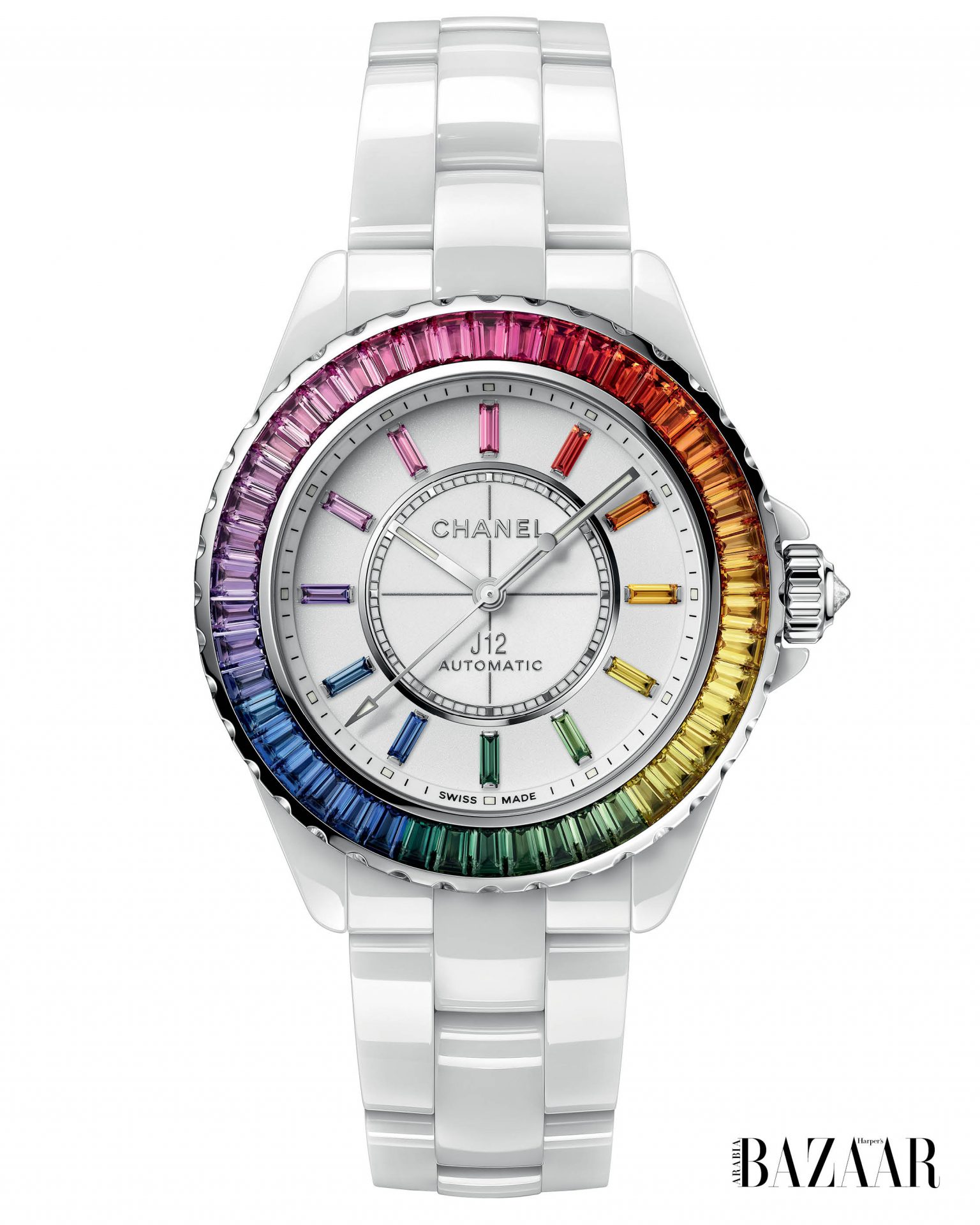
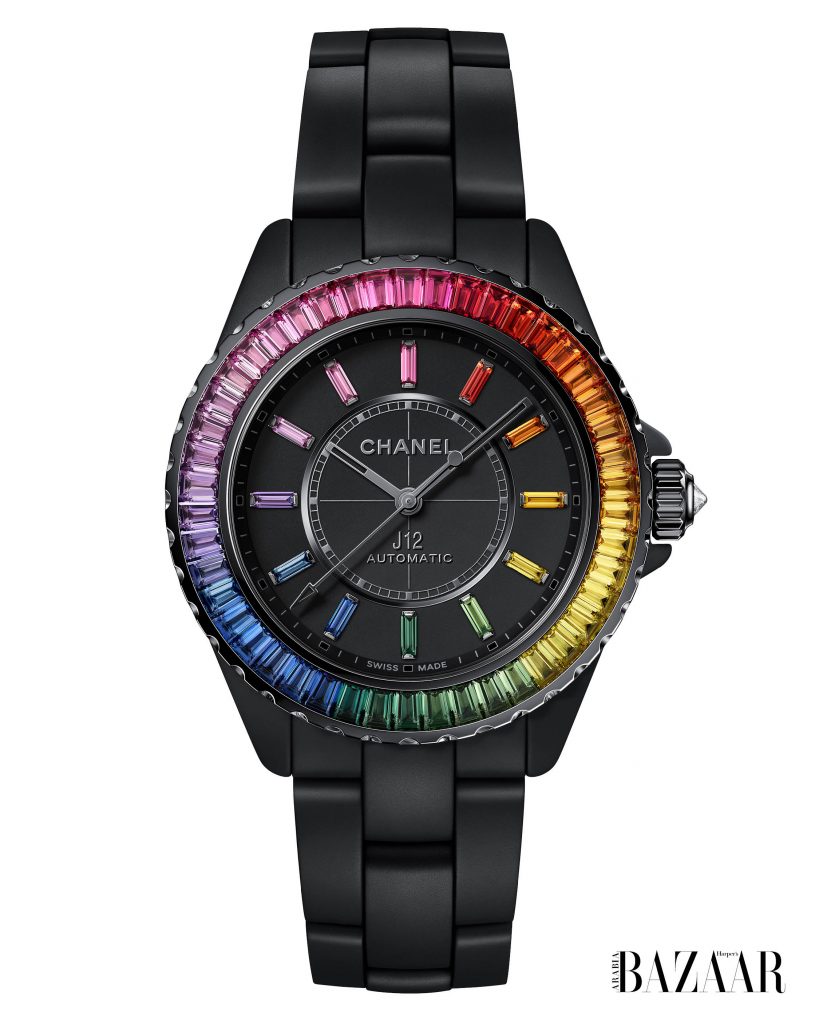
Chastaingt gave his Electro treatment to members of the J12 family, including the ceramic stalwart in the J12 Electro Dream. Against a choice of black or white 38 mm ceramic case and bracelet, the 12 colours of the rainbow shine on a black ADLC-treated stainless steel or white 18-karat gold bezel set with 46 baguette-cut rainbow sapphires (6.47 ct). Twelve baguette-cut sapphires (0.14 ct) mark the hours, shining forth from the white-lacquered or matte black dial. The crown is set with a brilliant-cut diamond. Limited to 55 pieces, the J12 Electro Dream is powered by Chanel’s automatic Caliber 12.1 with a blackened finish.
J12 lovers who are not such fans of high jewellery can choose the J12 Electro, which utilizes rainbow neon colouring for the numerals and markings on the dial and bezel in place of gemstones.
Hermès Arceau Toucan de Paradis

La Montre Hermès has followed a long-term strategy for its watches that involves slowly, carefully, and methodically improving quality and moving processes and manufacturing in-house as far as possible. Today, Hermès calibres are produced by Vaucher, which Hermès has owned 25 per cent of since 2006. Automatic Calibres H1912 and H1837 were introduced in 2012 as a base movement: the number 1837 refers to Hermès’ founding date, while 1912 refers to the year that young Jacqueline Hermès – part of the third generation of the founding family – appeared in a photo wearing a porte-oignon, a leather case she invented to allow her to wear a pocket watch on her wrist. Both movements were introduced in 2012 in honour of the brand’s 175th anniversary.
Hermès also specialises in artistic crafts for the dial. One of its many artful watches powered by Calibre H1912 and released in 2021 features a beautiful, rare art: the dial of the Arceau Toucan de Paradis takes over a week to produce as the depicted bird and its plumage are crafted using enamel and vibrant silk thread meticulously fixed in place to create a textile effect. This 38 x 10.26 mm white gold work of art is limited to 24 pieces and framed by 82 colourless, brilliant-cut F diamonds (0.63 ct).
Louis Vuitton Vivienne Spin Time Air

The 167-year-old Louis Vuitton company now forms the base of luxury group LVMH (Louis Vuitton Moët Hennessy), which also owns watch brands Hublot, Zenith, TAG Heuer, and Bvlgari. Louis Vuitton began making watches in 2002, starting with the Tambour line; the designs are created at its Paris headquarters, while production takes place within its own Swiss facilities. The brand took over movement specialist La Fabrique du Temps in 2011, allowing it to consolidate staff from the previous factory location in La Chaux-de-Fonds. The new location in a suburb of Geneva combines both teams and more under one roof, including employees of dial maker ArteCad, which Louis Vuitton also acquired back in 2011.
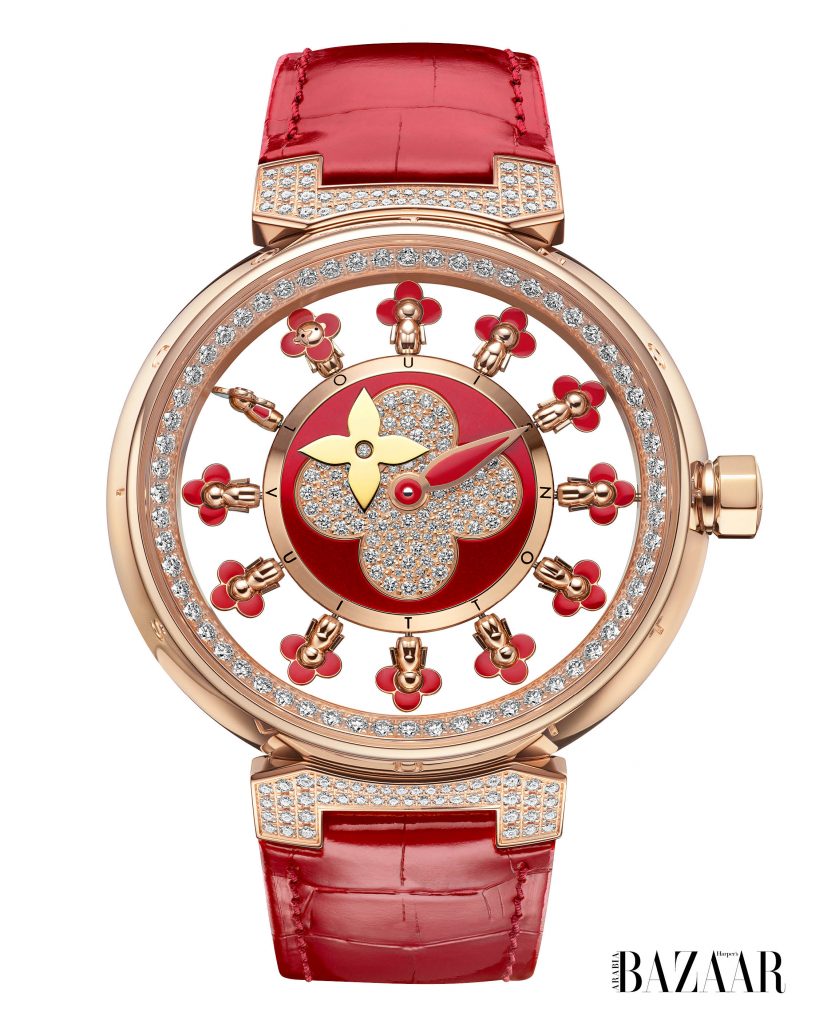
The effects of the high-powered reorganisation a decade ago are still being felt today, notably in the Tambour line – and 2021’s funky and fun Vivienne Spin Time Air is a great example. Powered by automatic Calibre LV 89, this version of the playful Monogram-inspired mascot is a modern and feminine take on Louis Vuitton’s patented jump hour mechanism using tiny rotating Vivienne statues to display the current hour.
The transparent nature of this watch with the movement suspended in the centre allows the little figures to be viewed from both sides. The current hour is displayed by a figure turned sideways, while the hour ahead sees the face of one Vivienne showing up for just a tiny part of the day; the minutes are shown by the one lacquered hand in the centre of the dial. The largish 42.5 mm pink gold case set with 239 brilliant-cut diamonds (1.69 ct) ensures that the 12 statuettes with lacquered flowers have more than enough space to shine.
From Harper’s Bazaar Arabia’s February 2022 issue.