
Autumn 2025 Haute Couture is Ushering In a New Vanguard of Fashion and Ancient Influence
The Autumn 2025 haute couture collections took place on the cusp of one of the most dramatic creative changeover periods in fashion in living memory. It heralded the arrival of a new fashion vanguard armed with revolutionary materials – and ancient cultures
A raven, a swan song and 125 million bioluminescent algae were among the viral stars of the Autumn 2025 haute couture season, which took place in Paris in mid July as a record-breaking heatwave swept across Europe.
As climate concerns conflate with myriad other global disruptions and turmoil to dominate the geopolitical conversation, the tectonic plates of the fashion world are shifting beneath our feet. Fashion’s biggest creative reset in generations is underway as luxury brands respond to a sustained downturn in consumer spending amid other economic pressures that have seen a global sales decline at almost every major fashion house and widespread drops in revenue. A head-spinning rotation of CEOs and senior executives continues unabated. And although creative-director spots at the marquee brands are now mostly filled, the lion’s share of those debut collections is not due to be unveiled until later this month in what promises to be a blockbuster of a Spring 2026 women’s ready-to-wear show season with the debuts of, among others, Matthieu Blazy at Chanel, Demna Gvasalia at Gucci, Pierpaolo Piccioli at Balenciaga and Louise Trotter at Bottega Veneta.
But hand-crafted, made-to-measure haute couture – a profession that was first formally organised in Paris in 1868 – is an entirely different beast to ready to-wear, its younger, industrialised cousin, which was born a century later to see garments sold anonymously off the rack in boutiques in multiple sizes. Couture, for short, is fashion’s dream machine, where price is no object and hundreds of hours of work go into individual garments, which are often heavily embellished by a panoplie of skilled artisans. It’s a medium sans limites, where starting prices approach $100,000 and have been known to reach as much as $1 million – patronised by a client base of one per centers that’s immune to any cost-of-living crisis.
New to their ranks is one Lauren Sánchez Bezos, who attended the Balenciaga show fresh from her June 27 wedding in Venice, where she wore a Dolce&Gabbana Alta Moda gown [alta moda being Italy’s equivalent of haute couture], which was widely reported to have cost around $300,000 – with a total event cost that Veneto President Luca Zaia estimated could have been in the vicinity of €40-48 million, the Associated Press reported. The day after the Balenciaga show, Lauren was back stateside photographed accompanying her new husband, Amazon founder Jeff Bezos, to the Allen & Company’s Sun Valley Conference, an annual summit for tech and media giants that’s often referred to as “summer camp for billionaires”.

Underlining the out-of-kilterness of this fashion moment: the season kicked off, quite unexpectedly, on May 27 – over in Rome, to boot – when Maria Grazia Chiuri presented what would just a matter of days later be revealed to have been her very last collection as Dior’s creative director of women’s haute couture, ready-to-wear and accessories. Presented in the formal gardens of the Villa Albani Torlonia, Dior’s Resort 2026 presentation concluded with 31 haute couture looks. A week later, Dior announced Jonathan Anderson would be its new sole creative director across women’s, men’s, haute couture and accessories. Although his Dior men’s Spring 2026 collection on the eve of the couture shows set the internet ablaze, we’ll have to wait until January’s Spring 2026 season to see just how he tackles the couture medium for the first time in his career.
Maria Grazia’s final haute couture offerings for Dior included richly hued liquid velvet columns, a frothy suite of sheer gowns festooned with lace, ruffles and 3D florals and several striking grey dresses embellished with trompe l’oeil caviar beading that lent an air of Roman statuary. Dior called the finale look a “trompe l’oeil gladiator armour dress”. Were there gladiatrices in Rome? Yes, but in infinitesimal numbers – a little like women creative directors at the helm of luxury’s biggest brands right now, with most of the top jobs currently going to men.

Back in Paris in July, meanwhile, Chanel presented a show designed yet again by the anonymous internal Fashion Creation Studio, which has kept collections ticking over since the abrupt June 2024 departure of former artistic director Virginie Viard. This was the studio’s final show before Matthieu assumes full creative control.
The collection took inspiration from Gabrielle Chanel’s love of the Scottish Highlands and opened with a suite of white and beige tweed looks, before moving into a much darker chapter. Of note: a tough chic black version of the iconic Chanel tweed skirt suit with silver chain embellishments, teamed with black over-the-knee boots. The preponderance of black on Chanel’s runway (almost half the collection) dovetailed with a dark mood that dominated the season, with the gothic romance and horror sentiment of January’s Spring 2025 couture collections, which unfolded as Roger Eggers’ reimagining of Nosferatu was powering ahead at the box office, standing its ground. The word “dystopian” peppered more than one show review.

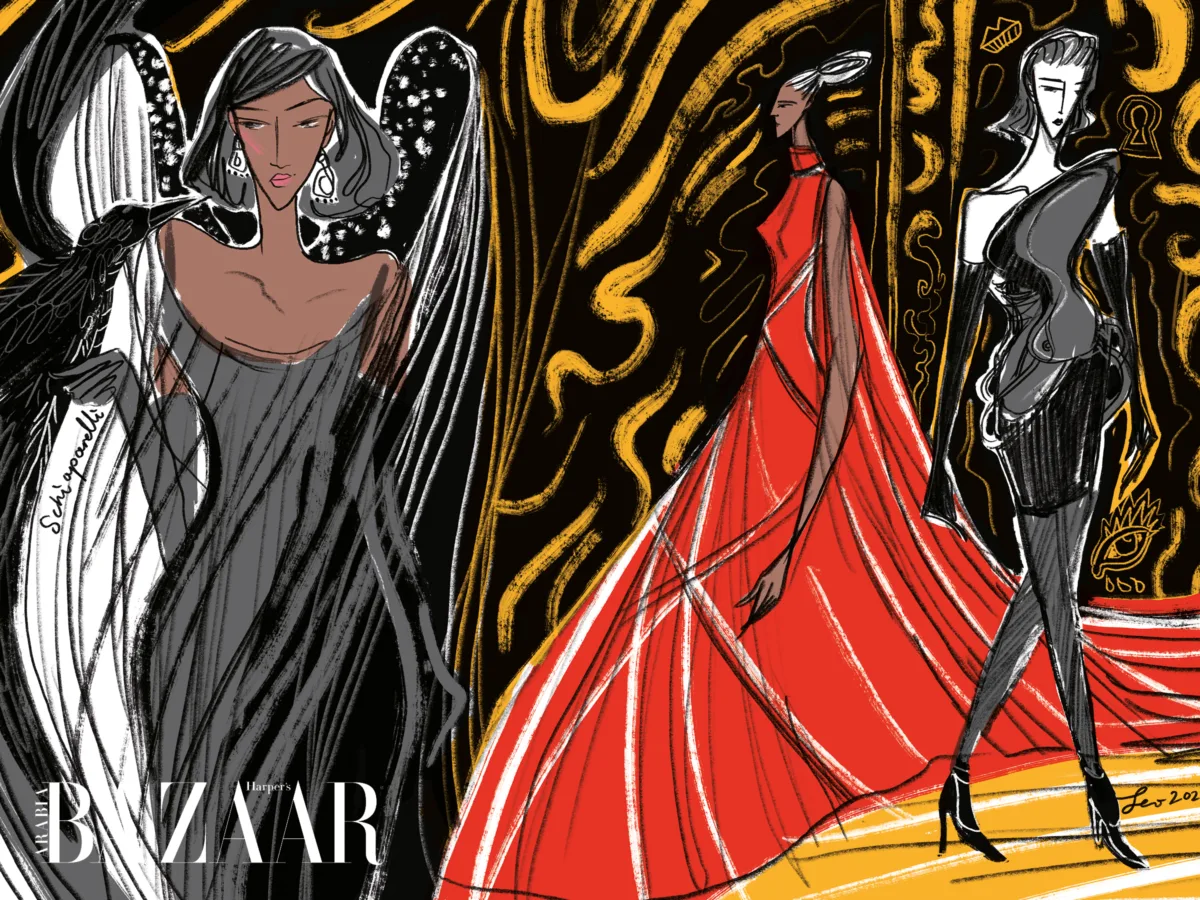
The week opened, as it often does, with a viral celebrity stunt outside the Schiaparelli show: on this occasion, rapper Cardi B standing on the steps of the Petit Palais in a dramatic fringed look from the Spring 2024 couture collection, holding a live raven on a tether. An omen? After six blockbuster years putting Schiaparelli front and centre in the pop culture conversation and dominating the red carpet, the tenure of creative director Daniel Roseberry is surely not under threat. But Daniel was nevertheless in a sober mood, delivering an almost exclusively monochromatic collection, highlights from which included an asymmetrical, draped strapless dress in lightweight black crepe with bulbous detailing over one hip; and an actual saddle as a bustier, fashioned from stretch velvet, satin and black lambskin, teamed with a black matte velvet pencil skirt.
The collection was inspired, he said, by the era of “peak elegance” which preceded Elsa Schiaparelli’s 1940 escape from Paris to New York ahead of the German invasion of
France, flanked by her friend and colleague Jean-Michel Frank, the interior designer and a cousin of Anne Frank. Noted Daniel in his show notes: “This collection is dedicated to that period, when life and art was on the precipice, to the sunset of elegance, and to the end of the world as we knew it”.

Demna Gvasalia was definitely signing off this season, presenting his last Balenciaga collection before heading to Gucci, with a star-studded audience on hand to bid him adieu. “This front-row image by [the Sánchez-Bezos wedding photographer] German Larkin for Balenciaga will go down in the annals of anthropology. It captures so many things about this period in time, I don’t even know where to begin,” is how WWD’s Paris bureau chief Joelle Diderich captioned a photo that showed Lauren sitting with Katy Perry, French-Malian pop star Aya Nakamura, Cardi B, Anna Wintour and Nicole Kidman. Kim Kardashian was on the runway channelling Elizabeth Taylor as Maggie in the 1958 film Cat on a Hot Tin Roof in an exact replica of Elizabeth’s ivory slip costume, complete with Elizabeth’s own diamond earrings.
Beyond a few lighter pieces – notably a frothy pink strapless ‘Debutante’ gown made from technical organza and a sculptural ivory Guipure lace wedding gown shaped with millinery techniques – there was a definite gothic undertone to the collection, which included sharp-shouldered black tuxedo dresses and full-length black gowns with sculptural necklines, one wasp-waisted and rendered in black leather. There was a striking black-and-white houndstooth skirt suit, a replica of a 1967 Balenciaga design that had originally been worn by Balenciaga’s fitting model Danielle Slavik, whom Gvasalia coaxed out of retirement to model in his second couture collection for Balenciaga in 2022. Danielle died on July 13, a few days after the show, aged 81.
London-based Hong Kong couturier Robert Wun presented a horror show of a collection called ‘Becoming’, which opened with a white ball gown and cape embellished with beaded ‘bloodied’ handprints and featured multiple looks with prosthetic arms sticking out from the coat sleeves of precision tailoring or else dramatically holding up veils. The veil of the finale bride was positioned over a small figurine perched over the top of her head. It wouldn’t have been out of place in horror franchise The Grudge.
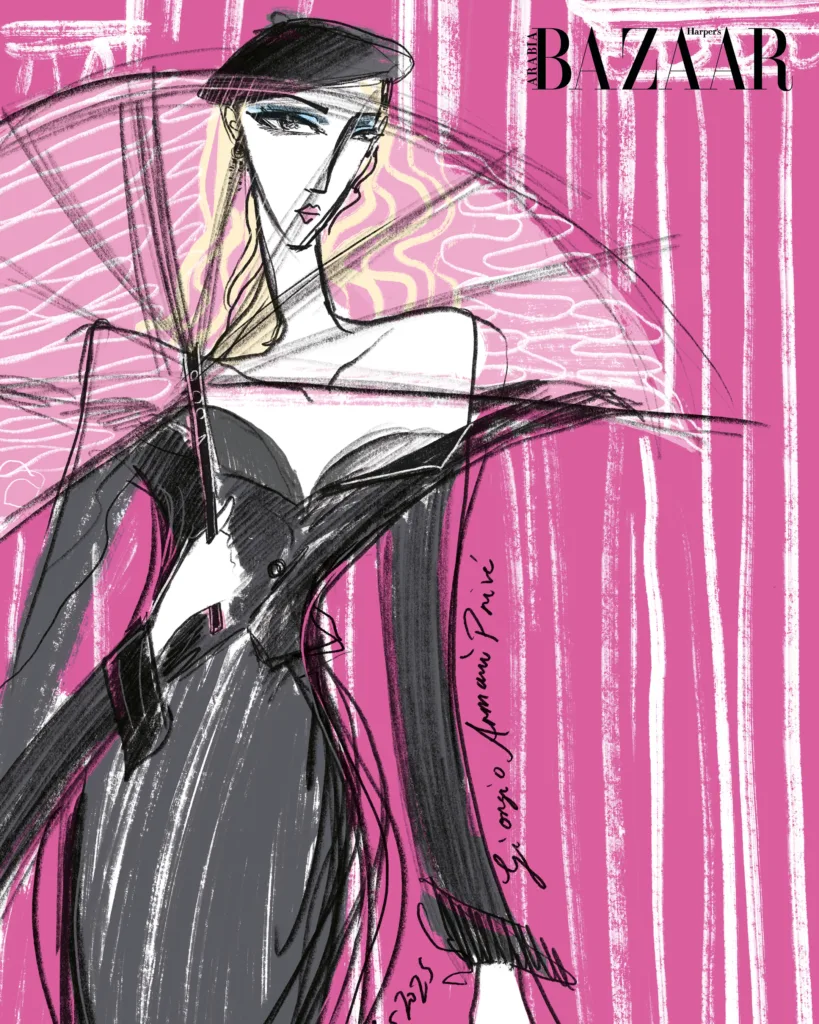
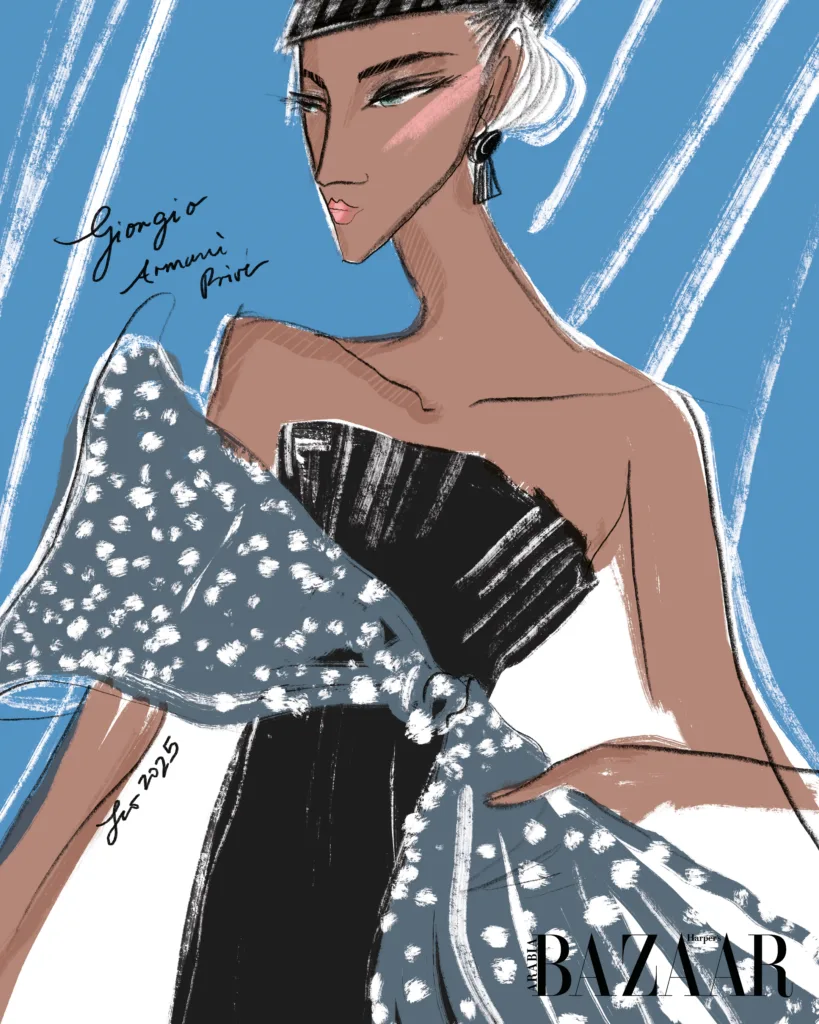
Viktor&Rolf delivered a modern, schizophrenic take on the Victorian mourning silhouette: two alternative possibilities of the same black gown, one pumped-up version packed with silk feathers; the other totally deflated with the stuffing knocked out of it. Even the normally greige-centric late Giorgio Armani was in a black mood, with more than half of the Giorgio Armani Privé Fall 2026 collection – called Noir Séduisant –rendered in black, including a plethora of streamlined black evening columns and sharp tuxedo looks.
But the season’s spectral pièce de résistance came in the form of the debut of Belgian designer Glenn Martens at Maison Margiela. It was presented at Le Centquatre-Paris, a cavernous, repurposed funeral hall in the 19th arrondissement with brand significance: this was where founder Martin Margiela had presented his final collection in March 2009, seven years after selling his label to Italy’s OTB Group.
The collection was inspired by the architecture of Flanders and the figurines of gothic church façades, and every model wore a mask or veil – a house code since the brand’s beginnings in 1988. They shuffled through the decrepit show space flypapered with decaying paper like glamorous ghouls in see-through plastic bustier dresses and separates, ragged lace shrouds, hand-painted canvas looks, an eye-catching troika of draped jersey bustier and corset dresses and one exceptionally beautiful, voluminous Duchess satin skirt and matching long-sleeved top in burnished gold that had been crafted using metallic threads that glistened under the lights and, combined with the matching mask, looked more like a Marvel Cinematic Universe CGI villain than anything IRL. The audience was floored. “Glenn Martens has come to save us,” trumpeted the headline of Business of Fashion’s recap. “People were having a breakdown… bring on the smelling salts, we just had a moment,” hyperventilated fashion journalist Dana Thomas in a July 11 Substack Live video chat hosted on Amy Odell’s Back Row newsletter.
One third of the collection was made from upcycled materials, including lining fabrics, vintage leather jackets and paper, with the masks embellished with crystal costume jewellery or crushed and compressed burnished metal boxes. Upcycling has been a hallmark of the Maison Martin Margiela Artisanal haute couture line, which was first launched in 2006 and enjoyed Guest House status on the Fédération de la Haute Couture et de la Mode (FHCM) schedule until 2012, when it was officially designated an haute couture maison.
It was by no means the first time that unorthodox materials had made their way into couture’s rarified corridors: in February 1966, Paco Rabanne’s first collection, Manifesto: 12 Unwearable Dresses in Contemporary Materials, incorporated Rhodoid plastic discs linked together with metal rings, among other materials (and shocked the establishment). But Margiela’s upcycling revolution today looks incredibly prescient, and it paved the way for a new vanguard of couturiers for whom sustainability is front of mind. They include Dutch couturier Ronald van der Kemp, whose Autumn 2025 collection, Call of the Wild, was inspired by the Amazon rainforest, with several looks done in collaboration with Brazilian artist Thayná Caiçara and a collective of Indigenous Brazilian artisans. Also, Paris-based Swiss couturier Kevin Germanier, who works with a global network of artists to upcycle plastic bottles and bags. This season’s Germanier offerings included ball gowns made from balloons and coquettish rah-rah dresses made from repurposed plastic raffia pompoms.
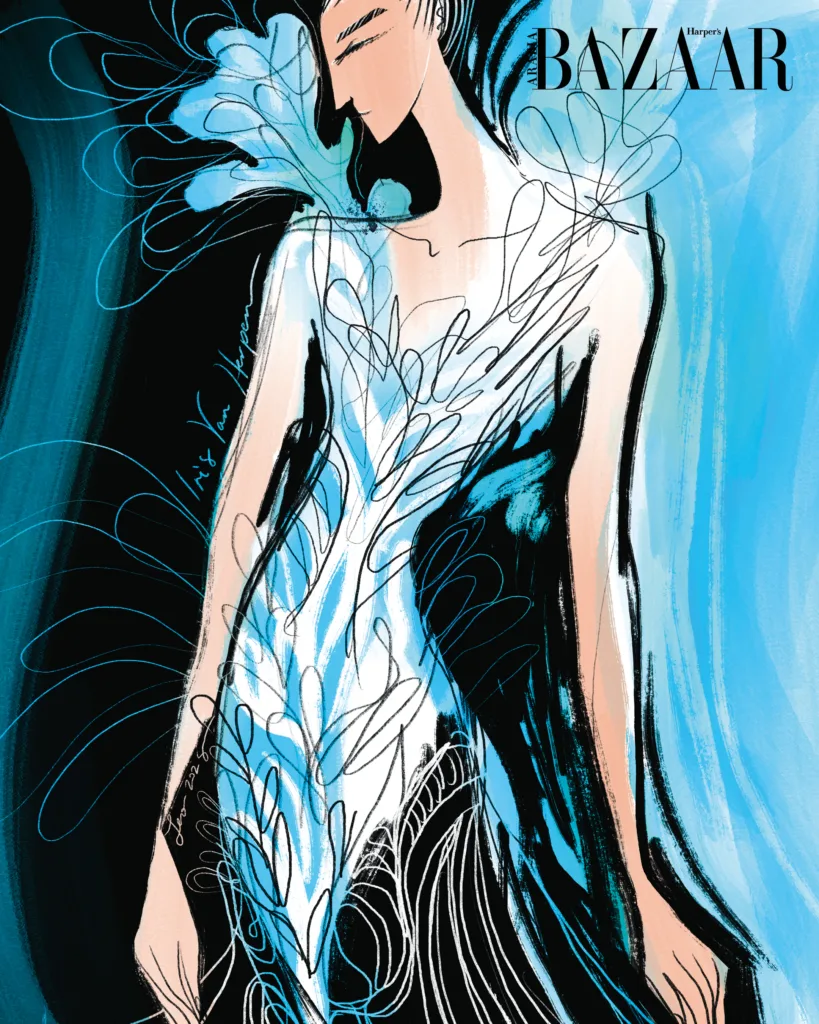
Iris van Herpen is a futuristic Dutch couturier whose otherworldly collections blend traditional haute couture craftsmanship with cutting-edge technologies such as 3D printing, laser cutting and magnetic weaving, and often draw inspiration from nature.

For her Autumn 2025 Sympoiesis collection, she went one better than mere inspiration by teaming up with British biodesigner Chris Bellamy and researchers Nico Schramma and Mazi Jalaal from the University of Amsterdam to develop a living, breathing bio couture gown, whose striking print effect was achieved by a network of tubes that contained 125 million single-celled bioluminescent Pyrocystis lunula micro algae that emitted light in response to touch.
The week’s notable newcomers included Dubai-based Rami Al Ali, the first Syrian couturier to be invited to join the official FHCM schedule as a Guest House. His Autumn 2025 collection, Guardians of Light, produced in collaboration with the Syrian Craft Council, celebrated his homeland’s cultural and crafts heritage. The show opened with a striking gold gown fashioned from long silk strands that were woven into a bodice detail inspired by traditional Islamic mashrabiya carved wooden lattice panels. And Rami’s were not the week’s only Guardians.
Another couture newbie – this time off-schedule – was Australian Indigenous designer Grace Lillian Lee. After winning a coveted three-month slot at the Cité internationale des arts – a 60-year-old artist-in-residence program – Grace chose a residency window that aligned with Couture Week to present her work at a space called 229 LAB on Rue Saint-Honoré over July 7-8. Called The Guardians, it was an extension of her 2024 Brisbane Festival exhibition The Dream Weaver: Guardians of Grace.
A Meriam Mir woman, Cairns-based Grace has become renowned for her intricate woven jewellery and spectacular exoskeleton-like body sculptures crafted from brightly coloured cotton webbing using the ‘Grasshopper’ technique that pays homage to her Torres Strait Island ancestry. She is also the founder of the First Nations Fashion + Design collective and a noted fashion show producer, who has mounted productions at the Darwin Aboriginal Art Fair, the Cairns Indigenous Art Fair and Australian Fashion Week. In Paris, she showed a series of vibrant couture looks that incorporated weaving along with several body sculptures. Each piece required 150 hours of work, and the entire capsule utilised 3.5 kilometres of cotton webbing.

Lee touched down with a posse of 16 friends, family, dancers and models – and some highly influential allies, notably Jean Paul Gaultier, with whom she had collaborated on a costume for a pop-up edition of his Fashion Freak Show at the 2024 Brisbane Festival. Gaultier turned up to support her, as did Andrew Bolton, the head curator of the Anna Wintour Costume Center at the Metropolitan Museum of Art and the equally influential Canadian Thierry-Maxime Loriot, who has curated exhibitions on Gaultier, Thierry Mugler and Viktor&Rolf. Visiting Australians included designer Toni Matičevski, Powerhouse Museum senior curator Roger Leong, Cairns Art Gallery consultant curator Julietta Park, Dolla Merrillees, the director Western Sydney creative at Western Sydney University and prominent philanthropist Stephen Fitzgerald, the former co-CEO and chairman of Goldman Sachs Australia and New Zealand, whose many board positions include a non-executive directorship of the Great Barrier Reef Foundation.
“I’m used to big events . . . but because this was such an intimate showcase, I wasn’t nervous at all,” Lee told Bazaar from Paris a few days after the show. “I was just excited and soaking up all the beauty . . . the fact that we were in the Marais and that Schiaparelli had just shown just around the corner. And then we’re doing our little showcase, which was so special. To have our community with us doing it was, I think, one of the proudest moments I’ve ever had. I felt like I belonged here, to be honest. I was like, Okay, this is where I want to be.”
Words by Patty Huntington. Illustrations by Leo Greenfield
From Harper’s Bazaar Arabia October 2025 Issue.