
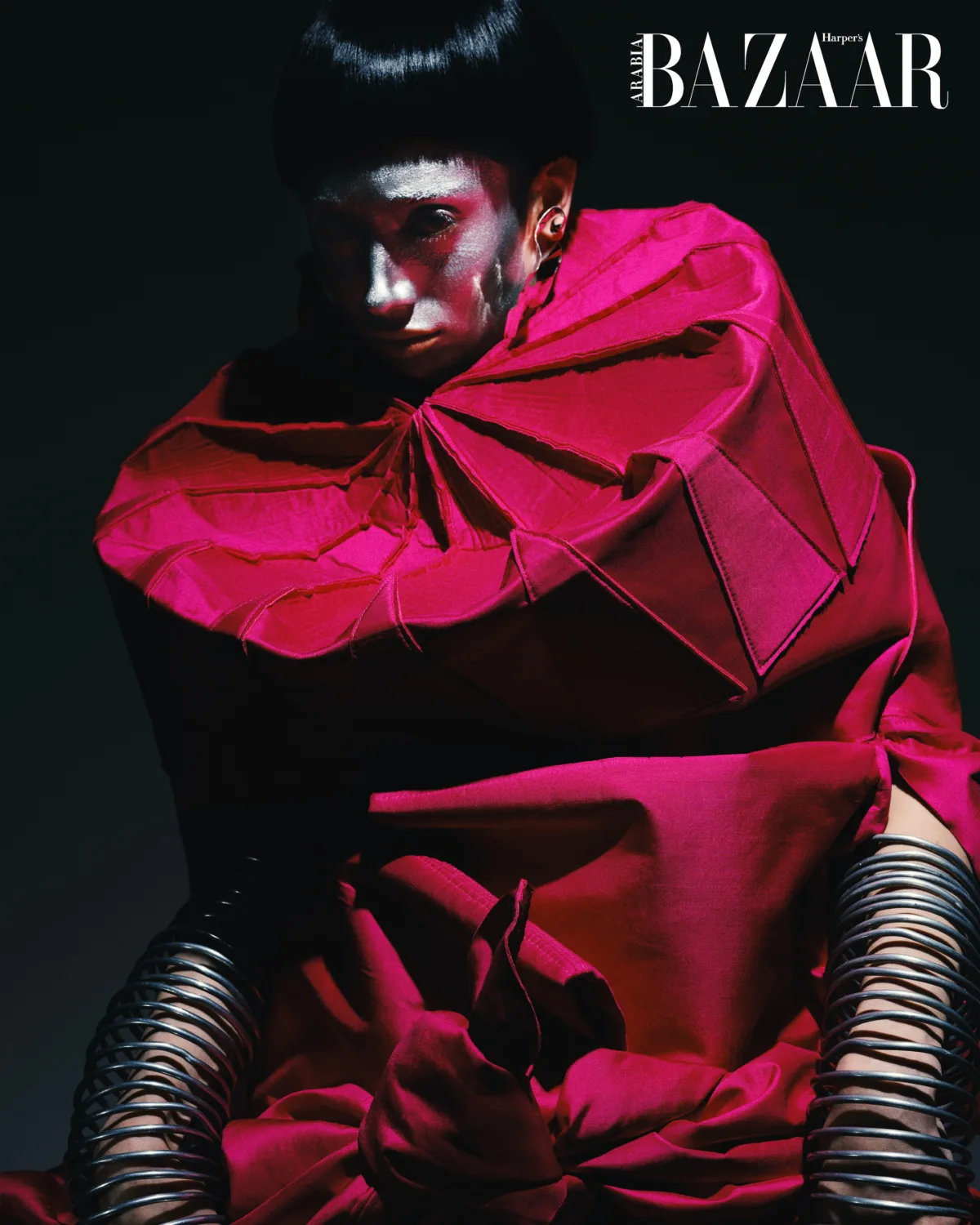
From Ramallah To The Runway: Palestinian Designer Ayham Hassan’s Graduate Collection Proves The Cultural Power Of Clothing
Embroidery hushed across borders, a jacket of half a million rubber bands and a shawl knitted by his mother – Ayham Hassan’s Central Saint Martins graduate collection was a masterclass in symbolism and a love letter to Palestine
“I don’t believe fashion exists just to be beautiful. It has to deliver a message, it has to provoke something,” says Palestinian designer Ayham Hassan. That belief forms the backbone of IM-Mortal Magenta: the colour that doesn’t exist, his graduate collection from Central Saint Martins. At once poetic and confrontational, it’s a culmination of struggle and identity, expressed through garments that speak louder than words. From a handknit shawl made by his mother in Ramallah to embroidery smuggled across borders, Ayham’s collection isn’t just about clothes – it’s about what they carry. Every detail, be it the shade of magenta to the embroidery threads and rubber bands, has something to say about his homeland.
Born and raised in Ramallah, his entry into fashion was anything but conventional. In a world where off beat careers like fashion were rarely discussed, his creative awakening came through pop culture and observing everything around him. “There wasn’t much of a design scene, but there was so much character. I was fascinated by the way people behave, how they dress for weddings or funerals,” he explains. It was performance, pop videos and later Alexander McQueen that opened up a world of fashion as storytelling. He recalls seeing the iconic Armadillo heel on Lady Gaga in her Bad Romance video, which further sparked his curiosity.
Whilst studying at Birzet University, he learned the political and cultural weight of clothing. “I began to understand that there are archives, and even awards for archiving. There’s politics behind all of it; behind museums, galleries and who gets funding,” he explains. It was during this time that he crossed paths with lauded “anti-fashion” designer, Omar Nasser Khoury, who became his mentor and steered the young creative’s ambitions in a new direction. Omar encouraged him to apply to Central Saint Martins, a goal that had once felt out of reach. Determined, Ayham began building his portfolio and launched a crowdfunding campaign to finance the move. The effort quickly gained traction.
A publication featured his work alongside a GoFundMe link, and when Bella Hadid reposted it, everything changed. The campaign went viral, securing the funds he needed to begin his journey in London. “Millions saw the stories and liked the Instagram post. Bella Hadid shared it, and then she followed me, which was unbelievable. Not long after, I got the call. They said, ‘Make sure you bring an umbrella, London is rainy.’ That’s when it hit me: I was going to London.”

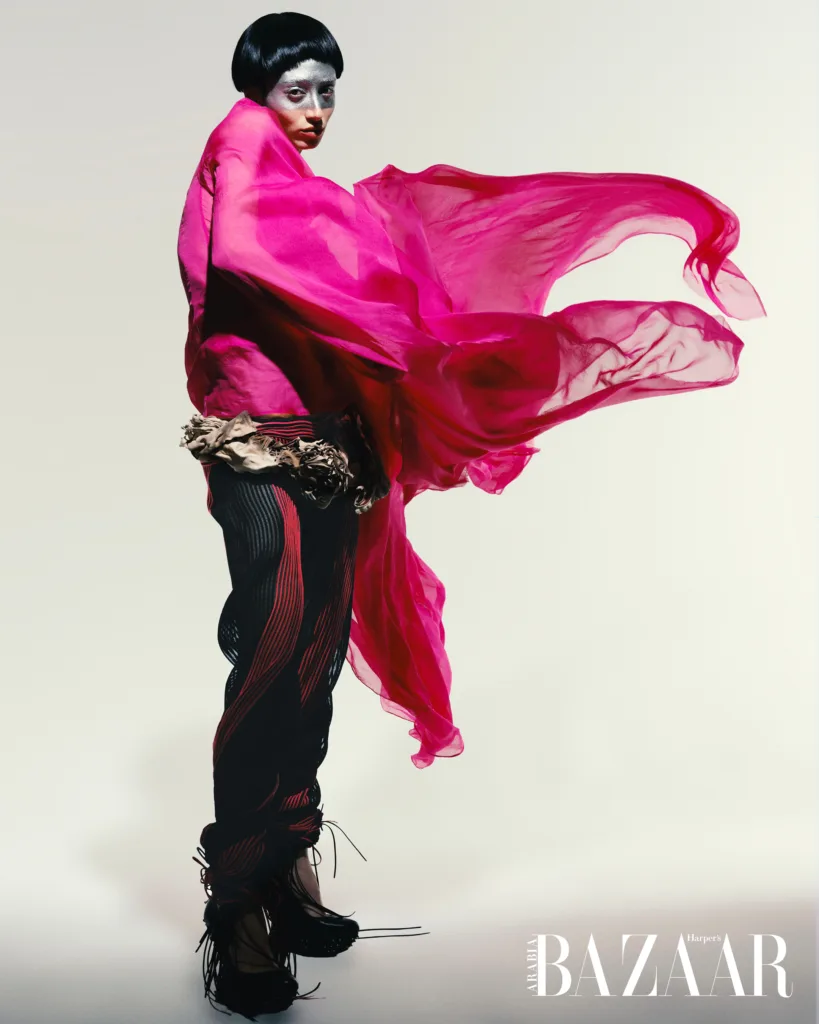
He began his BA in womenswear at one of the most prestigious fashion institutions in the world, where the acceptance rate hovers at around just six per cent. The pressure was high, as were the expectations. The final year is where everything peaks, as students begin developing their graduate collections. Ayham didn’t know where to start – the war in Palestine had him grief-stricken and worried for the safety of his family and loved ones in the West Bank. “I was forced to be inspired for this collection. I had to think about how I could motivate myself as a creative who has something to say. IM-Mortal Magenta came because I was looking at all the pivotal moments where history failed us and where everything started again,” he explains. And so began his deep dive into the Palestinian heritage of crafts, with the magenta colour symbolising struggle and resilience. His research into traditional motifs was shaped in part by time spent with Maha Abu Shusheh, a renowned historic thobes collector whose work preserving Palestinian dress offered a key source of inspiration. Traditional motifs, dresses and talismanic jewellery became a point of reference, where each layer tells its tale.
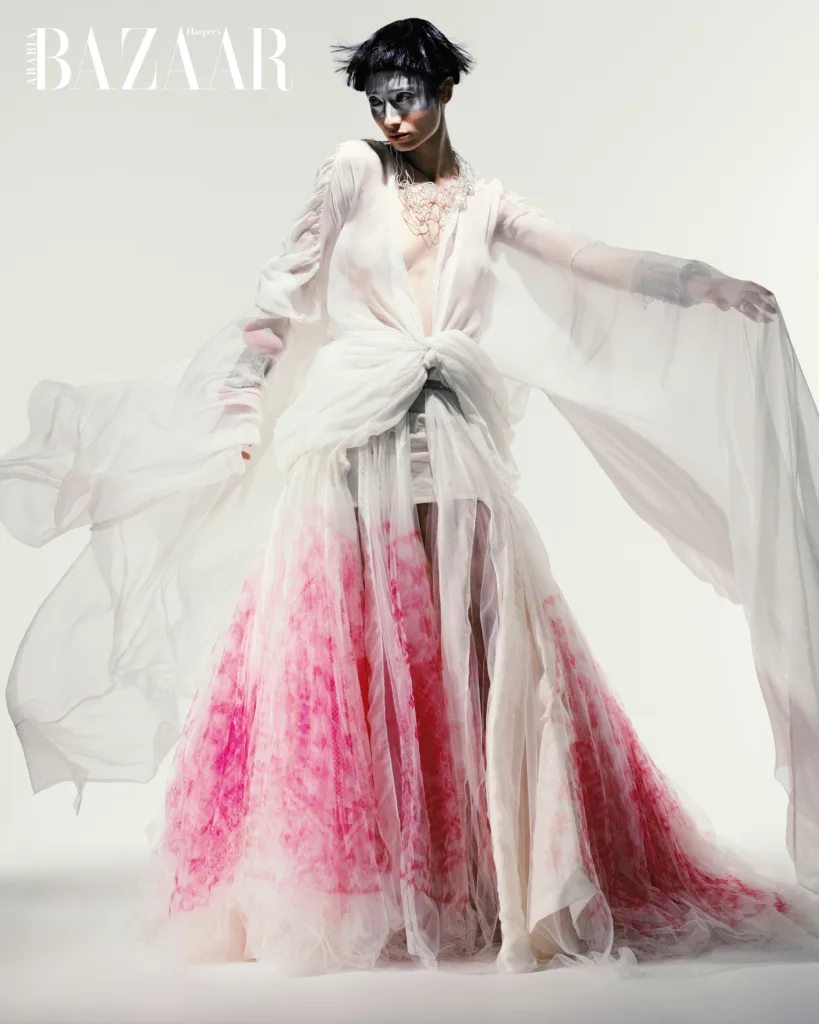
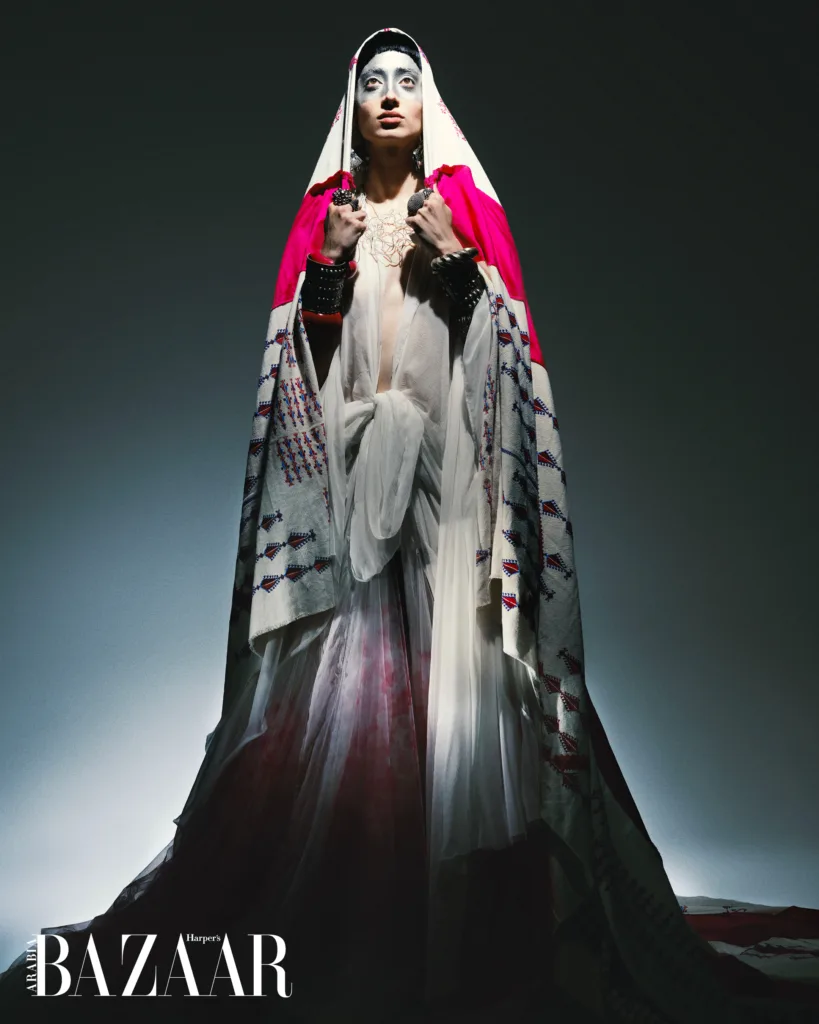
One of the most powerful pieces in the collection is the final look – a magenta embroidered shawl layered over sheer tulle. The tatreez embroidery was created over three months by eight Palestinian women working across villages. It was very important to him to work with artisans he had previously collaborated with in Ramallah, whose skills shaped his understanding of archival research and garment construction. “From a distance, it looks like a print, but every cross-stitch is done by hand, with each artisan adding their interpretation. I wanted to showcase my country and its craftsmanship.” With conventional shipping impossible, the fabric travelled much like its people do: across checkpoints, under scrutiny and by hand. He adds that since Palestine is not recognised as a country in shipping, his garments had a lengthy journey – from Egypt to Amman and then London. “The embroidery went through what we go through,” says Ayham. “It was searched and questioned.”
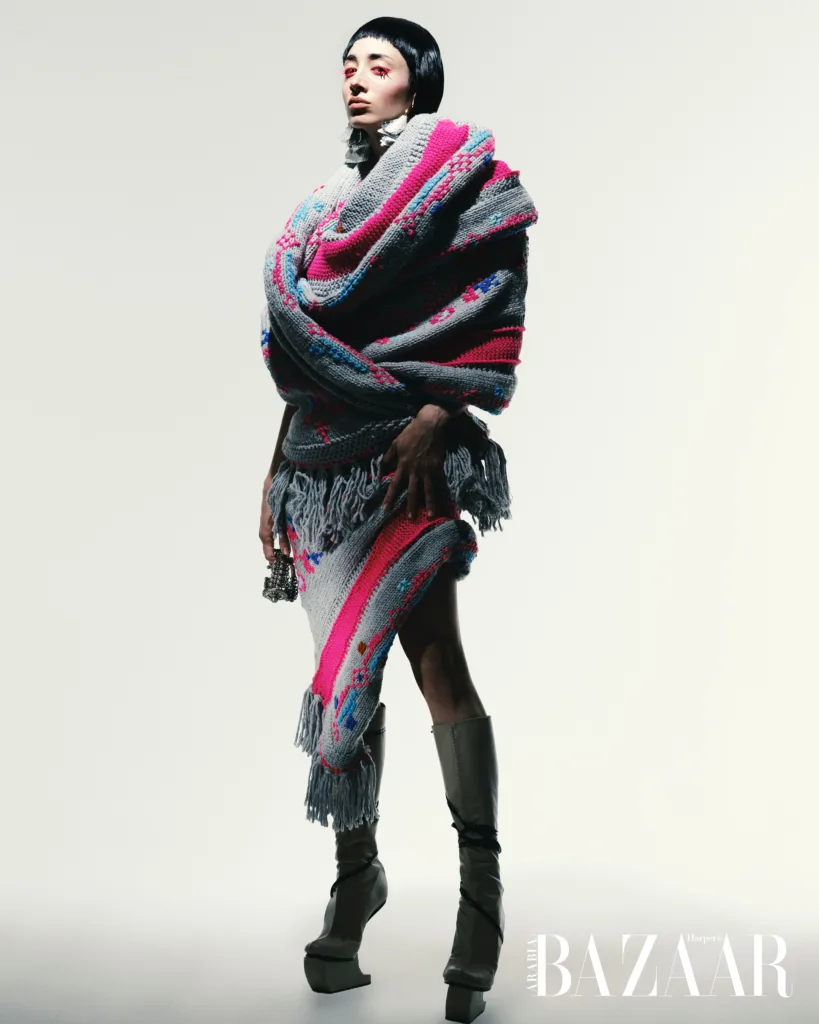
Another shawl, hand-knit by his mother in Ramallah, adds a further layer of emotional depth to the collection. Made from locally sourced wool, it features vivid magenta stripes inspired by the majdalawi thobe, embroidered with motifs of dancing birds and bullet flowers from Gaza. The majdal weave – a striped silk once made in the Palestinian town of al-Majdal before its workshops were erased in 1948 – was a defining narrative through the collection. And one of the heaviest pieces – both physically and metaphorically – was a conceptual overlay created out of half a million rubber bands – an ode to the slingshots children in Palestine once used during uprisings. “It smells like rubber. It smells like protest. When you wear it, it weighs over 15 kilos – your veins pop. But that’s the point. It’s not meant to be comfortable. It’s a performance,” he elaborates.
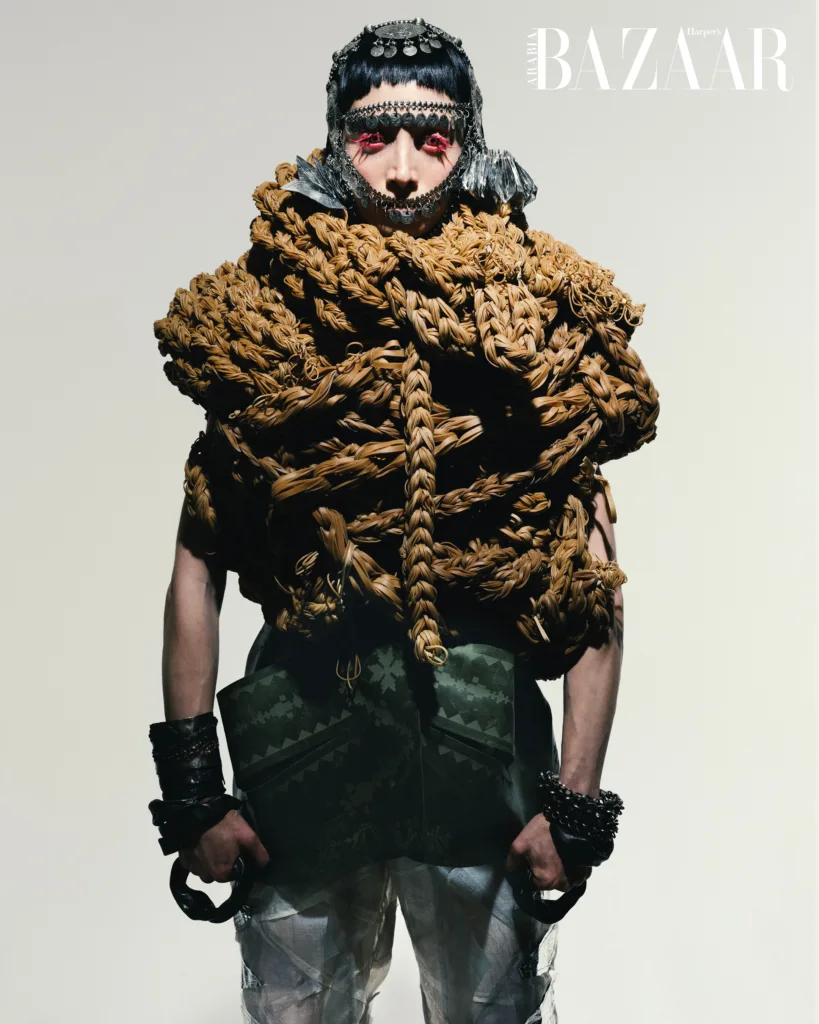
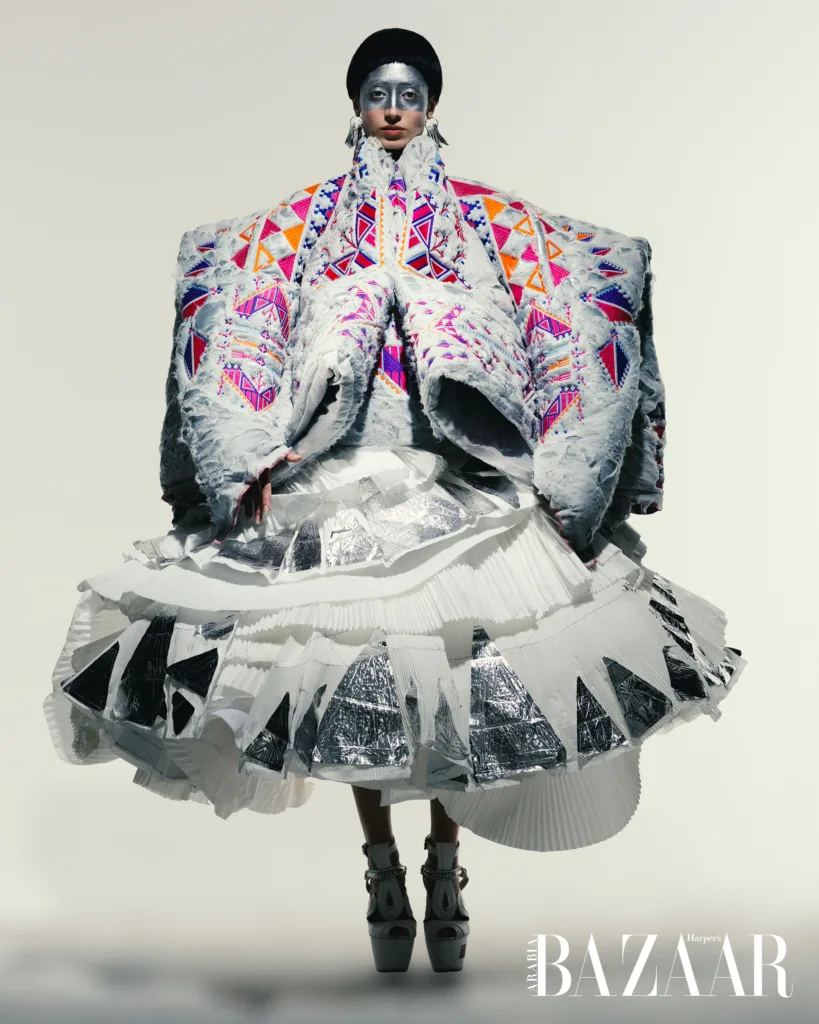
Another standout is the puffer jacket, inspired by press vests worn by journalists in conflict zones. Its exaggerated volume and rectangular cut are shaped by embroidery from Gaza, which forces the fabric to drape in unexpected ways. “The press vest is meant to protect, yet in Palestine it’s still targeted. I exaggerated its proportions to give it a majestic presence – like a warrior that’s been hit many times.” Beneath the jacket was a paper-thin skirt that moved with the faintest shift of air, its fragility a deliberate counterpoint to the bulk above. The pairing captured one of the collection’s most powerful themes: that strength and vulnerability can coexist. Metallic silver triangles embossed on the skirt spoke of centuries-old amulets worn for protection.
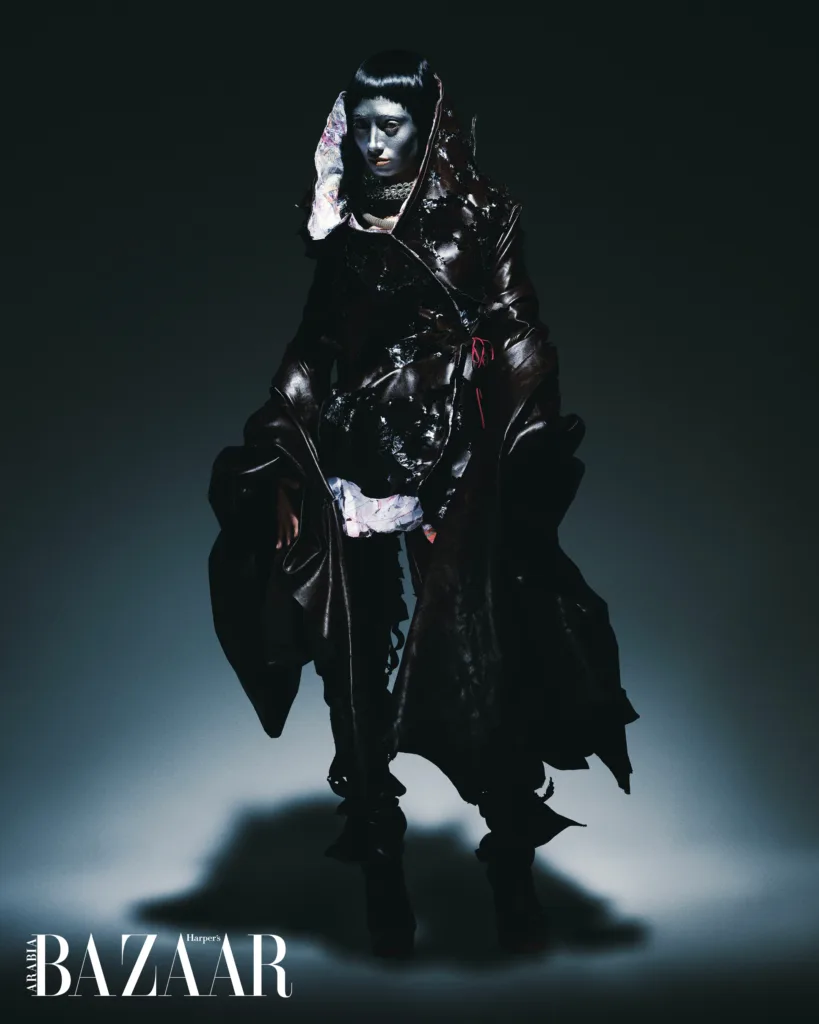
Despite the political nature of his collection, Ayham believes he struck a balance. “I had fashion, Palestine, politics, creativity and performance,” he says. The designer was also the recipient of the NET-A-PORTER and MR PORTER Education Fund in partnership with the British Fashion Council, which will allow him to explore another collection. The longterm goal? To look for investors and partners who believe in his vision. “I want to work with people ready to respond to what’s happening in the world, and to provoke change beautifully through fashion.”
Photography by Niklas Haze. Styling by Alia Aluli. Talent: Sharon Rose. Make-up:
Hadeel Tal. Hair: Ernesto Montenovo
From Harper’s Bazaar Arabia September 2025 Issue