
Bazaar Arabia Dives Into L’École Middle East’s Poetry Of Birds Exhibition, And The Rich History Behind Its Curation
We take a flight through the history and symbolism of birds in jewellery, guided by Guillaume Glorieux, Director of Education and Research, as Lécole, School of Jewellery Arts unveils its Poetry of Birds exhibition in Dubai
In 1940, as Europe was in the throes of some of the darkest days of the Second World War, the Duchess of Windsor appeared beaming in Bermuda beside her beau. On the lapel of her black-trimmed white blazer perched a large flamingo brooch, its feathers blazing with rubies, emeralds, sapphires and diamonds, one leg raised coquettishly – almost a victory salute. It became one of her signature pieces: bold, striking, and as impossible to ignore as its wearer.
Fittingly, whether by accident or design, the bird was an apt emblem for the twice-divorced American who crossed the Atlantic by ocean liner and captured the heart of King Edward VIII, prompting his abdication to marry her. In myth and popular culture, birds are often regarded as bearers of omens, both good and ill. The dove, associated with Venus, the goddess of beauty and love, heralds harmony. Yet birds once carried messages of battles, and the vulture always shadowed Mars, the god of war. The Windsors’ love story likewise drew a relentless glare of attention, oscillating between fascination and censure.
However, as one of the era’s defining style influencers, the Duchess helped throw a spotlight on birds as a jewellery motif. Her flamingo brooch ranks, alongside Van Cleef & Arpels’ sinuous golden Bird of Paradise, among the most celebrated creations of its kind. But the bird – both motif and muse – has far deeper roots in the history of jewellery-making, reaching back to the days when coloured feathers themselves adorned body, hair and dress, and when plumage, pinned or woven into adornment, signalled style and status. Across centuries and cultures, avian forms have migrated from nature to the jewellery atelier, retaining their symbolic significance while both inspiring and challenging goldsmithing techniques.
The human fascination with the only creatures that can lift themselves from Earth and float into the infinity of the skies has ebbed and surged according to taste and time, yet never
disappeared. It persists because birds reconcile opposites: they are near and far, domestic and wild, delicate and formidable. Their silhouettes cut clean lines against the sky, while their plumage is a riot of colour and texture. This intrinsic duality keeps the avian motif alive and intriguing, renewing its meaning with each generation of makers and wearers. And so much the better, because birds lend themselves perfectly to testing and showcasing the goldsmith’s skills.
They can be portrayed in an infinity of poses – perched on a branch, mid-flight, wings unfurled, or wings folded in repose – with endless variations of tail, crest, beak and eye. A jeweller may focus on a single detail – a feather vane, the fan of a tail, the iridescent shimmer of a throat – or abstract the whole into line and volume. For jewellers, the colour palette and texture is irresistible: feathers translated into gemstones, enamel or
guilloché gold; wings caught mid-flight in diamonds; a body distilled to a single cabochon sapphire, opal or tourmaline. Few motifs offer such generous scope for technical bravura
and artistic imagination.
Birds became especially fashionable in jewellery between 1850 and 1960, when advances in science and art fed a collective fascination with ornithology. “Fuelled by the developing practice of travel, which allowed individuals to discover all kinds of exotic birds alongside the more accessible varieties found in the French countryside and forests, the interest in different species of birds was greatly enriched by scientific progress,” explains Guillaume Glorieux, Director of Education and Research at L’ÉCOLE, School of Jewelry Arts. Naturalists such as John James Audubon painted life-size portraits of exotic species, while taxidermy “bird paradises” – glass domes filled with jewel-toned birds perched on tiny branches, graced aristocrats’ salons from Paris to St Petersburg.
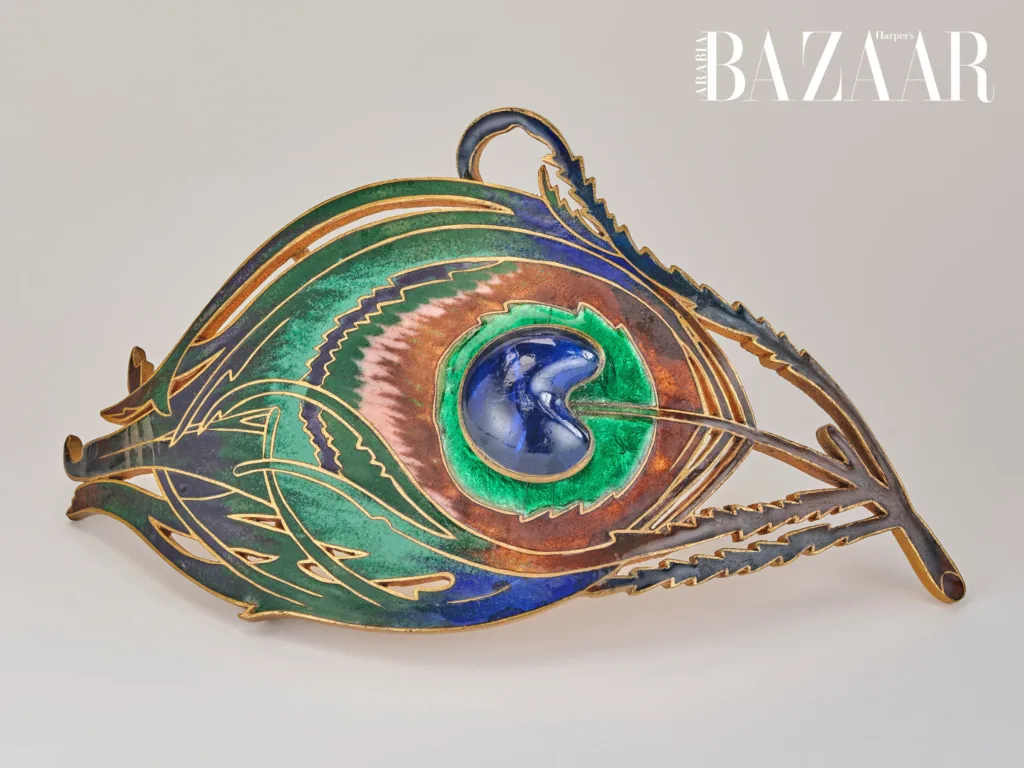
This avian craze migrated from books, art and science to the jeweller’s bench, bringing with it the details of artistic and scientific research that also found their way in jewellery-making. “At that time jewellers made it a favourite motif in their creations – mainly in brooches, but also in pendants and rings – with the greatest inventiveness,” says Guillaume. Mellerio presented a daring peacock-feather brooch at the 1867 Paris Universal Exposition, its sapphire “eye” haloed by concentric rows of emeralds, rubies and diamonds was a sensation. The piece so captivated Empress Eugénie, the wife of the French Emperor Napoleon III, that she commissioned another for herself, cementing the feather’s prestige.
Birds Take Flight With Art Nouveau
By the 1890s, birds took on a more sinuous, sensual form. Art Nouveau swept Paris, and jewellers like René Lalique, Henri Vever and Lucien Gautrait found in avian motifs the perfect subject for a whimsical style brimming with curves, counter curves, effervescence and colour that challenged received notions of structure and balanced design. “The bird offered creators a remarkable formal repertoire, and they focused on the representation of the body, plumage and the bird’s movements by playing on the contrasts of colours, formal variations and the lines evocative of Synthetism,” explains Guillaume. “The research and experimentation conducted by jewellers reflected the overall evolution of the decorative arts, from the mid-19th Century to the mid-20th Century, vacillating between naturalism and stylisation.”
In this era, the peacock reigned supreme. Its iridescent tail feathers became canvases for plique-à-jour enamel, shimmering like stained glass in blues, greens and purples. Lalique, ever the poet of jewellery, imagined peacock pendants flickering with multicoloured opals and their bewitching translucencies. At the same time, Japonisme brought the crane – an emblem of longevity – into the jewellery world. It’s elegant silhouette appeared in brooches and pendants, marrying Western craftsmanship with Eastern symbolism and restraint.
With the arrival of Art Deco in the 1920s, birds reemerged in sharper, angular lines. “By then the bird was one of the most represented animals by jewellers, and the motif fitted the new
esthetic canons and inserted itself into the movement’s decorative vocabulary.” says Guillaume. Stylised swallows and storks soared across platinum brooches; their triangular wings set with baguette-cut diamonds. Jewellers such as Van Cleef & Arpels, Boucheron and Mauboussin distilled nature into elegant, sleek silhouettes. The look was modern, cosmopolitan and liberating. Just as the Jazz Age embraced skyscrapers and speed, jewellery transformed birds into emblems of dynamism. Birds became not only metaphors for freedom but also reflections of speed, as aviation, automobiles and ocean liners accelerated the movement of people and goods – making everyone feel like birds crisscrossing the globe at whim.
During the Second World War, avian jewellery took on an overtly political role. In German-occupied Paris, Jeanne Toussaint – Cartier’s formidable creative director – collaborated with designer Peter Lemarchand on the now-legendary “caged bird” brooches. In one version, a brightly feathered bird languished behind golden bars, a discreet but defiant protest against Nazi rule. After France was liberated, Cartier released the same design again, this time with the cage door flung open, the bird emerging triumphant.
Elsewhere, Juliette Moutard at Boivin designed eagles as emblems of strength and, later, roosters, an animal often associated with French pride. Van Cleef & Arpels created doves – known as message-carriers – bearing olive branches, heralds of peace in a battered world. It was a protest in bejewelled form, with jewels that were no longer only about beauty, but also as wearable messages of resistance and hope.
Postwar Dreams: Birds of Fantasies
The optimism of the postwar years exploded in colour and informs that defied rigid geometry, fully embracing newly found freedoms. Birds of paradise – with their grand plumage and sweeping tails – became the stars of brooches by Van Cleef & Arpels, Cartier and Mauboussin. “Pierre Sterlé was one of the most creative in the field, and the clean lines of his birds tended towards abstraction,” explains Guillaume. Pierre was in fact called the “couturier of jewellery,” for his unique ability to make jewels look as supple and light as fabric. His birds were modern sculptures: large, kinetic brooches with gemstone bodies and wings of finely worked gold or diamond pavé, blurring the lines between art and nature.
Flying Forwards
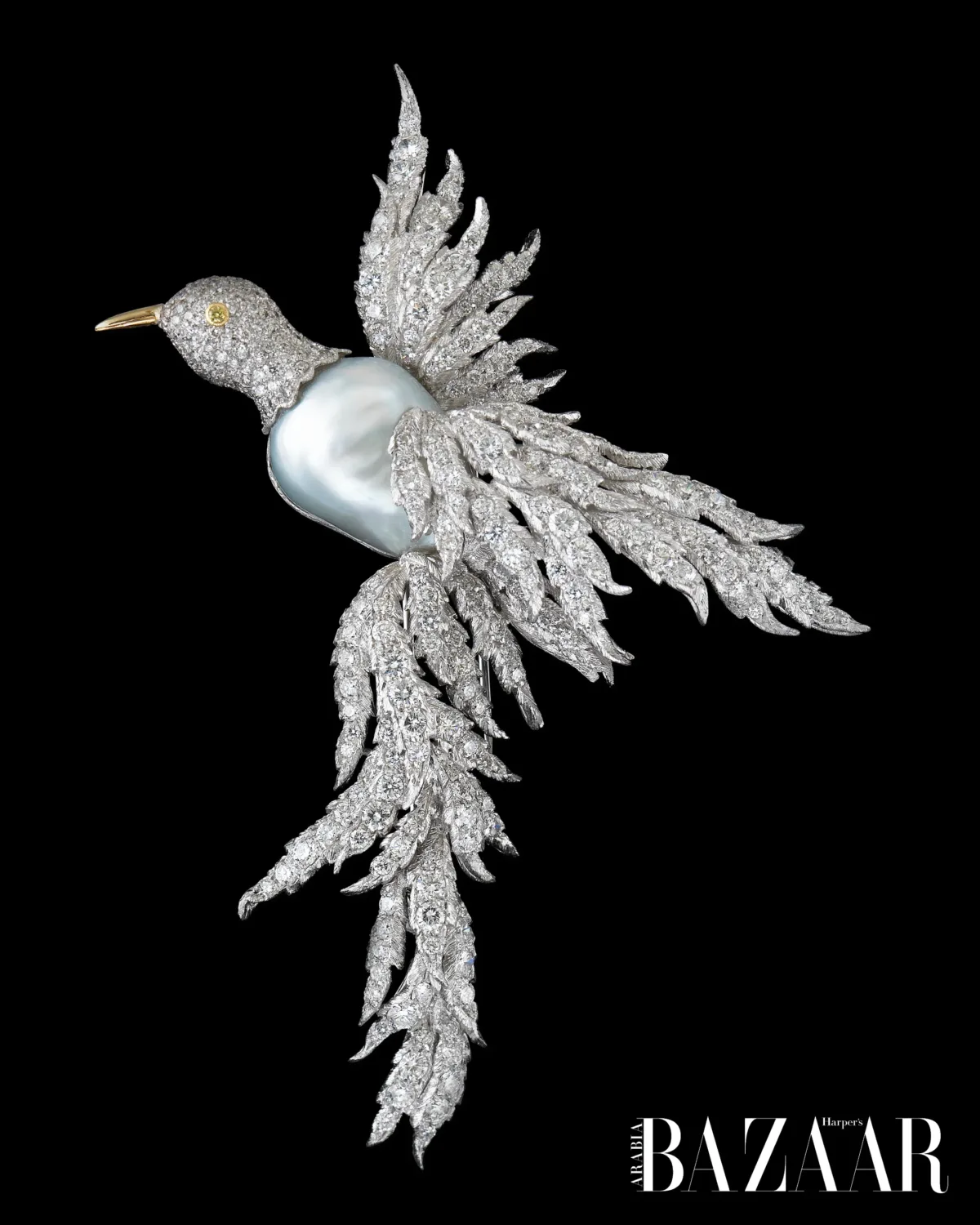
The fascination with birds has never truly waned. Buccellati has revived the motif with delicate birds of paradise in richly textured gold, while Jean Schlumberger’s vivid imagination, where flora, fauna and celestial motifs collided and coalesced, birthed fantastical creatures like Bird on a Rock. Vaguely inspired by the oiseau de paradis, Schlumberger’s bird defies zoological classification with feathers that sparkle like the trail
of a comet – an invitation to look up and dream, to reach for the limitless possibilities. The piece endures as a totem of wonder, bridging whimsy and high craft with audacious ease.
From haute joaillerie to couture, avian imagery remains synonymous with fantasy and freedom. In an era of global travel, migration and climate awareness, the bird is a poignant
reminder of human fragility and resilience, our collective fascination with beauty and wonder, and our eternal search to dream big. “The bird in jewellery seduces via the poetic universe it creates,” says Guillaume. “It reconciles the real and the imaginary, the physical world of nature and the spirit.”
Poetry of Birds
L’ÉCOLE Middle East, School of Jewellery Arts, supported by Van Cleef & Arpels, has curated an exhibition titled Poetry of Birds that runs until April 25, 2026. It explores the timeless symbolism of birds in arts, poetry, and jewellery, focusing on the dialogue between 19th and 20th Century Western jewellery and Islamic arts, with poetry as the common thread; lecolevancleefarpels.com
Lead Image Credits: One of the key pieces in the Poetry of Birds exhibition is this Jean Schlumberger for Tiffany&Co. Bird on a Rock brooch, featuring a large cultured pearl body with its wings and tail set with diamonds
Imagery Supplied
From the Harper’s Bazaar Arabia December 2025 Issue