
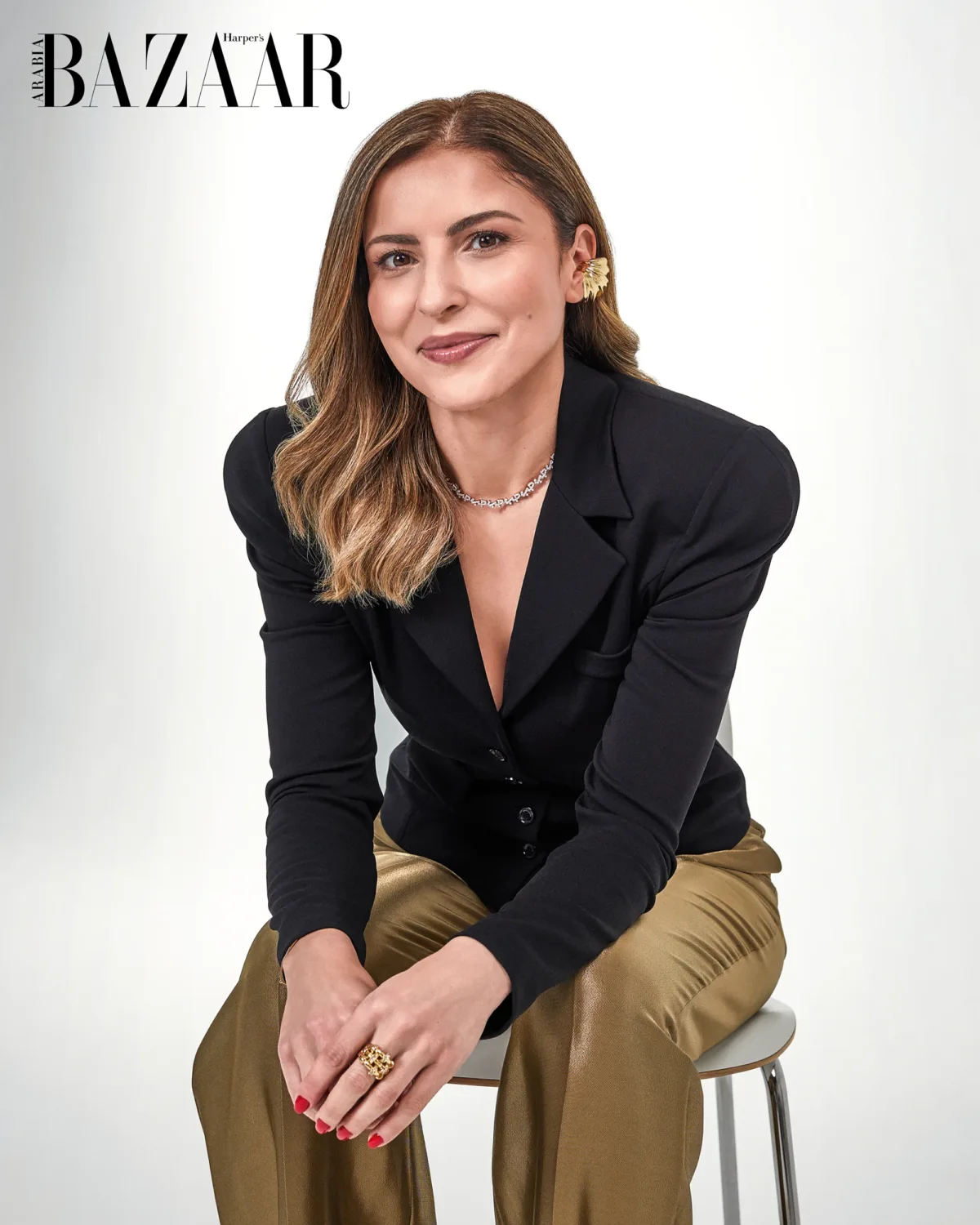
CellSave Arabia: How Co-Founder Sarah-Al-Hajali Is Pioneering Stem Cell Technology In The Middle East

Sarah-Al-Hajali, co-founder and CEO of CellSave Arabia is determined to redefine the medicine of tomorrow
Sarah’s story begins far from Dubai, where she is currently firmly ensconced. “My mother is Romanian,” she says, “and my parents immigrated to Sweden, so that’s where I grew up.” A childhood in Scandinavia instilled in her both discipline and curiosity – two qualities that would later define her leadership style. “It was a beautiful upbringing,” she says, “but I always felt that I wanted to work somewhere where things were still being built.”
That search led her, during her master’s degree, to Abu Dhabi for a research project. “I fell in love instantly – with the region, the people, the pace of growth,” she tells us. After returning home to complete her studies, she moved back to the UAE to pursue what she describes as “a future full of possibilities.”
Her first role was at the Centre for Arab Genomic Studies, which is closely linked to the Sheikh Hamdan Award for Medical Sciences in Dubai. This would be the initial step in igniting her calling; “We were working on genetic diseases that are prevalent in the region, like thalassemia,” she explains. “One in four people here are carriers. I met so many children who needed regular blood transfusions just to stay alive.” When she discovered that one of the most promising treatments for such blood disorders involved stem cells, her path became clear.
In 2005, long before regenerative medicine became a wellness buzzword, Sarah co-founded CellSave Arabia. “We were the first facility in the region licensed to provide stem cell storage and services,” she says. “At the time, the rest of the world was probably ten years ahead, but the UAE has always had this spirit of catching up quickly.”
There were of course challenges at first, with her thinking perhaps being ahead of its time. “I think I was too young and too ambitious,” she laughs. “Back then, Dubai was focused on
building the biggest and the best in architecture and infrastructure – not necessarily in biotech. But I was lucky to meet investors from Saudi Arabia who believed in the vision.” Fast forward twenty years, now CellSave has evolved into a regional leader, serving families across the Middle East with expansion plans into the United States. “Usually, it’s companies from abroad that open here,” she notes proudly. “For us, it was the other way around. We started in the UAE, and now we’re expanding globally.”
Unlocking Potential
For the uninitiated, this subject can seem complicated – and that’s why there’s an aura of suspicion associated with it. Sarah, ever the scientist, makes it accessible: “Stem cells are the building blocks of life. They have this unique ability to become any type of cell in the body and to repair damaged tissue. When you think about it, that’s the essence of healing.”
Her facility focuses on collecting and storing stem cells from umbilical cord blood and placental tissue – cells that are, “as young and as potent as you can get.” Stored properly, the argument is that they can be used for treatments decades later, not just for the child but often for parents and siblings too. Over the years, Sarah’s witnessed stories that could make even the most hardened naysayer believe in miracles. “I’ll never forget a little girl with cerebral palsy,” she recalls.
“She left for treatment in the U.S. in a wheelchair and came back walking. Not perfectly, but walking. That kind of progress – there’s no price you can put on it.” She mentions another family whose child with thalassemia now lives disease-free after a stem-cell transplant. “You can’t help but be moved by those moments. They remind me why I started this.”
For Sarah, progress in regenerative medicine must go hand in hand with public understanding. “Education is everything,” she says. “There’s still so much misinformation – people thinking it’s unethical or, on the other extreme, that it’s a miracle cure for everything. The truth lies in between.” In the U.S., doctors are legally required to inform expectant parents about their options for cord blood storage or donation. “That’s my dream for this region,” she says. “That every parent, before giving birth, knows what stem cells are and what they could mean for their family’s future.”
Female First
Behind CellSave’s cutting-edge technology lies a workforce that is, unusually for a STEM-focused enterprise, predominantly female. “Our lab is full of women,” Sarah says. “It wasn’t a conscious quota decision. I just wanted to create a place where women in science could thrive.” She is quick to add that the UAE’s ecosystem has been instrumental to her success. “Here, women are supported. The leadership has created an environment where we can pursue ambitious careers without being limited by gender. I’m proud to be part of that
story.” As a mother of three, she speaks candidly about balancing ambition with motherhood. “I built the company while having my children,” she says. “I was literally in labour, on the phone making sure things were running smoothly at the lab.” She laughs, thinking back. “I think I was back at work two weeks later. Maybe that’s my secret to staying young.”
Looking Ahead
Today, CellSave Arabia is poised for its next chapter: expansion into Saudi Arabia and deeper collaborations with global research institutions. “The demand has doubled in the past three years,” Sarah notes. “People are more aware now. They understand that by storing stem cells, they’re not just thinking about today – they’re investing in their family’s future.”
Photography: Efraim Evidor. Styling: Imogene Legrand
From Harper’s Bazaar Arabia’s November 2025 Issue.
