
Are Investment Purchases Now Made With The Heart, Rather Than Head?
Our anonymous industry insider has witnessed every heirloom inheritance, and every ‘investment’ claim imaginable in the GCC… and what happens to it five years later. Muna Mire asks if emotionally intelligent jewels are the smart buy?
Muna Mire (MM): I think we’ve ruined the word ‘investment’. It used to mean foresight. Now it means, “I want permission to buy something expensive.”
The Insider (INS): That’s not untrue. But I also think we’ve romanticised the alternative. People say “I’m buying for memory,” and then they buy a piece they don’t even like that much, because the occasion is big and the pressure is bigger.
MM: Fair. But I’ll still argue that jewellery is the most honest object we own. You can wear it through seasons of your life. It sits on the body when nothing else feels stable. In this region, especially around Ramadan, Eid, weddings, births, promotions, it’s not just adornment, it’s how time is marked…
INS: I agree with that, but I’ll add something slightly less poetic. In the Middle East, jewellery is also a social language. It says “I showed up.” It says “I honoured you.” It says “I understand what this moment costs.” That’s exactly why people should stop calling every emotional purchase an investment. Emotional value is real. It just isn’t resale value.
MM: You’re the one who wants to separate the two.
INS: Not to kill the romance. If you buy a piece because it makes you feel something, own that. But don’t strap a finance label on it as a coping mechanism, A investment piece has demand beyond your story.
MM: Demand is fickle. It’s trend, it’s celebrity, it’s what’s ‘correct’ this year. I’ve seen women panic-sell pieces that were bought with genuine joy because the internet decided they were over.
INS: And I’ve seen women insist something is timeless because it was expensive, then quietly stop wearing it because it doesn’t fit their life. Timelessness is not a price point. It’s behaviour. It’s how often you reach for the piece, how well it survives wear, and whether it still looks intelligent when the novelty wears off.
MM: So what do you consider an investment, truly?
INS: Demand, durability and recognisability. It might be boring, but this is the truth. Not necessarily a logo, but a clear signature. The pieces that hold value tend to be the ones that can be authenticated easily, serviced easily, and understood instantly. If it’s too complicated to explain, it’s usually too complicated to resell.
MM: That sounds like you want women to buy only the ‘safe’ classics.
INS: No. I want women to understand the difference between “I want this” and “this will hold.” You can do both. You can buy a safe anchor and then buy something wild because you love it. The problem is when the wild piece is justified as the anchor.
MM: A useful way to put it. Anchor versus appetite.
INS: Exactly. And Ramadan or Eid is the time where this confusion peaks. The intention is generous, the emotions are heightened, and gifting culture turns jewellery into a love letter. Beautiful. But it also means people are making bigger purchases, faster, sometimes with less clarity. The smartest gifting is still emotional, but it’s emotionally intelligent.
MM: Define emotionally intelligent in jewellery terms.
INS: It means you’re buying for the person’s real life, not for a fantasy version of them. You’re thinking about their daily wardrobe, their habits, how they move. You’re choosing pieces that can be worn often, not only displayed. The most meaningful gifts are usually the ones that become everyday. Not because they are small, but because they are usable.
MM: I agree with that. The pieces that become heirlooms aren’t always the biggest stones. They’re the ones that were present. The bracelet that was worn through a divorce and then through a new beginning. The earrings that showed up at every family dinner.
INS: Now we’re aligned. Because that is where emotional value and investment value can overlap, when a piece is loved enough to be worn, and strong enough to survive. Condition matters. A piece you wear is a piece you risk. But if it’s made well, it can handle a life and still hold value.
MM: So we agree the new investment is emotional, but only if we’re honest about what that means.
INS: Yes. Emotional investment is not “I felt something in the boutique.” It’s “I chose a piece that will sit inside my life.” And if you want the piece to have financial resilience too, you choose a category that behaves well over time, you keep your documents, you service it, and you don’t confuse novelty with value.
MM: And you allow yourself joy.
INS: Always. I’m not anti-joy. I’m anti-self-deception. If you want romance, buy romance. If you want an investment, buy demand. If you want both, buy the piece that can hold a story and still hold its shape.
MM: That might be the most useful line in the whole argument.
INS: Good. Because the point isn’t to turn jewellery into a spreadsheet. The point is to let women buy beautifully, and wisely, and without needing to justify beauty as something else.
MM: Especially during the month of Ramadan. When gifting is not just generous, it’s symbolic. It’s a way of saying, “I see you.”
INS: Then give the gift that lasts. Not because it’s heavy, not because it’s loud, but because it’s right.
MM: Right is the new rare.
INS: Right is the real luxury.
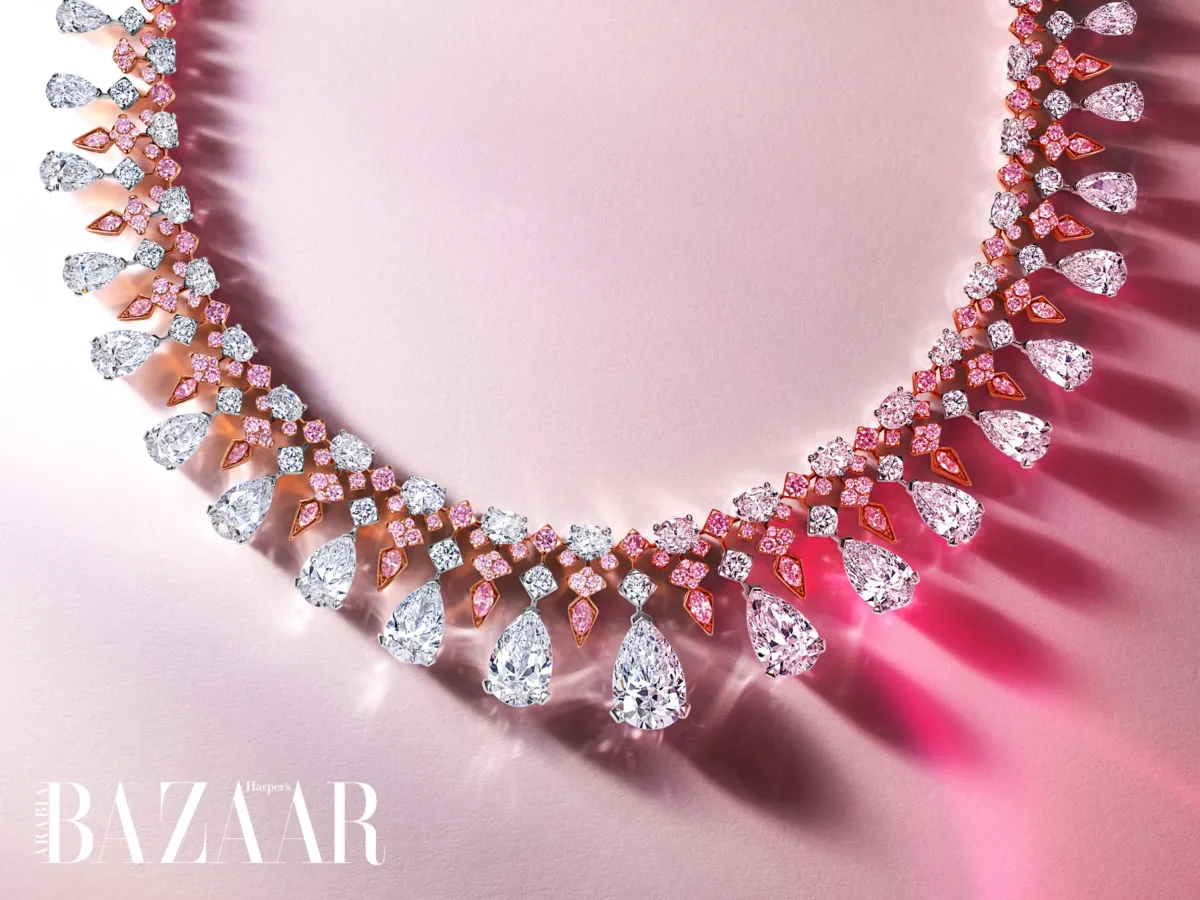
Lead Image Credits: Harmonia Necklace in White and Rose Gold with Pink Diamonds, POA, David Morris High Jewellery
Note: This content was created and printed prior to February 28, 2026
From the Harper’s Bazaar Arabia March 2026 issue