
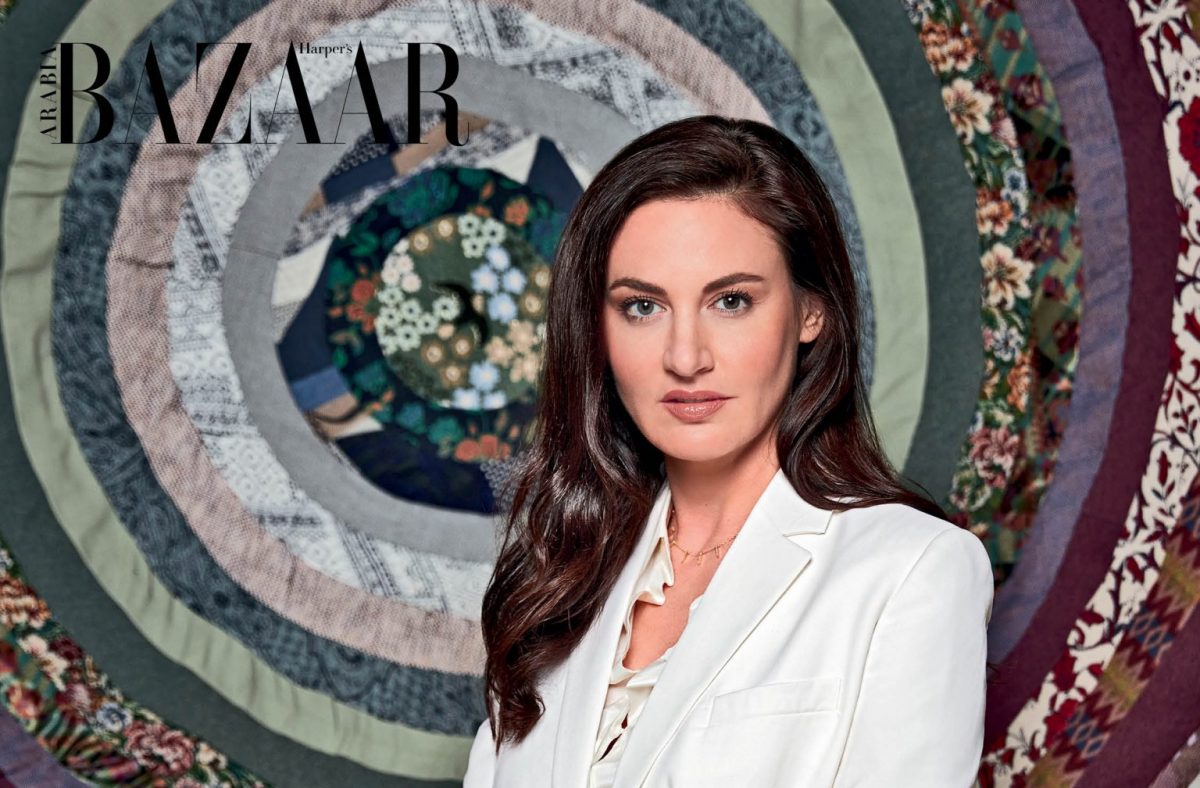
Hadley Gamble on Social Change, Sleep Deprivation and How She’s Still Mastering The Dynamics of a Region in Constant Evolution
The Dubai-based TV journalist has her fair share of stories. Having interviewed everyone from Putin to the Pope, it was her turn in the hot seat – here in our latest issue…
In a rare moment, in which the news business isn’t looking to her to unpack complex energy dynamics or election politics, CNBC News anchor Hadley Gamble is carving out some rare ‘me’ time for herself, while sipping back to back cups of coffee. Her famously long, dark mane of Disney princess hair is in a messy bun, her Fellini-eque face is washed clean after a workout and her eyes are tired yet alight as she starts telling stories like a modern-day Nellie Bly.
She reflects on how she came to this region, which just a century ago was home to fisheries and pearl harvesters and today is one the most international, forward-looking business and culture hubs in the world. Driven by her love for producing and writing, Hadley was on the lookout for a foreign posting, so when one came available in Abu Dhabi, she went for it. Dismayed when the head of the foreign desk at a major network told her the GCC wasn’t the “real” Middle East, she knew she had to help the world better understand its importance.
“I realised there was a deep misunderstanding of the Gulf, yet another vacuum or blindspot in how the world sees the Middle East. And over a decade later, we see a MAKING HEADLINES country like the UAE exporting not just investment and creating ‘unicorns’ but also a concept of tolerance that means millions of expats of different origins, faiths and creeds sharing a country,” Hadley points out.

Worldwide, Hadley Gamble is known as a sharp, knowledgeable figure.
Indeed, viewing her as nothing more than just a pretty ‘talking head’ would be a huge tactical error. Just ask Russian President Vladimir Putin, who she put in the hot seat less than a year ago.
After asking the inevitable: “Are you using energy as a weapon?” Putin accused her of being too beautiful to understand him. Undaunted and unabashed, she responded with a natural burst of laughter. “I had just turned 40 and this man was telling me I looked beautiful, instead of answering the question, it made me laugh,” she recounts. Unlike journalism icons like Barbara Walters, for example, who was known for addressing her interviewees with the tone and patience of a fourth grade teacher (and who also interviewed Putin at the start of his presidential career), Hadley is not one to save the hard-hitting questions for last.
Putin went at Hadley full force and she, in turn, faced him with equal intensity. “There’s this element of no fear,” the journalist explains when asked how she maintains her composure during high profile interviews. “I don’t see anyone as more powerful than I am. Once they are in that seat, I have them. Unless they run off the stage, they’re mine,” she adds, noting she was the last Western journalist to interview Putin before his invasion of Ukraine. In response to Putin’s chauvinistic remark, colleagues like David Sheppard, energy editor at the Financial Times, rushed to Twitter to defend Hadley Gamble. He admonished one commentator saying “It’s patronising, it’s sexist and it’s not on… Would he have said the same to a male journalist? No.”
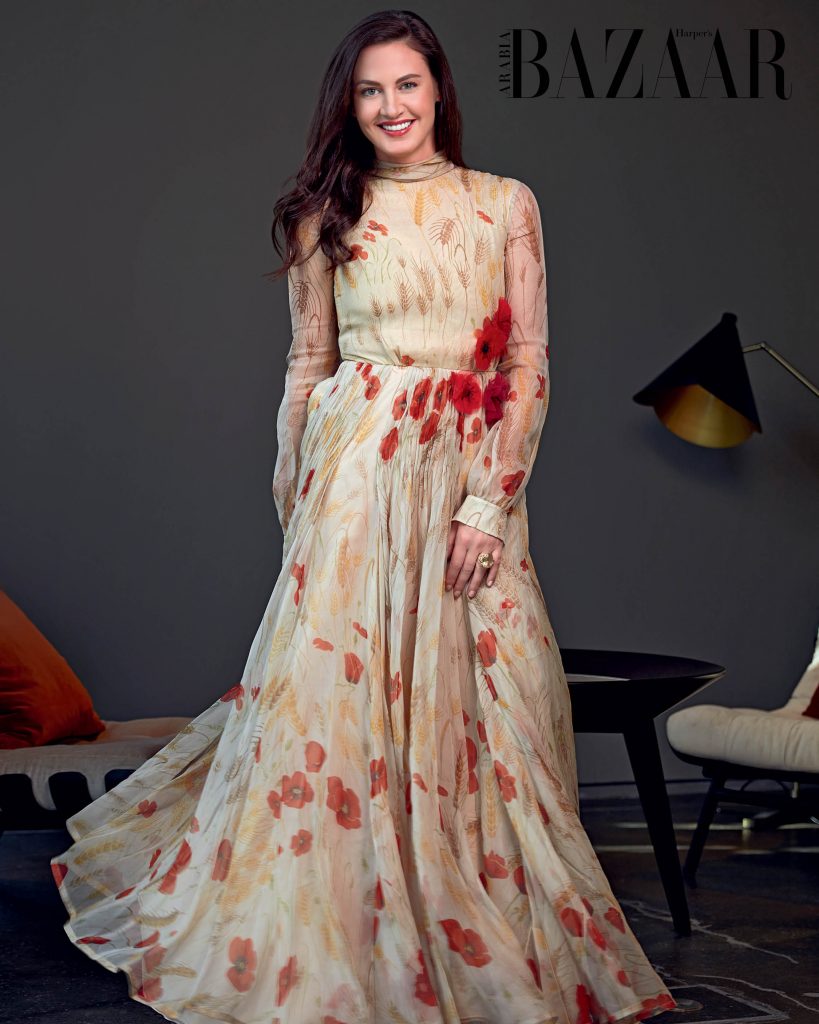
A native of the eastern mountains of Tennessee, Hadley’s father put her to work early, grooming horses from the age of 10. She never ever thought about becoming a journalist, much less living in the Arabian peninsula. “I think maybe shovelling manure probably gave me a very different perspective on all of the stuff that we cover,” says the daughter of a car dealer and a teacher. “This was not the life prescribed to me,” she admits, adding that her family expected her to be a teacher, maybe study law and get married.
“I really got to understand, you know, what money means to people and what making a basic living is… I mean, nobody has a harder life than a farmer, who wakes up at five in the morning to make sure that everything is still alive,” she reflects. After graduation, Hadley began working as a stringer for the Associated Press and Reuters covering the Florida gubernatorial election. Whilst helping an old boyfriend study for the bar, she was introduced to an old flame of his, a booker for Good Morning America who told her about an internship at ABC in the political unit. The meeting proved life-changing. At only 22, Hadley was hired as a production assistant for the World News Tonight with Peter Jennings.
“Watching Peter marking up every script in his show with his famous red crayon, sending them back for revision after revision until they were just right gave me a real sense of the importance of our work. It’s about accountability and trust,” she says.
Since then, Hadley Gamble has risen to a rare post few American journalists have ever attained, evolving with the rapidly changing times impacting this region, the diverse economy and the growing power of women. “I was in the room when [Saudi Crown Prince] Mohammed bin Salman announced his vision for 2030… that [moment] was the key to putting women in the workforce as agents of social change,” she reflects, lauding female-only version of companies like Careem, which allowed women to build careers outside the home.

“They’ve mandated that when it comes to private companies, they want to see an X amount of women on boards. They are actually doing much more and faster [here] than in Western societies in order to make sure that women have a place in the workforce in a real way,” she adds, noting that there are more women with a degree in higher education in the region than there are men. “For me, [being here] for over a decade in this region has been about building relationships. This job is a marathon, not a sprint,” she adds, noting that what she likes about journalism is developing relationships and pursuing the long stories that evolve over time.
On a personal level, often clad in smart, curve-hugging shift dresses and three-inch heels, (“the higher the better”), Hadley admits she is in constant pursuit of one luxury that she has very little of – rest. Working in perhaps one of the most sleep-depriving professions of all, the senior international correspondent recently returned home to Dubai from Davos at the end of May and realised her de-ornamented Christmas tree was still standing in her living room. She reveals that she keeps herself in shape without any sort of solid exercise regimen, pretty much surviving on irregular “at best” eating habits. In February, Hadley moderated a panel of Middle Eastern leaders in Cairo and then jetted off to Munich to tackle the Munich Security Conference where she spoke to Bill Gates, Ursula von der Leyen, Olaf Scholz, Jens Stoltenberg and Peter Maurer. Exhausted, she checked into a wellness spa retreat centre to get herself in order.
“Only bother me if there is a war,” she said at the time. And of course, there was one. At 2am she was awakened by a knock at the door and before she knew it she was up and speaking to Ukraine’s Minister of Foreign Affairs Dmytro Kuleba who told her that the world had changed. “‘This is an attack on the world order,’ were his ominous words,” Hadley Gamble remembers. Then it was time to catch a flight to Moscow where she reported on the plunge of the rouble and energy security, the day after the war began. Hadley and the crew left Russia just two weeks later. “I don’t remember sleeping for about 10 days while we were there,” she recalls.
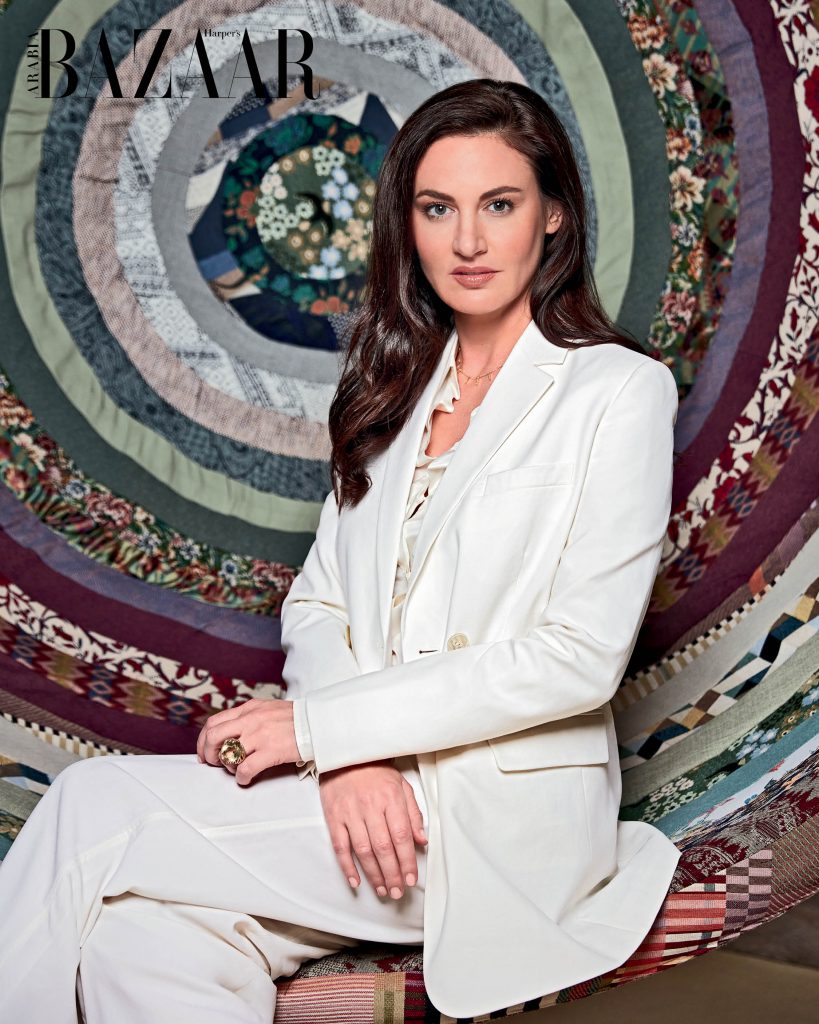
Indeed, Hadley is a treasure trove of stories and scenarios, like when she was invited to a private service with Pope Francis and he asked her to pray for him. And she reported on the 2015 death of Saudi Arabia’s King Abdullah, known as the “great reformer” and who is revered for pushing large-scale education and infrastructure projects in the oil-rich nation.
Looking ahead, Hadley sees journalism as a public service, a noble profession that is constantly under threat. Where funding and short attention spans are the main culprits, she says as she looks towards the future of her industry, one involving social media platforms and second-long roundups tailored to time deficits. “Would you have ever thought that we’d be talking about TikTok as a real medium? I found that social media, especially in our region, is what people are watching. Nobody waits for the 8am morning news,” she ruminates.
As for Hadley, her social life is thriving in the vibrant concrete jungle of Dubai and she considers the forward-looking metropolis her home. A life filled with chasing stories, sleeping on planes and commuting back and forth to the CNBC studios in Abu Dhabi where Capital Connection’s studios are located, makes having a personal life hard, though she is open to meeting someone who shares her same values. “Every relationship teaches you more about yourself and the whole point of living is to grow and become a better, stronger and hopefully, more interesting person. Trust, transparency, kindness, the chutzpah to tell it like it is – even if the truth hurts… and generosity of spirit,” she answers when discussing what she is looking for in a companion.
Whilst Hadley is charting the future of a rapidly changing region, one few Westerners have made it their mission to understand, she is simultaneously writing her own multifaceted history. Hers is an ever-evolving adventure and one that will undoubtedly continue to make headlines.
Photography: Adel Rashid. Styling: Nour Bou Ezz. Make-up: Mabs Khakwani. Stylist’s Assistant: Cristina Burca. Special Thanks To 25hours Hotel One Central
From Harper’s Bazaar Arabia’s July-August 2022 issue.