

Paris Gets a New Cultural Landmark — and It Moves

Cartier’s new Fondation turns architecture itself into part of the exhibition
The first thing that hits you inside the new Fondation Cartier isn’t the art but rather the silence. Not the museum kind, but the focused kind, the kind that makes every step sound sharper against glass. The stillness almost dares you to whisper.
Our group was led straight to a closed-off room inside the main exhibition hall — a box within a box, if you will. The contrast was deliberate. Outside, the building is all light, reflection, and scale; inside, the air was controlled, the lighting warm, the walls opaque. It felt like being inside the brain of the building, about to be told how it thinks.
Béatrice Grenier, the Fondation’s Director of Architecture, spoke about it in her calm, matter-of-fact way. “We had to invent and grapple with new design and heritage,” she said. “Five moveable platforms can be adjusted to different heights… we can open volumes or contract spaces.” She explained how the floors literally rise and fall – a system designed to handle everything from massive sculptures to delicate installations. Rather than a show of engineering, it was a way to give the art room to breathe.
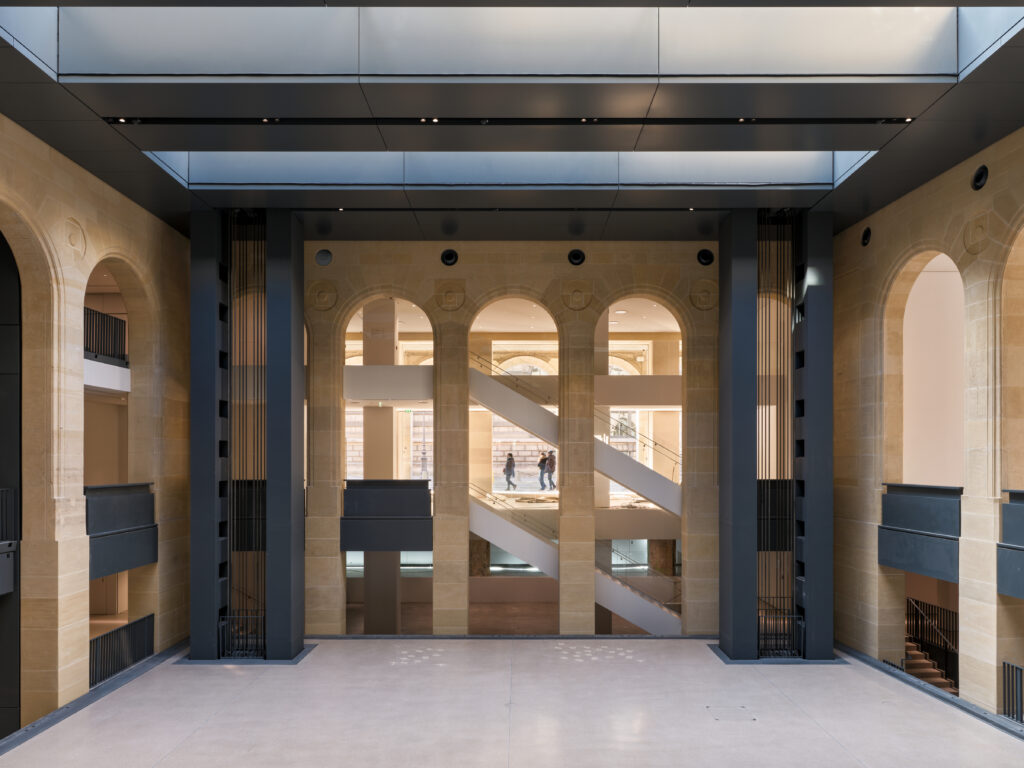
The building itself has a past life or two. The address – 2, Place du Palais-Royal – first opened its doors in 1855 as the Grand Hôtel du Louvre. Later, it became a department store that defined 19th-century Parisian luxury, then a labyrinth of antique dealers and jewellers. Today, the Fondation Cartier takes over, adding another layer to the city’s obsession with reinvention.
Although, let’s be clear: Jean Nouvel’s redesign doesn’t erase that history, it amplifies it. The façade is all glass and reflection, but it doesn’t show off. Depending on where you stand, the outside world bleeds into the walls – trees, cars, passing faces – all becoming part of the space. The city never disappears; it’s absorbed.
And then there’s the exhibition itself – Exposition Générale, a statement in scale if there ever was one. Over 600 works by more than 100 artists fill the Fondation’s open-plan levels. The curation, by Grazia Quaroni and Béatrice Grenier, feels purposeful and unforced.
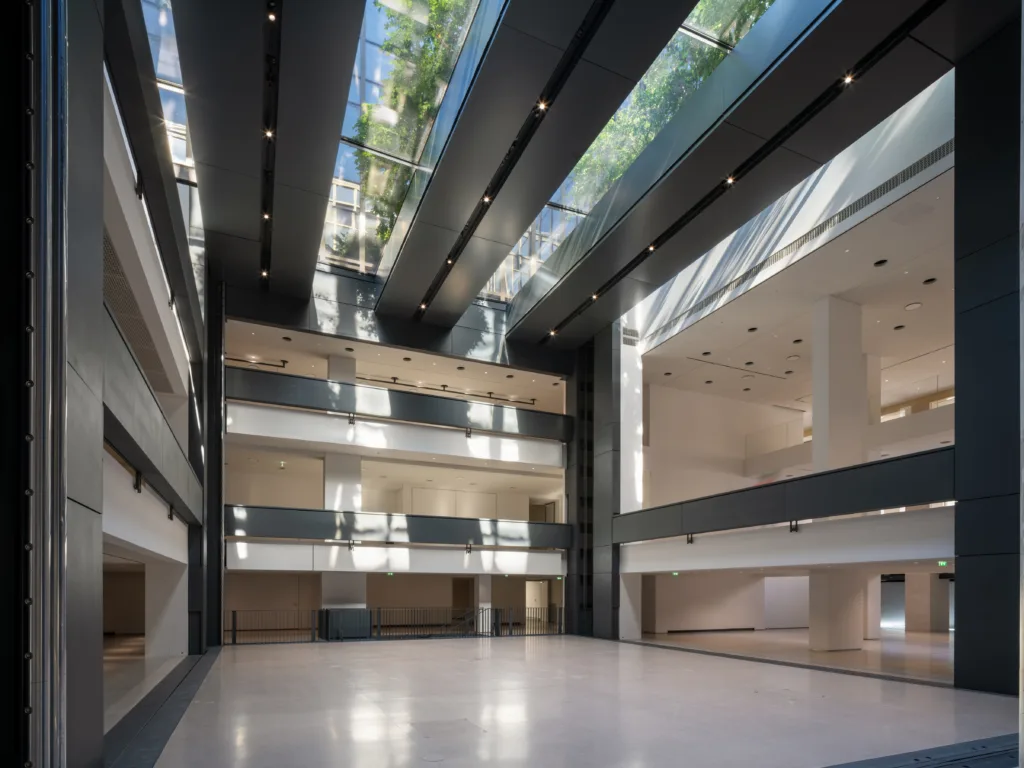
Quaroni put it simply: “Choice is a better word than selection.” She mentioned how the title nods to the building’s department-store past – “a way of showing objects differently.” It’s a smart analogy. The Fondation lets you build a narrative as you go.
Walking through it, you start to understand why the building needed to move.


Right: © Andrea Branzi / Adagp, Paris
And then, quietly tucked away, Patti Smith’s Paris, Etc. – a series of Polaroids from 2008 – stops you with its restraint. They’re small, imperfect, and intimate; a reminder that even in a space built on scale, stillness still wins.
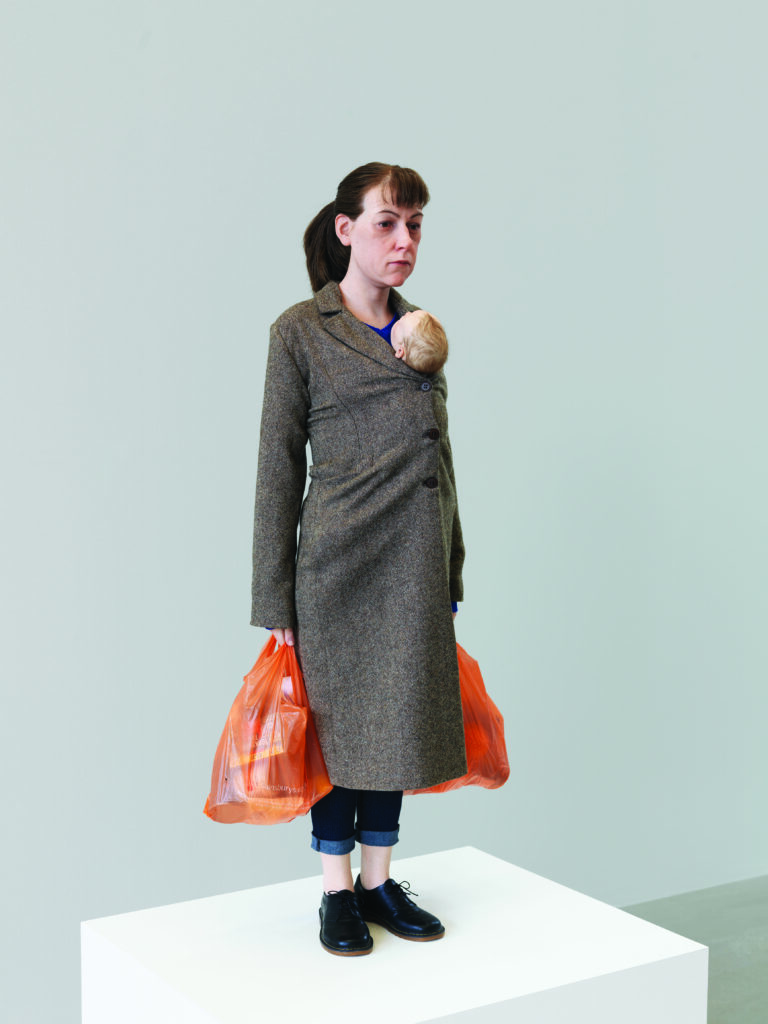
Down another corridor, Ron Mueck’s Woman with Shopping catches you off-guard. She’s small, tired, holding her bags and her baby with the kind of weight you can feel. It’s one of those works that doesn’t shout for attention — it just stays with you, and it still does until today.
Quaroni later mentioned how “some artworks belong to different categories” and how the challenge was finding a rhythm, not a sequence. That feels like the right way to describe the Fondation itself – rhythm, not rules. The layout doesn’t guide you; it trusts you to find your way, up, down, around, and back again. Each turn reveals something new, and sometimes, something you missed the first time.
From certain angles, the reflections fold Paris into the art and you catch a glimpse of a sculpture and a pedestrian in the same frame. Inside and outside blur until you can’t tell which side of the glass you’re on.
Cartier could have made a statement about legacy. Instead, it built something alive with a new Fondation that simply asks you to pay attention.
Images Supplied