
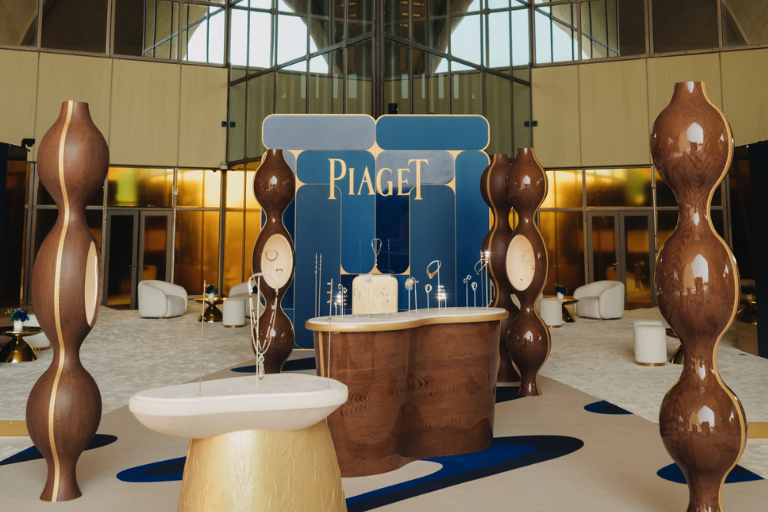
Piaget Unveils ‘Shapes of Extraleganza’ in Abu Dhabi

Piaget redefines what it means to shine
There’s an unmistakable luminosity to Piaget. It’s a Maison where artistry and innovation have long danced in harmony and in Abu Dhabi, that spirit took centre stage as Piaget unveiled Shapes of Extraleganza at Erth, a setting chosen as much for its architectural grace as its sense of heritage. The evening celebrated form and movement through a collection that captured the Maison’s joyful sophistication (elegant, daring, and utterly radiant).
For Cynthia Tabet, Piaget’s Global Product Marketing Director, it’s a house of contrasts – think elegance meets extravagance, precision of watchmaking intertwining with the imagination of high jewellery. Among the pieces unveiled in Abu Dhabi, the Desert Pearl Swinging Sautoir – an exclusive creation in diamonds and mother-of-pearl – pays tribute to the region’s pearl-diving heritage and Piaget’s dialogue with culture.
During a conversation with Harper’s Bazaar Arabia, Tabet shares more about the story behind this design, the Maison’s hidden treasures, and how Shapes of Extraleganza captures the modern woman’s quiet confidence and bold spirit.

You’ve worked with some of the most established Maisons in the world. When you joined Piaget, what did you see that felt truly untapped or underestimated about the brand?
Piaget is full of hidden treasures and can be seen as a niche Maison. It will always be different and is all really about duality: The elegance in the extravagance, the technical expertise of a watchmaker and the creativity of a jeweller because the Piaget family started as watchmaker and then became jeweller. Piaget is joyful, celebrating life and its heritage in the contemporary world.
The title “Shapes of Extraleganza” immediately feels bold. How much of that confidence comes from heritage – and how much comes from knowing today’s client?
Piaget blends tradition and modernity, in a way that its designs remain timeless. Drawing inspiration from the Maison’s innovative 1960s and 1970s designs while incorporating modern elements make the collection feel both vintage and contemporary.

The collection leans heavily on geometry and movement. Do you see structure as a creative limitation or as a way to push design further?
Definitely as a way to push design further. The motto “always do better than necessary” comes from our founder Georges-Édouard Piaget and, to this day, it embodies our core values of excellence and innovation; it gives the artisans the opportunity to explore and to use different technics to achieve pure aesthetic.
There’s an Abu Dhabi-exclusive sautoir that nods to pearl diving and local craftsmanship. How did that process of connecting Piaget’s codes with regional identity actually unfold behind the scenes?
With the Desert Pearl Swinging Sautoir in diamonds and mother-of-pearl, we wanted to craft a jewel specially for Abu Dhabi. We wanted to pay homage by using a material so dear to the UAE; our design studio got inspired by nature, sketched and then our gemmology team sourced the right materials. It is a long process, that involves passion and collaboration.

Many heritage houses are rediscovering their archives. For you, how do you decide what to bring forward versus what to leave in the past?
Historically, we are watchmakers that became jewellers – which means the Maison blends the precision of watchmaking with the creativity of jewellery. The design studio works hand in hand with the artisans and the patrimony team to get their point of view. While going through the archives, some designs appeared very modern, very avant-garde for their time – yet timeless in a sense. Piaget has always been focussing on doing what had never been done before. Now, when we look back, some really great cultural pieces were designed back in the 70’s. When we see the Swinging Sautoir with the trapeze form for example, it was love at second sight for the design team that decided to make it a watch that becomes a jewel on the wrist – the Sixtie.
Piaget has a strong link with art movements of the 1960s and ‘70s – not in a nostalgic sense, but in how it embraced experimentation. What does “experimentation” look like inside a modern luxury house today?
For Piaget, experimentation is key, as we can only achieve greatness by trying and trying. We use old technics at the service of modern designs; we pay homage to artists by implementing their core aesthetics in our pieces in a subtle way. The best example would be the Andy Warhol watch. The relation between Andy Warhol and Yves Piaget was a genuine one.
A photograph exists of Warhol taking a picture of Mr Piaget in Washington and Mr Piaget treasured this portrait ever since. As Andy Warhol was a member of the Piaget society and a fervent client of the Maison, people started to call one of our watches – the so-called Black Tie – the “Andy Warhol watch”, as it was his favorite. Given this authentic connection, it made absolute sense to collaborate with the Andy Warhol Foundation of Visual Arts to explore further, and this is why we launched the ‘Collage’ watch, a subtle homage to Warhol’s auto portrait polaroid.

This event is happening at Erth – a venue that celebrates architecture and legacy. Do you think a setting can influence how people experience jewellery?
I am passionate about architecture, and I strongly believe that a nice setting can influence how people feel at the time they are seeing the collection. When you are surrounded by beauty and harmony, you are in good condition to take it all in and appreciate High Jewellery.
You’ve built a career on understanding both creative language and market logic. How do you ensure those two sides – the artistic and the commercial – actually complement each other instead of competing?
Our creation process is dynamic. We typically analyse targets, trends, our collection, and the market to inform briefs. Simultaneously, we encourage the design team to explore innovative ideas, which can sometimes drive the process, subsequently identifying and integrating the target market. The most important thing is to stay authentic and true to Piaget’s core values.

The Middle East has become a major audience for high jewellery. What do you think makes clients here engage differently with craft and design?
I believe that the Middle East has always appreciated the beauty of crafts, art and jewellery, particularly gold and gemstones. Both at the core of Piaget’s aesthetic, the house of gold and ornamental stones. Abu Dhabi is a premier luxury retail destination, driven by a combination of cultural appreciation, investment value and a thriving event scene. The region is a great place to experience and expose beauty.
When you’re reviewing a new piece for the first time, what’s the one detail that instantly tells you, “this feels Piaget”?
The piece needs to be bold, innovative and wearable.
Images Supplied