
When Everyone Is Visible, Who Becomes Iconic?
Do girls today have role models, or instructions? Yasmina Bitar speaks to arab women about the faces, bodies and moral demands that make up modern iconhood in the internet age…
The Template 2.0
When Farida was 12, Madison Beer’s face presided over at least four of her WhatsApp group chats. “Just a daily reminder that you could be this,” Farida told me.
“This” meant more than beautiful. Madison had “the most insane body”: a 23-inch waist curving into a perfect peach of a bum, filling minuscule denim shorts that, “obviously, in Egypt, we didn’t have”. She drove a Jeep through Calabasas with a chiselled L.A. hunk and made music about boys and break-ups before Farida and her friends had acquired either.
“We wanted to live like her,” Farida said. She called Madison “the bookmark for being a girl.” They saved her to Pinterest and burdened anyone travelling abroad with an order for Victoria’s Secret Pink — “random-ass cups, hats, hoodies, whatever she wore.”
Madison said her workouts were 20-minute YouTube videos. Farida and her friends believed her. They did Blogilates “religiously” behind closed doors, flushing with embarrassment when their mothers barged in and discovered them trying.
One girl lost enough weight to acquire the thigh gap and reached what Farida now calls “the brink of an eating disorder”. When the others asked how, she told them her mother had put her on a diet. They were appalled, admiring and envious in roughly equal measure.
Farida’s mother learned beauty from television too. Cindy Crawford stepping from a red Lamborghini in a white tank and denim cut-offs in the 1992 Pepsi advert remains her “epitome of beauty.” The fixation on denim shorts, it turns out, is hereditary.
Her Arab icon was Sherihan, whose Fawazeer costumes were less outfits than apparitions. A red Fouad Sarkis mermaid gown came with enough feathers to qualify as plumage – other looks survive simply as “a poof and a poof”. Farida’s mother still pulls them up for daughters who, Farida admits, “really don’t care”.
Sherihan was watched in wonder. Madison Beer lived in the girls’ phones, close enough to save, shop and emulate.
“All the Arab icons felt like they were made for my mum,” Farida said. The women Farida’s friends named were almost always white or white- passing. Dark brows, olive skin and fuller lips were welcome; they simply seemed to need an L.A. zip code before becoming universal.
Before long, even Madison Beer no longer felt singular. “She’s one in, like, a hundred girls that are the same vibe,” Farida said. Instagram feeds and TikTok edits returned the same girl with minor alterations until the person she had treated as exceptional became the platform’s house style.
The New Beauty Vocabulary
At 17, I went to Dr Maryam Zamani during my lunch break for nose filler, still in my school blazer and a grey plaid skirt with a jagged hem because I had rolled it up rather than let my mother shorten it. She objected to the skirt but accompanied me and bought me a treat from the café next door.
That afternoon, I discovered iced matcha and the possibility of not hating my side profile, roughly the pinnacle of teenage self-actualisation. A selfie Bella Hadid posted from the Nickelodeon Kids’ Choice Awards supplied the reference. Her nose descended in one clean line. Mine changed with the angle and my mood, encouraged by the folding mirrors on my bathroom vanity, which offered views no emotionally stable person needs to inspect daily.
After the filler, I turned sideways and found that the hook had become a slope. For days, I checked each morning to see whether my old nose had returned. It had not. Filler fades, though not with the urgency I apparently expected.
Years later, I returned to Dr Zamani with a notebook instead of my mother and asked what women were bringing into her clinic. One woman in her twenties opened her phone to dozens of filtered selfies. “She was not showing me photographs of celebrities, but heavily edited versions of herself,” she said. “She wanted surgery to make her unfiltered face resemble the one she saw every day.”
Though “objectively beautiful”, she had studied that version for so long that “her own reflection felt unfamiliar”. The doctor spent most of the consultation asking why she felt she needed an operation.
Patients still arrive with individual faces, but increasingly describe them in what Zamani calls a “new beauty vocabulary”: fox eyes, a snatched jawline, fuller lips. The reference may come from Patrick Ta make-up or FaceApp’s Passion 2 – “the one we all use to give a photograph a little zhuzh,” as one young woman told me.
The Hollywood Reporter rendered the “A-List face” as a woman assembled in parts: Bella Hadid’s nose, Hailey Bieber’s eyes, Angelina Jolie’s lips, Jennifer Lopez’s skin and, apparently, Sydney Sweeney’s breasts. She could have come from anywhere and remained legible as white, tan enough to borrow from several places, white enough never to explain any of them.
I recognised the edit. Our brows, colouring, cheekbones and lips are welcome in the composite. The nose is still usually assigned to the before picture. I had spoken this beauty dialect for years. At 13, I selected a surgeon from the Tatler Beauty Guide, which I read with the seriousness others reserved for textbooks. At 21, when I finally went for a rhinoplasty consultation, I brought my mother and pointed at her face. Bella was the private brief. My mother was the respectable reference.
My mother remembers me returning from school asking, “I want your nose. Why is my nose not like your nose?” I had grown up among blonde, blue-eyed girls with small, straight noses and used hers as proof that another face was available within the family.
My father remembers me sobbing about my crooked nose in the back of a car on the Amalfi Coast while the sea flashed past and he enlisted the driver to stop for gelato. The feature I wanted removed was his too. Only after changing it did I wonder whether I had erased the clearest evidence of the man I loved.
When I asked whether he mourned its disappearance, he answered, “Zero.” Then he laughed. “I’d rather you look like your mum anyway.” I had the rhinoplasty. I liked the result. Knowing where the wish came from did not make me wish for my old nose back. For years, I treated that wish as a London problem. Then Farida described her school in Cairo. One girl in her class had a rhinoplasty at sixteen. Within a year, “eight other girls” followed, many visiting the same surgeon. For a while, Farida said, they wore versions of “the same nose”.
“Anyone who disliked something about themselves, nobody grew to love it,” she said. “We just changed it.” Farida considered changing her own nose “a million times,” although her face eventually “grew into” it. When her brother calls women “so plastic,” she tells him the category has become meaningless; “That’s just normal now,” she said. When I asked her to picture an average woman, Farida paused: “The cast of Love Island.”
Effortlessness Is The Ultimate Flex
At Wembley, Elyanna opened with Al Sham. Gold coins rattled at her waist as women in white moved with her hips, and a song rooted in the Levant filled a stadium Coldplay had spent the summer selling out. For a few minutes, Britain’s biggest stage looked built for an Arab pop star.
That visual language had been rehearsed long before Wembley. In Nazareth, Elyanna’s sister Tali styled her for backyard covers while their brother Feras held the camera. On her first American tour, the family crossed ten cities in less than a month in a van. One black-lace dress, heavy with gold coins, was designed in two days and cut directly on her body. In each city, young Arab fashion students answered an open call to help, already familiar with how she moved onstage.
From Wembley, the years behind it can look like destiny. Eliane Al Hajj, a media consultant and the founder of Medium Mena, knows how many people were involved. She says the Wembley moment took “four or five years” to build. Behind a single artist may sit as many as 40 people scattered across countries, “a team that doesn’t sleep.” Talent accounts for half the work, she estimates. The rest is positioning, consistency and loyalty to an identity that everyone involved must protect, then disappear behind.
For Eliane, that work does not stop at the visible. With some artists, she folds hypnosis, Reiki and NLP into the process, addressing the private exhaustion that might otherwise register onstage or on camera. “Aura is like a muscle,” she said. “It can be trained, developed and strengthened.” Mahmoud Saad, a Cairo-based stylist and image-maker, always starts with coffee before clothes. Before he even opens a garment bag, he asks a client how she arrived here, why she wants to change and where she hopes to go. Trained as a civil engineer, he still speaks of “engineering” an image towards its destination. “Every fitting is more therapy than it is styling,” he told me.
For a Tresemmé campaign during Paris Couture Week, Mahmoud worked with Egyptian creator Zayneb Azzam, who usually appeared in flared jeans and a tank top, her blow-dry too accomplished to be accidental. Invited to choose three looks, she reached for a tight lace dress with a plunging neckline. It suited her perfectly and gave the camera precisely the version of Zayneb it already knew.
“I let you pick your three, and then you let me pick my three,” he told her. Mahmoud chose a high-necked red gown by Egyptian designer Salma Asman, fitted through the body and almost entirely covered. He had reduced Zayneb’s image to three words: “effortless, sexy and bold”. The dress kept the adjectives and changed the evidence. Colour and silhouette did the work instead of exposed skin. When she tried it on, her hesitation collapsed into a single word: “Okay.”
The Instagram response was a chorus of “You changed her.” Fashion Week street-style photographers began taking her picture.
What looks effortless may require four fittings and calls at 3 a.m., when a client begins doubting the version of herself waiting on the rail. Mahmoud offers alternatives until his preference returns to her as her own conclusion. “It’s all psychology,” he said. “Like playing Tom and Jerry.”
At the far end of that logic sits Haifa Wehbe. “You could put Haifa in anything because it’s Haifa,” Mahmoud said. “She created an adjective. There’s no way to describe her except by her.”
For everyone else, Mahmoud checks the forecast and the colour of the carpet before Cannes; for a music video, whether the singer will dance and how the fabric will move once the frame turns vertical.
A prominent New York-based paparazzo offered the anti-climax. “Ninety-nine per cent of the time, the images are basically just a subject walking into or out of a building,” he told me. “There really isn’t anything iconic about that.”
At L.A.’s Sushi Park, photographs are prohibited inside; outside, its strip- mall balcony has become some of the most recognisable architecture on the celebrity internet. It offers privacy through dinner and distribution on the way out. In February 2026, Hailey Bieber emerged with Zoë Kravitz in jeans, a boxy white T-shirt, fur and thong sandals. By morning, Harper’s Bazaar had turned their departure into a headline about thong sandals and faux fur. The sushi remained unreviewed.
Prove You Mean It
London-based, Italian-Greek fashion and beauty creator Amara Riva has been designated something of an honorary Arab by her loyal following across the region. More than 800,000 people follow her on TikTok, where Mini Kellys and blow-dry tutorials a Victoria’s Secret Angel might find professionally threatening sit beside advice for women with “junk in your trunk” worrying about cellulite before a holiday. In the comments, she is called both an icon and a big sister.
When those comments turned hostile and her words began being used against her, Amara narrowed the frame to “the glam, beauty and nice bags”. “I felt safer doing that,” she told me. “Being a person with opinions made me feel like, blegh, let me just keep my mouth shut for a little bit and do the easy stuff.” She eventually began talking directly to the camera again, without giving up the bags or blow-dries. The demand was no longer simply to look the part, but to prove what you believed.
When I asked Zeenah, a 23-year-old trainee lawyer raised in Dubai, whom she considered an icon, she named her own mother first. Pressed for a public figure, she chose Amal Clooney: a barrister who had worked on landmark human-rights cases, then crossed red carpets beside an Oscar-winning silver fox apparently content to be introduced as Amal Clooney’s husband. The dream, or at least Zeenah’s.
“She’s not defined by her husband,” Zeenah said. “She’s a lawyer, but she’s also a glamorous person. She does it all.”
When I repeated Zeenah’s answer over dinner, Amal Clooney nearly made my mother choke on her salad. She lowered her fork. “Hardly,” she said. My mother had read Amal’s public silence on Gaza as complicity. Then, in May 2024, it emerged that the lawyer had spent months on a panel of international legal experts assessing the evidence behind the ICC prosecutor’s applications for arrest warrants against Benjamin Netanyahu, Yoav Gallant and three Hamas leaders. That did not end the argument. The question became what counted as action: whether private legal work could substitute for public speech, and whether applying the law to Israeli and Hamas leaders was itself an intolerable symmetry.
When I brought my mother’s objection back to Zeenah, she initially insisted that Amal had spoken. Then she searched her memory. “I always assumed that she had strong values,” she said. “Now I’m surprised, because I made an assumption without actually thinking.”
Zeenah had looked at a woman who could move from international legal work to a red carpet without appearing compromised by either and taken the coherence as proof of conviction. My mother had taken the silence as proof of the opposite.
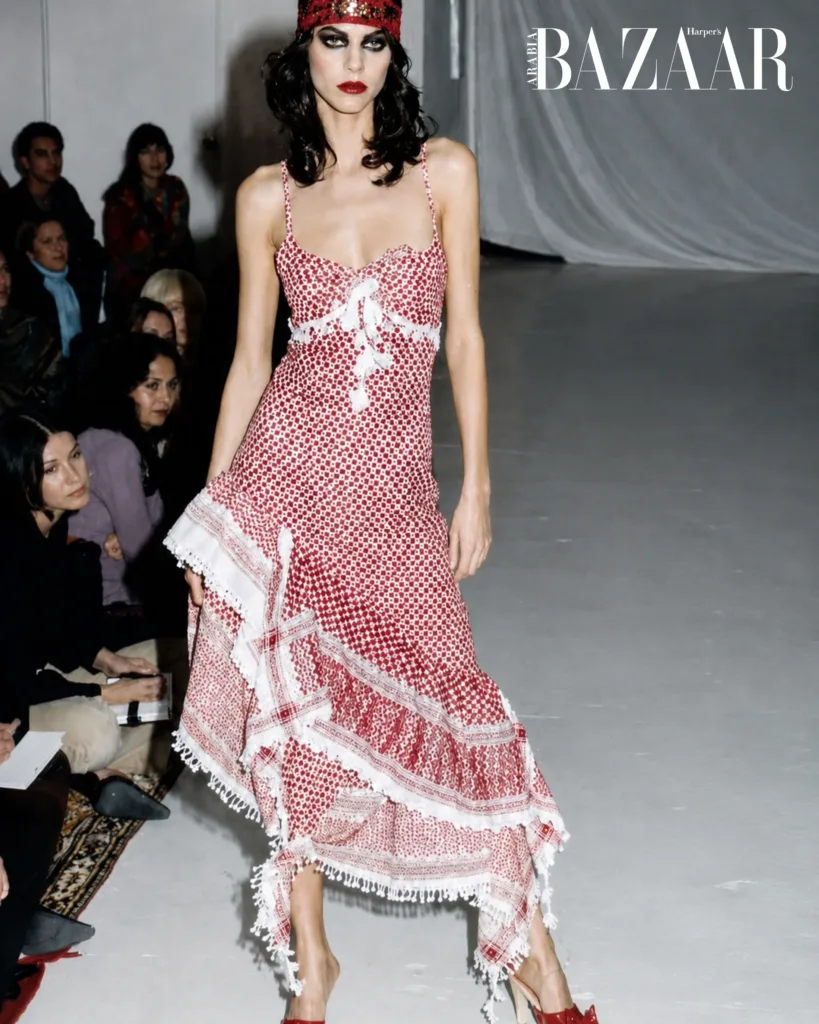
Aya, Zeenah’s 16-year-old sister, chose Bella Hadid. She began by dismissing Bella’s more obvious qualifications. “She’s a model, she’s beautiful, she has an amazing body,” Aya said. “How many other people in the world are like that? So many. Literally, her sister is one of them.” What distinguished Bella was Palestine. “She could have lost everything,” Aya said. “She could have lost all of her brand deals.”
Bella has said that companies stopped working with her and old friends dropped her after she spoke publicly about Palestine. At Cannes in 2024, she appeared in a vintage red-and-white dress made from keffiyehs and posted photographs beneath the words “Palestine on my mind, in my blood and on my heart”. The dress travelled through fashion pages and fan accounts. Her father, Mohamed Hadid, calls her his “Princess of Nazareth”. Admirers have adopted the title too.
Zeenah and Aya had grown up in the same Dubai household, raised by the same mother and with little disagreement over Palestine itself. They disagreed over what sincerity should look like. Zeenah found it in a life that appeared to hold together without visible compromise. Aya wanted proof that could be seen. Minutes later, the photograph of Bella in the keffiyeh dress was still open on the phone. One of the sisters mentioned the eye lift she had wanted “for so long”, pinched the skin at her temple and held her face beside Bella’s on the screen.
The modern icon must be singular enough to carry meaning, yet reproducible enough to become a template. Bella’s dress made visible what set her apart; her face was already being pulled back into parts.
Lead Image Credits: Jason Lloyd Evans