
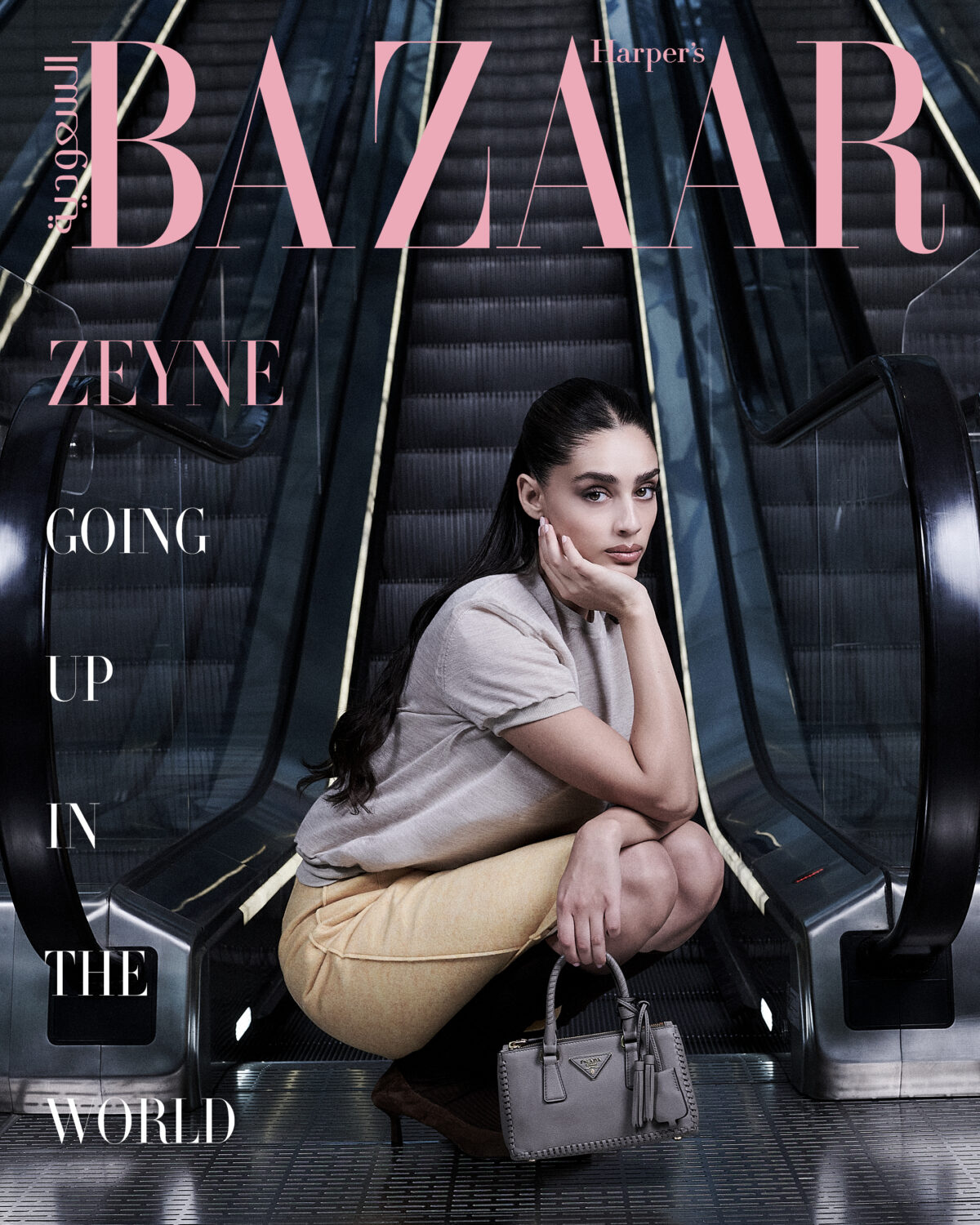
Zeyne Is The Harper’s Bazaar Saudi Winter 2025 Issue Cover Star
Between her mother’s sudden illness and a six-month paralysis that left her unsure whether music mattered at all, Palestinian singer-songwriter, Zeyne has reclaimed her place on the world stage with her debut album, Awda
Zeyne appears on my screen from a low-lit London restaurant, halfway through a mini press tour (and a cheeseburger). Silver earrings glint on either side of her glitter-dressed eyelids, but the sharp self-possession in her eyes eclipse them as we speak. Now one of the Arab world’s most closely watched new voices, the pop star says: “Everything happens for a reason.” By that logic, the universe had a staunch, borderline petty emphasis on the absolute delay of her debut album, Awda. Between bashful bites, she traces the gauntlet of setbacks that kept the record in limbo until its eventual drop.

Since dreaming up the album in September 2023, she has weathered one blow after another: a muddling break-up; her mother’s life-threatening diagnosis, delivered as the situation in Gaza deteriorated dramatically; a sixteen-hour detainment in a cell by US immigration when she tried to perform a fundraiser for its victims. Oh, and just as the album was finally set for release this summer, she broke her tailbone falling down the stairs. “Cherry on top, it was amazing,” she jokes. “No one tells you how painful that is!” Six weeks in bed followed, bingeing the first three seasons of The Summer I Turned Pretty. “I couldn’t do anything else.” She grants that the rest did her some good. “I was on the run last September,” she admits. “It forced me to sit down and actually process my emotions, which I’ve been holding off for so long… I finally confronted myself.”
Just a few tube stops away from where she rings me, above the Vue cinema in Leicester Square, a billboard now and again blinks with her likeness as part of YouTube’s Foundry programme. Not long ago, she was living in London, often shuffling to and from that same venue from her nearby home on Liverpool Street. Back then, she was an overworked intern at a PR firm in Moorgate, “trying to prove myself so hard to these white people that I’m worthy of staying there.” In no way could she conceive of her imminent sweep to stardom. “It’s so surreal for me that six years later, I come back to the same city, but I see myself pursuing the dream that I’ve always wanted to do ever since I was a kid,” the singer tells me. “Imagine, I used to go to that cinema to watch movies!”

The firm did offer her a job, but COVID disagreed, and while marooned in Amman, she opened an anonymous Instagram covers page (“I was shy!”) filming herself from the chin down. For 14 days of the government-mandated quarantine, she posted a new cover every day, trying to build the muscle of singing in front of people without quite being seen. Though she began to accrue a sizable following, she decided to take the page down. “But then over a hundred people DM’d me and they were like ‘What are you doing? Of course you can’t, you have to keep going.’ The government corroborated in its own way, extending the lockdown. “So I was like, why not take advantage?” She began showing her face, collaborating with musicians in Amman, and eventually met her current producer and label head Nasser AlBashir, who was often invoked as a grounding force for her throughout our conversation. Nasser posed the question that would catalyze her ascent: Why didn’t Zeyne write her own songs?

By the time she began working on Awda, the stakes to making music had changed. In September 2023, her mother fell critically ill. “That was a huge shock for me, for my family, for her as well,” she confesses. Two weeks later, Israel began bombing Gaza. Zeyne has a grim memory of sitting in the hospital waiting room between her mother’s surgeries, “watching what was happening to Gaza” on the screen. “It was just too much.” For six months, she was not in a headspace to make anything. The girl who had taken pride in feeling things in excess – an “extreme feeler,” as she called herself – suddenly couldn’t feel at all. “I used to love the fact that I feel a lot, and when I stopped having that, I felt like there was something wrong.” She discloses that her nervous system shut down, devastated into a numb languour. “I literally couldn’t cry even if you ask me to look at a video of someone dying,” It was so much that she seriously contemplated quitting music. “I didn’t feel like it made sense in the world that we live in… I felt like I was wasting my time. I didn’t feel like the music we were making was causing any social change.”

It took the people who knew her beyond her stage sobriquet to pull her from her fugue. For those who knew Zein Sajdi – the government name that flashed at the bottom of our call (though I personally know Zeyne, seeing it felt like the release of sudden classified information). Bayou, the R&B artist and close friend, hauled her out of the spiral: “He was telling me, ‘Take all the time you need to process whatever you’re going through, but don’t think about stopping.’ Nasser kept the studio open, unwaveringly patient. When she finally walked back in, a debrief was in order, and out of that conversation came Bali. It was the first song she wrote after six months of stasis. “It’s such an introspective song that talks about how heavy the world felt at the time; all the things that made me feel I didn’t recognise myself anymore when I looked in the mirror.”
Writing for Zeyne is now a protected process of healing. “Whether it was heartbreak, whether it was longing, love, grief, nonsense, whatever it is, I have to be going through something to be able to express it,” she says. “Otherwise I feel like it’s adding to the noise but not really standing out.” For Zeyne, Arabic is the decidedly singular vessel through which these emotions are able to hold. “I feel like there’s a limit to what you can express in English; Arabic is so rich and I feel like it would be wrong not to use it.” It was also during this time that Zeyne became steeped in the discourse of ‘decolonising your mind,’ the practice of unpacking Western-imported, imagined insufficiencies as an Arab. “Why do we always doubt ourselves for not being smart enough, cool enough, beautiful enough?” She pauses. “It’s an internal thing we were born with as Arabs, thinking that we’re not as cool as someone in the West and you need to copy them in order to be civilized, you need to dress like them to be fashionable.”

Those questions crystallised as Zeyne shot up the charts, and in late 2024 she released her searing song-and-visual suite, 7arrir 3aqlak/Asli Ana. The project induces all manners of tears and goosebumps, an ineffable work that summoned Palestinian pride with a euphony beyond language. “Our language is enough, our beauty is enough, our culture is so rich, why don’t we show that?” An indictment and an avowal, the song was never just for Palestinians. “I made it for everyone to see our culture, our people and land and food and traditions and jewellery, our tatreez,” Her song 7ilwe, a tender incantation of self-love, builds on that matrilineal devotion to the women who raised her. “It’s about the generational bond that comes with having a loving mother and grandmother,” explains Zeyne. The video pays homage to both, and nods to Asli Ana in its visceral visuals. In one tableau, she, her mother, and her grandmother stand together, twenty metres of braided hair connecting them like a living installation. “We wanted it to be like a picturesque painting shot.” When she sings 7ilwe now, she says, “I definitely feel empowered… I just want to hug my mother and grandmother and never let go.”
Even in her grainy, half-lit apparition on screen, it’s easy to sense the steady softness that settles in Zeyne’s features. The artist is acutely acquainted with her own nervous system, candidly alluding to it the way she would her discography. “I ended up just recently being able to process and feel and cry about things that happened two years ago that I personally blocked myself from doing so last year, because I wanted to be strong enough for the people around me,” she says. “I feel like I’m coming back to myself and who I am… it’s a feeling I haven’t felt in so long – like, years. It’s really cool.”

She keeps close to the rituals that anchor her: a regular diet of Pilates, therapy, enough water, a fastidious skincare routine. At night, she plays Olivia Dean and The Marias in the shower, then ends the day with Qur’an to fall asleep. “It really calms me down,” she shares. “Just having some sense of religion really grounds me. It’s so easy to get lost with the world.” She wears a tiny pendant from her siblings, reaching to clasp it when she feels overwhelmed. “Just having it around my neck, it makes me feel protected, grounded,” she says. Her newfound somatic awareness extends outwards as well, noticing when friends bite their nails or hold their breath too long. “Your answer is always there in your gut and your body is always trying to tell you something.”
The Arabic word ‘nour’ translates loosely to light, but it also carries a spectral, spiritual eminence that lives specifically in the face. When one has ‘nour’, it evinces an inner brightness forged through pure understanding. Watching Zeyne talk about the last two years, it gleams through her, hard-won and unmistakable. When I ask her what she’s working on next, she groans theatrically. “Girl, what do you mean what am I working on? I just dropped a 13 track album!” She protests, then concedes with a grin that she is, already writing, planning collaborations, and the next version of herself she feels ready to meet.

Lead Image Credits: Cashmere and Silk Knitwear; Skirt; Leather Pumps; Prada Petit Sac Noir Bucket Bag, POA, all Prada
Photography: Antonio Dicorato. Styling: Nour Bou Ezz. Make-Up: Raffaele Romagnoli. Hair: Maggie Semaan. Senior Producer: Steff Hawker
From the Harper’s Bazaar Saudi Winter 2025 Issue