Expo 2020’s Hind al Owais and Cartier’s Sophie Doireau On Ally Ship, Transformation and Advancing Gender Equality
With a rousing manifesto of ‘When Women thrive, humanity thrives’, Expo 2020’s Women’s Pavilion is arguably the most crucial cornerstone of the entire site. Here, we speak to the two formidable names laying its foundations…
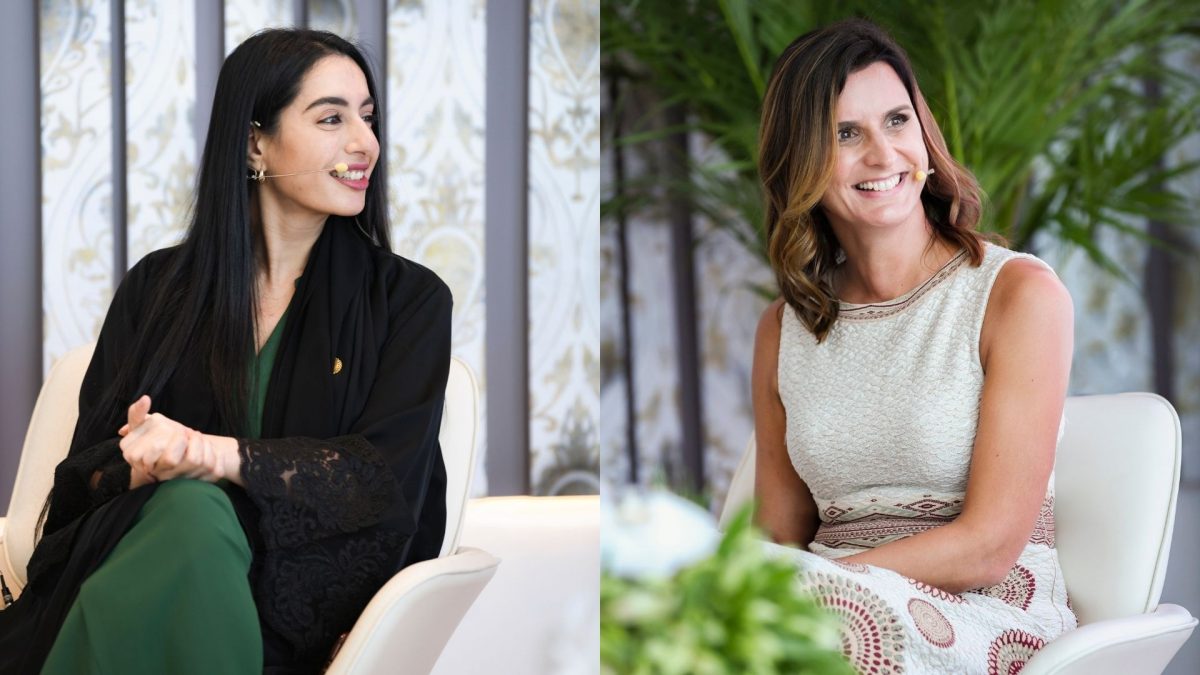
It seems fitting that at the very heart of Expo 2020’s Women’s Pavilion is a beautiful, powerful relationship between two women. Hind Al Owais, VP of International Participants for International Organisations, and Sophie Doireau, MD for Cartier UAE and India have come together to help direct the pavilion’s mission in the six months it will be active, opening to as much fanfare as expected on 1st October.
Reflecting both the UAE’s and the global agenda, the pavilion’s objective is no mean feat; to advance gender equality to the point where, eventually, no women’s pavilion will even be necessary. But how will they achieve such immense, tangible change in hearts, minds, and hopefully even policies? Thought-provoking, deeply inspiring dialogue and storytelling that is rooted in the paths (and conversations) less travelled, tributes to both well-known figures as well as everyday heroines, and an eye fixed firmly on allyship and transformation…

Harper’s Bazaar Arabia (HBA): What you’re trying to achieve is such a huge, multifaceted endeavour. Where do you even begin with something like this?
Sophie Doireau (SD): We have commitments that we cherish – the Cartier Women’s Initiative and Cartier philanthropy – that we wanted to bring to the region, and we thought what better place than this world exhibition to host them? We said, let’s think big, let’s think broader and let’s give a home to women in general. So we reached out to Expo, met with Hind and had an amazing conversation where we realised we were completely aligned. This is a collaboration between the public sector, private sector, and artists – all of whom are part of the adventure. It gives another lens and another dimension to this topic. A new perspective.
Hind Al Owais (HA): For us, it would be building on the UAE’s commitment in this field. I think in the past 50 years alone, the UAE has made great strides in advancing gender equality. Thinking about all the laws that have been adopted in favour of women, supporting women economically, making sure that we have a seat on the board, that equal access to education is ensured… Now, I think 90 per cent of all UAE women have a university degree. It’s a really important statistic. They just adopted a law on having a 50/50 representation of men and women in the Federal National Council. It’s a huge achievement for the UAE, and when you think about this deeply rooted commitment of the country, the decision to host the Women’s Pavilion at Expo becomes self-explanatory, because everything that the UAE has done since its inception, up to now, has been very much putting women’s progress and advancement at the heart of its efforts.

Expo 2020’s Women’s Pavilion, in collaboration with Cartier
HBA: That leads us on to our next question; how much do you feel the pavilion is coloured by the fact that it is in the Middle East? Would it be hugely different if it existed elsewhere?
HA: There’s a story that we are telling about women in the UAE because it’s a perception that has to be corrected. It’s a new perspective that we want to invite the world to leave with. But when you look at the larger storyline, the way that we are telling it would resonate globally. No matter where the pavilion is hosted, it would still deliver the same effects and outcome and would still engage visitors in the same way as it would if it was hosted in New York or Paris or Beijing.
HBA: Can you articulate what your North Star is for the pavilion?
SD: We want this world to be better, and we want people to act. We want people to realise that wherever they are, whoever they are, they can do something meaningful. And it can be through many things: from how we educate our kids to the way we run our companies for them, from the way we manage our teams to the way we run the country. There’s so many different actions that, in the end, will change the world. And really, I hope one day we won’t even need a women’s pavilion. But we need to act now, all together, both men and women. We’re glad you expressed that because, ultimately, we do need men to be our allies…
HA: To add to that; we want a better world, we want better faith in humanity. But I think what’s really important is that, at Expo, we have an opportunity to try to achieve it. Her Excellency Reem Al Hashimy shared this quote from the Quran, “I have made you peoples and tribes that you may get to know one another.” At Expo, we have that opportunity to get to know one another. Not as opposing camps of men and women, or country versus country, but being in the same space to share the Expo grounds and to be connected to each other. This is really the beauty of Expo – this faith, that North Star… we might really have a shot at it.
HBA: Do you feel that it will be more meaningful now it’s being hosted post-Covid?
HA: No doubt. I think that Covid taught us many lessons and also impacted the agenda of gender equality significantly. There was a web report that said that it’s going to take us 106 years to close the gender gap. Now, after Covid, that has increased to 153. There’s a whole shadow pandemic right now and that’s the violence against women.
SD: That’s why it’s more urgent, more meaningful. In this post-Covid era, we hope we learn – but it’s time to act.
HBA: Was your conception process quite structured or more organic?
HA: We were guided very much by the global agenda on gender equality and women’s empowerment. We looked at the five Sustainable Development Goals, at the Beijing platform and declaration and at the different pillars that UN Women is working on. Of course, it’s impossible to cover everything, but you can still tell the story of inequality. [Namely], that women have always been part and parcel of advancing our world; whether it’s through peace and security, political participation, health, innovation, education… women have always been there. We wanted to tell the story through the work that women have done to eradicate poverty, and through the voices of women today that are coming up with solutions.This is what also kept it very interesting for us; that we were led by the women themselves, rather than by the issue. And you look around and you have so many amazing women and so many inspirational profiles in history and today, and it makes your job easier because it allows you to tell the story of how amazing they are. It’s not about us. It’s about them.
SD: The chance we have is for six months. As you said, we can’t cover everything, but we can cover a lot. Imagine us speaking about global issues through the lens of women. And it’s also very interesting to see the parallels and bridges that we’re trying to build between the overall programming and all sorts of country pavilions. We see that it’s a topic that’s very important for many people, whether it’s for countries or companies. This will be a place to welcome them to speak. It’s very inclusive.

HBA: How much do you feel your personal perspectives have evolved just by the process of putting this together?
HA: Before, I was very much dealing with the issue like a lawyer looking at frameworks and implementation of resolutions, or looking at statistics and numbers. But when you have the opportunity to really tell the story through the voices of women, it opens up something within yourself that I’m able to tap into a little bit more. So that’s on a very personal level.
SD: I’ve changed my perspectives on the topic away from many misconceptions. I changed myself, I learned a lot, particularly about the progress that the UAE has made in terms of women’s empowerment, and really – it’s impressive. For me, this is a once-in-a-lifetime journey. Sometimes it’s scary but it’s so great to have these huge responsibilities that we’ve been given by a country, by Cartier… I’m so proud to be part of it. I’m so proud to work with Hind now. We have the same vision, but in a way we think differently, and that is so rich.
HBA: You seem like you’ve got such a beautiful relationship. What do you feel is the biggest thing you’ve learned from each other?
HA: I think that having the flexibility to always commit to the principle that we are one, right? First and foremost, that no matter what happens, we are delivering this together, with one voice and doing this by consensus. To value the commitments that you’re making to this relationship above all else, and to always find a solution, or a compromise. And to always think of what’s best, not for me, or my opinion, but what’s best for this project, because I’m doing something that is way beyond myself. This is for Expo, for the UAE and for women globally.
SD: We are kind of the same in that we are convinced that this requires commitment and and I think that we are not afraid. There can be compromise, because we have different perspectives, but that is the richness of this collaboration. There’s trust and respect, and we know that this project is beyond our two entities because it’s a world project in the end. This is the most beautiful open forum we could have for such a cause.

HBA: What’s exciting you the most about the programming?
SD: Education. The solution to women’s empowerment starts with education. I think if all women had access to it, it would completely change the world. So this, for me, is the starting point of the solution.
HA: It’s very hard for me to tell you one component or another as I think the way that we’re doing things is special because we are cross-cutting. We’re tackling the gender-equality agenda across everything, whether it’s in health, water, travel… you know, how do we talk about women’s ability to move in the world and feel safe? All issues are women’s issues. And women’s issues are everybody’s issues. We need to have this recognition. You can’t just put feminism or gender equality in a bucket, just leave it there and tell the world, ‘hey, let’s fix this.’ No, we are half of the world’s population so everything affects us – and we can affect everything, too.
From Harpers Bazaar Arabia July-August 2021 issue
