Cultural Historian Omar Kholeif On Art In Times Of A Virus
Writer, curator and cultural historian Omar Kholeif discusses the future of art in the wake of the ongoing pandemic, the resilience of visual culture and our duty to continue supporting artists
Yesterday I attended my first performance since the first warnings surfaced around COVID-19. However, this event was not held on one of my beloved theatre stages, which all remain shuttered, but rather it was held at Marian Goodman Gallery in London. I arrived palpably anxious.
I could feel my throat ceasing up behind an N95 mask, my breath fogging up my glasses, making sight indiscernible. I stood in a line two metres apart from the person ahead of me before I was ushered into a show by Tavares Strachan (b. 1979 Nassau, Bahamas).
Sanitiser with me, I started to massage my hands repeatedly with the disinfectant as if it was a moisturising balm that solves all the world’s problems. I dotted about the gallery rooms running away from the proximity of the eleven other people who had entered with me in a pre-booked time slot. Abruptly, a voice from a staircase began to invade my consciousness; first with a whisper, slowly moving through octaves into a majestic crescendo.
I was enraptured. Doors opened, rooms were revealed, three singers moved in and out of space revealing a story of ‘invisibility’, of an African-American explorer to the North Pole who had been marginalised from history, a tale all too familiar. The exhibit’s title, In Plain Sight, felt just as much a nod to the experience of lockdown, as to the artist’s underlying theme.

Tavares Strachan. We Are in This Together (Multi). 2019. Cobalt, super blue, sky blue, traffic light green, green, clear gold neon, transformers. 40.6×185.4×0.8cm. Edition of 9 plus 2 artist’s proofs
A capella voices streamed in and out from black bodies; it left the audience mesmerised for forty minutes. All phones were required to be out of sight. I turned to look at the people around me, who respectfully kept their distance, wore their masks, all the while transfixed by the meticulously choreographed scenography of Strachan and his performers’ storytelling.
There is something to be taken from this experience that speaks to the resilience of the gallery context and the visual arts more broadly in the months since the overwhelming devastation wrought on by COVID-19. Art is suturing; its healing potential comes not from its role as a mass medium but equally from the intimacy that gallery spaces can engender and enable, between artists and everyday people.
There has been a heightened sense of fear that the world of visual culture will collapse in the wake of our current pandemic. Yet, it is my belief that of all the cultural forms, the visual arts are the most resilient. Art is scalable – the ambition of a work of art is not simply marked by its production budget but has as much to do with the time afforded to the artist to create and imagine the potential of her or his work.

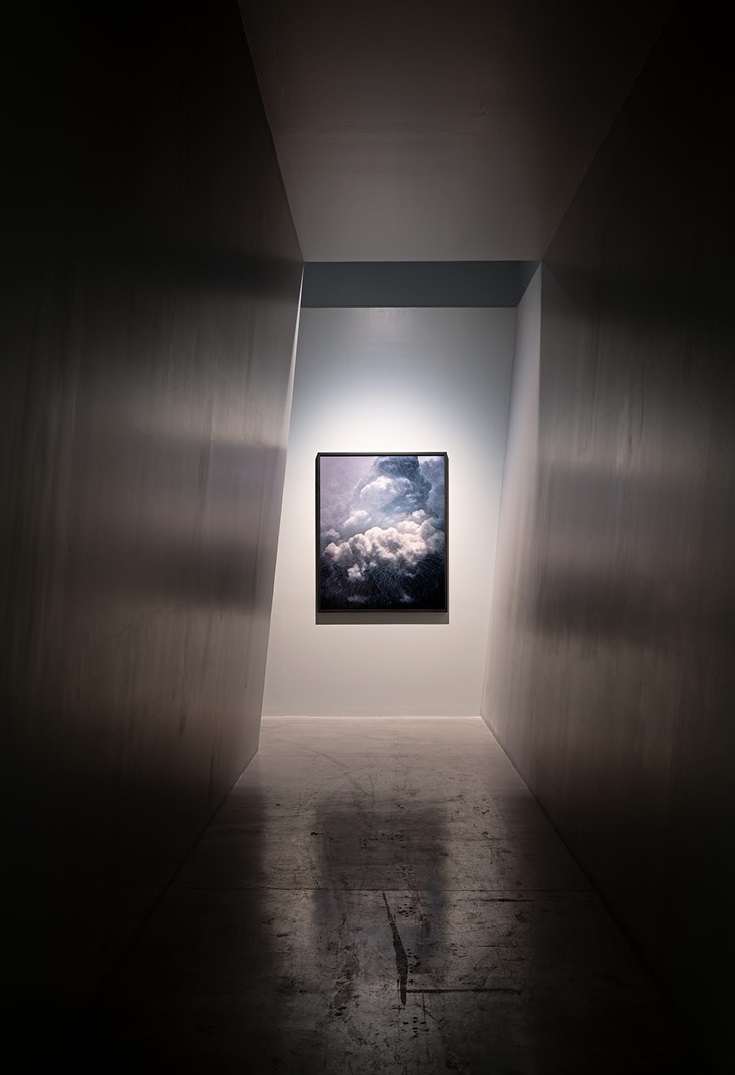
An installation view of Art in the Age of Anxiety. Image courtesy of Sharjah Art Foundation
Art can be a socially distanced experience, which for many of us, is infinitely more pleasurable than swarming around a painting amidst masses of people attempting to take photos of a painting, waving their phones in front of an artwork for the benefit of social media. If I have learnt anything from this historical moment, it is that we must continue to support artists to envisage their full potential as practitioners, to enable them to dream of new scenarios and contexts that will help shift our imagination.
Certainly, not everyone will be able to physically experience art as before, but this period has also proffered moments of reflection as to how art can be experienced on both a distributed scale, as well as through the individual experience. At Sharjah Art Foundation, we have always anchored our work around artists and their ideas. This is what is most urgent now, to give voice to those figures who can help us change the way that we all see the world.
Dr. Omar Kholeif, FRSA, a writer, curator and cultural historian, is Director of Collections and Senior Curator at Sharjah Art Foundation. His most recent curatorial endeavour, Art in the Age of Anxiety was held at Sharjah Art Foundation from 26 June – 26 September 2020. The accompanying publication will be published in Autumn 2020. It features more than a dozen newly-commissioned writings and artist projects. It is co-published with Mörel Books and distributed internationally by the MIT Press.
From the Autumn 2020 issue of Harper’s BAZAAR Art