
Discover The Aamache Residence By Renowned Lebanese Interior Architect Nabil Dada
Superb projects are nothing but familiar for Dada who today dazzles us once again with the Aamache residence, an incredible triplex located in Beirut, offering unobstructed views of the Mediterranean
Time and projects have passed since Nabil Dada opened his first store Schemes in the Sanayeh neighborhood of Beirut as a fresh graduate of the Academie Libanaise des Beaux Arts (ALBA).
At a time where only Dada and one more boutique were introducing contemporary furniture and fixtures to a crowd hungry for modernity in pre-war Lebanon, Schemes managed to develop first-hand relationships with Italian furniture manufacturers.
Later on growing into Dada & Associates, the studio found fame through customization and commissions of one-off designs, pleasing clients with one-of-a-kind pieces. A passion for the Midcentury Modern style, Dada’s practice is also known for mixing Italian craftsmanship with French detailing and Middle Eastern influences and has completed most of his first Beirut projects honoring this highly sought-after combination.

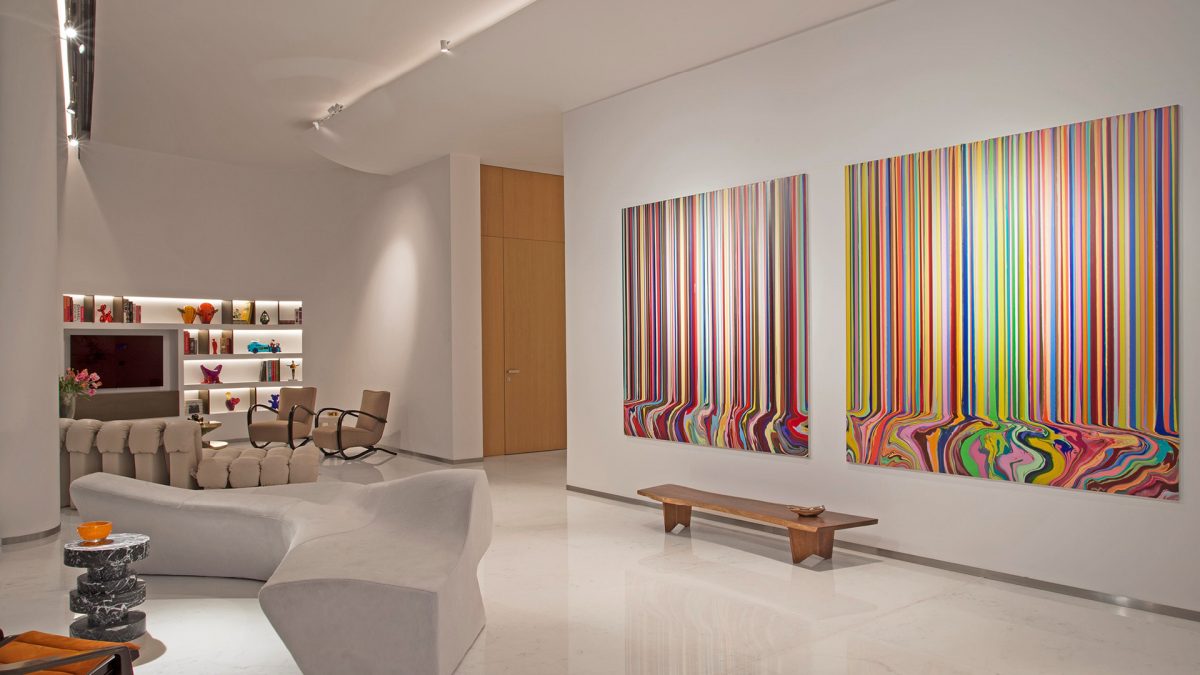
Interior view of The Aamache Residence
At a time where Dada & Associates started gaining momentum, the Lebanese civil war broke and forced the practice to relocate. It’s in Saudi, a country where Dada’s reputation needed no further introduction, that he decided to settle down. In 1991, after Lebanon had waved years of conflicts goodbye, Dada headed back to his home country and graced some of the city’s complexes such as the Beirut Souks Cinema or the Beirut Yacht Club with his divine and refined taste.
The architect answered our questions about this dreamy abode.
Tell us a bit more about the Aamache Residence and which room is your favorite?
Nabil Dada: Although quite subtle, the architecture plays a big role in this Beirut apartment. The client had requested a minimalist look so I created the architecture with seamless curved lines that are expressed in both the walls and ceilings. The monochromatic curved surfaces help blur the visual boundary between the two. A brass blade cuts through the ceiling in the living area, concealing the spotlights and AC grills. I wanted to hide the functional elements of the space in order to maintain the purity and cleanliness of the ceiling’s surface.
In terms of furniture, I opted for pieces that maintain the light aesthetic of the house such as a coffee table by Vincenzo de Cotiis and a polished stainless steel dining table, both with a mirror finish, which blend seamlessly with their surroundings. The organic shapes of the DeSede and Zaha Hadid sofas complement the soft lines of the architecture by creating a fluid circulation through the living space.
My favorite space is the dining room, both the functional and aesthetic aspects are solved through the architecture. The dining room is lit with a dome, detached from the ceiling, which in addition to concealing the AC grills, houses a circular strip of indirect lighting coupled with small spotlights.
The idea was to create a chandelier that is physically integrated with the architecture of the space and its effect is reflected below on the mirrored top of the dining table.

Dining room view of The Aamache Residence
You mentioned that the Zaha Hadid sofa was an element you used in one of your first project and that it still looks great today. How important is the timeless aspect of a furniture piece to you?
Nabil Dada: (Kindly note that the Zaha Hadid was often used in our projects however not in the very first one as it was released at a later stage in my career.) Besides its fluid, avant-garde form, one of the reasons I have kept going back to this Zaha Hadid sofa throughout the years is the way it was designed for people to sit on both sides. I use it to connect and create a dialogue between multiple seating areas, a role that it fulfills in this apartment.
The most important aspect of the furniture selection is the pairing of pieces with designs that stand the test of time. I want my clients to live with furniture that will always look relevant.
The purity of this sofa’s lines is the reason why 20 years after it was first released it still looks as relevant as ever.

Interior view of The Aamache Residence
The Ian Davenport paintings are the colorful highlight of the apartment. Are you usually more attracted to monochromatic tones or believe in the need for colors in a specific place?
Nabil Dada : I’m attracted to art with a strong character which I usually find in pieces that are rather sober in color. Most of the artworks I have at home are predominantly black and white with very subtle hints of color. I believe a monochromatic painting can be very powerful, especially when there’s a play on texture, which is why I really admire Richard Serra’s work. However, in this specific apartment the monochromatic aesthetic is translated in the walls, floors and furniture so these paintings by Ian Davenport introduce a vibrant energy to the space.
The rug from Italian designer Vincenzo De Cotiis was inspired by one of his trips to Beirut. Did it matter to you to add this reference to Lebanon in this project?
Nabil Dada : Between the light aesthetic of the interior and the endless view of the Mediterranean, it almost feels like the apartment is detached from the chaos of the city. This vibrant rug by de Cotiis is meant to evoke the different layers of Beirut’s urban space and I chose it to inject a subtle dose of this chaotic energy all the while creating a balanced contrast with its surrounding pieces

Living room view of The Aamache Residence
Which material (brass, marble, etc. ) can’t you see a living space existing without?
Nabil Dada : I like noble, natural materials such as wood and marble. So much beauty can be found in their organic veins that sometimes we’re inclined to believe they were intentionally designed. If I were to choose one of these two I would say wood because of the versatility of the material which means it can be used for the floor, walls and ceilings.

Interior view of The Aamache Residence
Images courtesy of Wael Khoury Photography