
Our Homeland: Ayesha Hadhir On Her Art And Familial Histories
A rich discovery of our inherited societal traditions, Ayesha Hadhir’s experiential work is her story, history and legacy, all woven into a single fabric
Over the course of history, many philosophers, poets and writers, including the celebrated late Maya Angelou and Confucius, have said something to the effect of, “If you don’t know where you came from, you won’t know where you’re going.” These words ring especially true for multimedia artist Ayesha Hadhir, whose sensorial work is an intimate reflection of her ancestors. Ancient traditions,
a deep sense of belonging, the concept of home, who we were and who we’ve become, are all themes she explores zealously. “Art is really about investing in your ideas and believing in the things that you have to say or do,” says Ayesha, who has always admired her rich, familial past. “Even if there is no commission, I’ll just keep on going and try to find ways of expression and eventually, the artworks find their home.”
Ayesha’s life as an artist bloomed through a love for fashion. Aged 15, her dream was to join the prestigious Parsons School of Design. She would often showcase self-designed clothes in public exhibitions, even selling them via Tumblr (the Instagram of its time). “That’s really when I started becoming an artist and understanding art and the freedom that comes with it,” Hadhir admits, now equipped with a bachelor of fine arts degree from Zayed University. “Today, I work with both fashion and art. It’s rooted within me.”
As a child, the fashion aficionado was exposed to fabrics – her family would visit textile shops in Madinat Zayed each year to buy fabric for cultural celebrations such as Ramadan or Eid. “We were always surrounded by the idea of textiles, and it’s now a part of our life,” Hadhir enthuses. “My obsession started when I discovered I could manipulate the material to become so many things.”
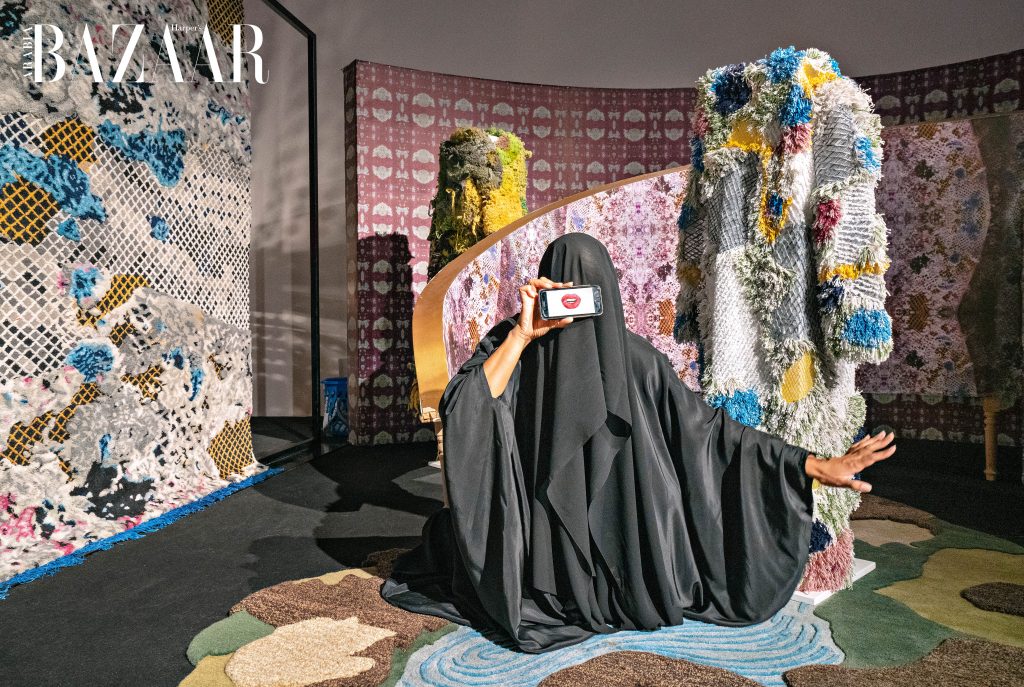
Today, the Abu Dhabi-born visual artist specialises in immersive installations, creating evocative pieces using textile. “The material is so flexible and there’s so much you can do with it,” she smiles. “I love working with materials that are flowy and can be manipulated and be shaped as a chair or a sculpture. It can be a tapestry on your wall or a big carpet on the floor – it’s all about how I can manipulate the fabric to be shown in different forms.”
Since making her debut in the art world, Hadhir has cemented a career that has seen her exhibit widely in the United Arab Emirates. Four years ago, she launched her first solo exhibition, called Al Doobah (2018), curated by visual artist-entrepreneur Walter Willems, in Dubai’s Alserkal Avenue.
A formidable creative force, she has participated in exhibitions including Tashweesh, commissioned by UAE Unlimited at Maraya Art Centre, Sharjah, in 2019; the 35th Annual exhibition, curated by Nasser Abdullah, Emirates Fine Art Society, Sharjah, in 2018; Emirati Traditional Games Exhibition, curated by Sumayyah Al Suwaidi, at Al Qattara Arts Centre, Al Ain in 2017; and a project called Do Art, Do it Now!, commissioned by the Guggenheim Abu Dhabi in 2017. Presently, Hadhir works in art programming in Abu Dhabi’s design and art hub, Warehouse421.
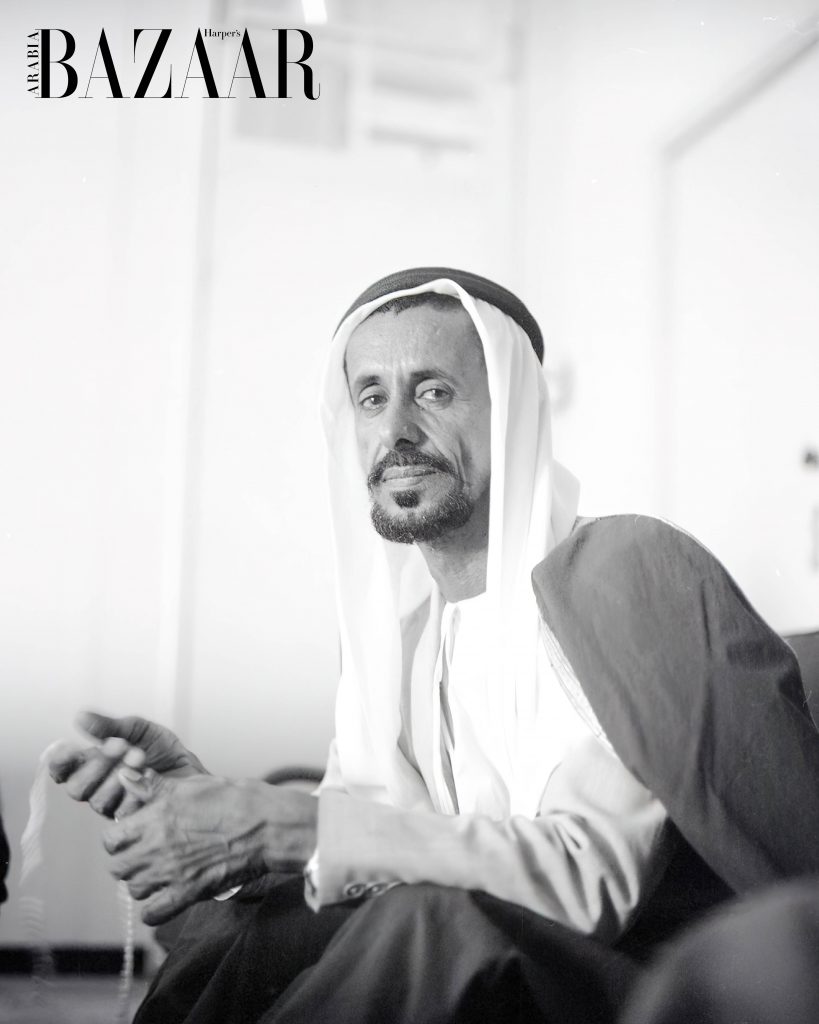
The cultural capital city, Abu Dhabi, has played a vast role in shaping not just Ayesha’s art, but her way of thinking, too. “It’s my identity, I would say,” she says. “When I look at old photographs of the Abu Dhabi coast, I can still identify my grandfather’s house. I look at them and compare them to now, and where we actually used to live – they are full of my family history. So, to me, we come from here. This is our land.”
Taking a cue from familial histories, in her inaugural solo show the artist experimented with mesh garments and other found objects placed underwater – a project called Al Doobah, which took almost a year to produce.
“It took time because of the amount of research and documentation that went into building the work,” explains Ayesha. “For me, it’s always about certain phases that I am going through, whether emotional or physical. It’s about keeping my eye open for everything that may come.” The quest for answers about her origins was the greatest inspiration behind the underwater installation. “My ancestors are a huge part of everything I do.”
Hadhir humbly admits that her work would not be possible without joining hands with other artists, artisans, craftsmen and performers. “Producing large-scale works like the one I worked on for the Beyond: Emerging Artists programme with Shaikha and Rawdha Al Ketbi has taught me the power of collaboration,” she observes. The project, Neither Concealed Nor Revealed (2019), was mentored by artist trio Hesam Rahmanian, Ramin and Rokni Haerizadeh, one of the greatest collectives in Dubai’s art scene. “We used to meet and plan for this exhibition on a daily basis, and we even went on an adventure to experience each other’s work,” smiles Ayesha. “We took part of our work to the desert and sea, and to abandoned places, to live the lives of each other’s environment. The power of my work only comes to life as we put all of these minds together and create an even bigger impact.”
Ayesha’s curiosity about water was piqued while she was part of The Salama bint Hamdan Emerging Artists Fellowship (SEAF) from 2016 to 2017, a 10-month artistic education and development programme which supports around 15 emerging UAE-based artists each year. “I’d just finished university and I went straight to SEAF,” Hadhir recalls. “During that time, a lot of my work changed in terms of my thinking.”
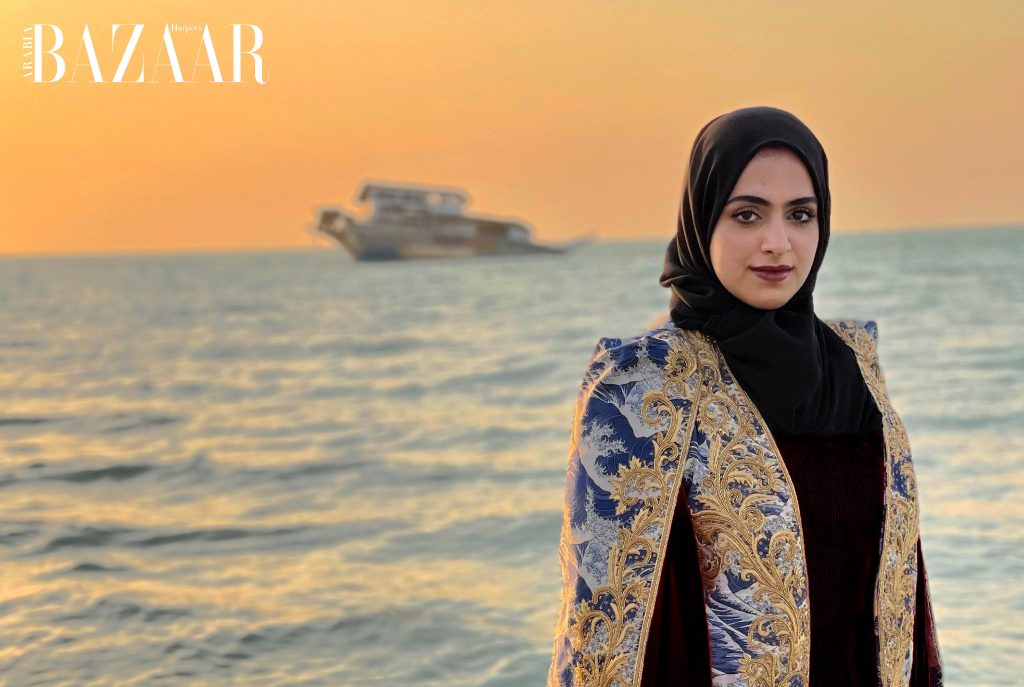
This is when the artist began studying water in depth, visiting the sea almost every weekend to document the changes that occur over time. “This was just fascinating to me and I started to think about marine biology.”
She began sinking dresses under the water, studying the different phases the garments go through, as well as the intricate changes and movement that can be observed throughout the summer and winter months. The artist became infatuated with the differences between artificial and natural sea water. “I had an aquarium at the time that I was infusing with chemicals to recreate the idea of the sea,” she explains. “It got me into a whole obsession of just trying to crack that code of understanding algae, the reflection of the sun, how things grow and how they die.”
Remembering her childhood lessons in activities such as diving and fishing, Hadhir became more and more invested in the idea of the sea and inevitably; it became a central theme in her work. “Everything in terms of my diving, the sea, my family, my ancestors and even how I was taught to swim, all became a part of my work,” she reveals, describing her art today, as an “obsessive documentation of the underwater world.”
In fact, Ayesha’s grandparents also had a special bond with water. Her maternal grandfather, Salem ben Mayed, was a leader of a ship, while her other grandfather, Mubarak ben Hadher, was the ruler’s representative on Das Island, specifically at the time when oil was discovered in Abu Dhabi in the ’60s.
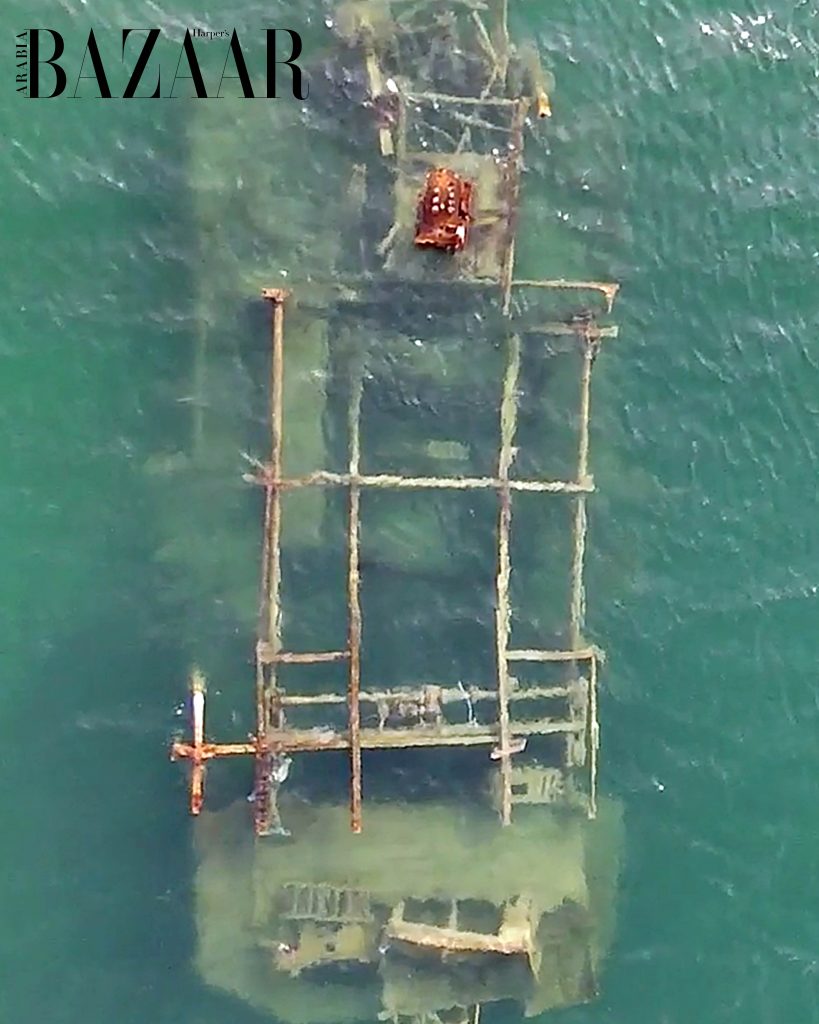
A report from the ’30s, which was labelled ‘secret’, describes Das as an uninhabited island off the coast of Abu Dhabi. Today, the ancient island is an important landfall for migrant birds and the oil industry. Remarkably, ben Hadher’s former house there is set to become a museum, and is still visible on Google Maps. It was here that Hadhir found the very first barrel of oil, which later ended up being part of an art installation.
“We should treasure these little stories that are passed on from the generation that actually lived through them,” she reminisces, explaining how her grandfather would leave his homeland for months on end to live on an island of men and study and dig oil, planting trees for food while the women stayed behind as the caretakers, raising children alone.
Hadhir recalls tales her grandmother would tell her: “She used to tell me how powerful women were back then when they were pregnant,” she says. “They used to cross the dunes and when a woman went into labour, she would just give birth on the go and literally carry her child back. There would be no one there to help her. That, to me, was so interesting – the power that they had. These are things that we don’t talk about today.” And so the artist made it her mission to share this story through her powerful work, Labsat Al Bisht (2020), which was on view in the historic Qasr Al Hosn as part of a commissioned project.
Having made history with such crucial roles, Ayesha’s ancient lineage has inspired her as an artist to achieve greatness in her lifetime and leave her own legacy. “All of that obviously influenced me – how they had to serve the country and what they had to give. I think about myself as a woman trying to embrace what they had to go through – the hardship of diving, for example – and I try to understand that physically. All of what they had to do impacted how we live now. Just think of the importance of their roles. I often ask myself, how can I also be as relevant as they were and what are the differences that I can make now?”
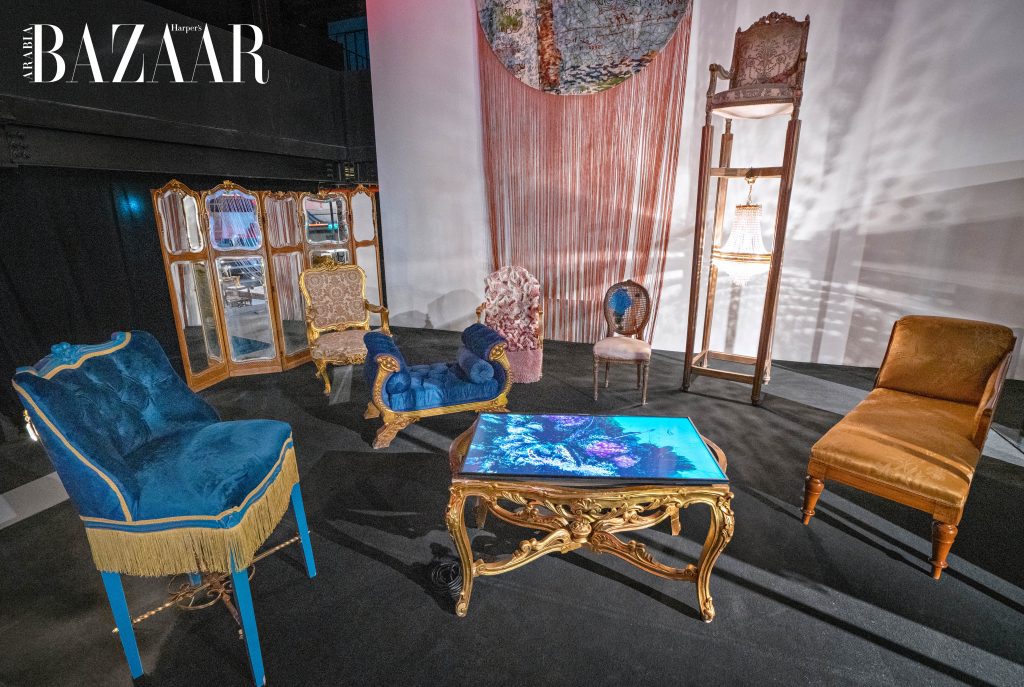
If we do not study our heritage, we will not know where we are headed. With such a storied past, the role that Ayesha’s work plays in contemporary society is clear: “For me, the purpose of art is to tell the story of our lives now and to document the life that we are living for the history of the next generation.” She pauses. “Most importantly, to express who we are but also to be remembered, to be understood, to have a voice.”
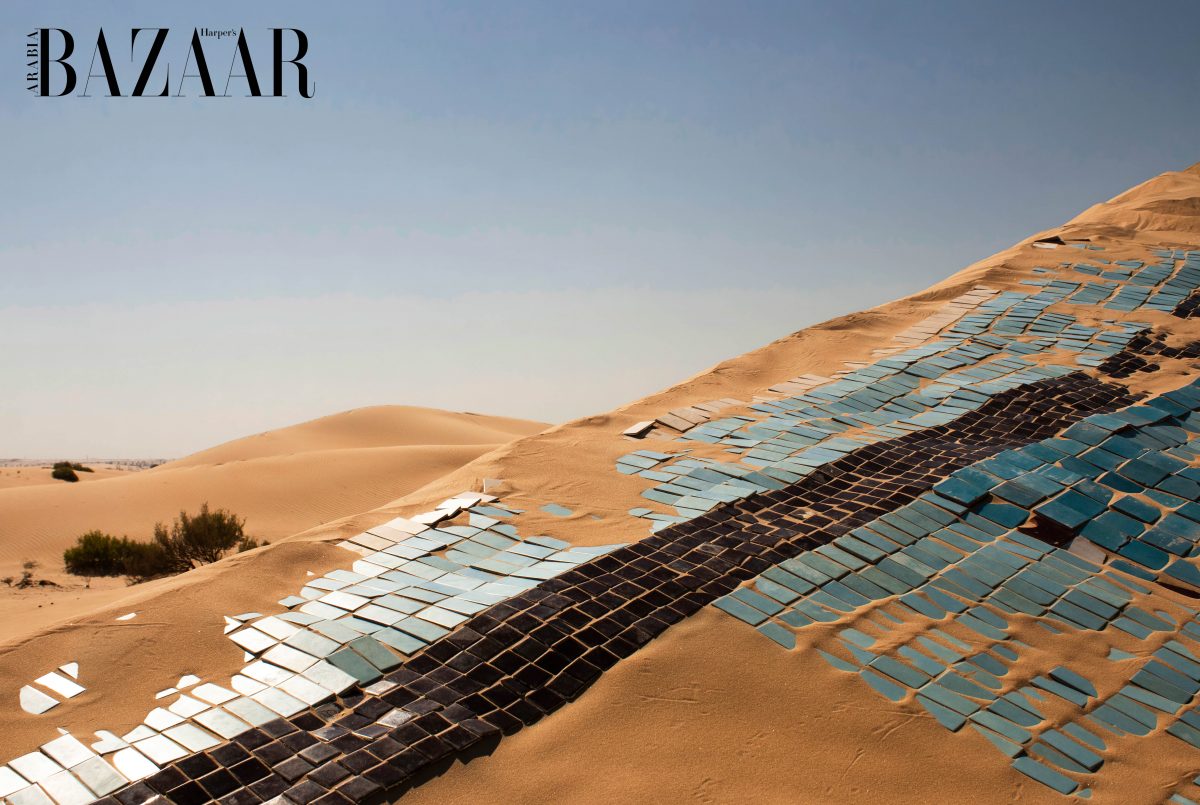
Lead image caption credits: Ayesha Hadhir. If I Had To Move A Sand Dune. 2019
From Harper’s Bazaar Arabia’s December 2021 issue