Out Of Exile – Inside Thenjiwe Niki Nkosi’s Heroes Series
After a four-year hiatus, the Sharjah Biennial is back, celebrating its 30th anniversary with the thought-provoking curatorial theme of Thinking Historically in the Present. Artist Thenjiwe Niki Nkosi – who is showing her Heroes series at Sharjah Art Museum – explains why her work fashions new dimensions to historical narratives
Both the 15th Sharjah Biennial, and Hoor Al Qasimi herself, owe much to the late Nigerian curator, art critic, writer, poet, and educator Okwui Enwezor. “His idea of ‘thinking historically in the present’ is the conceptual framework for the Biennial, which we’ve sought to honour and elaborate on while also reflecting on the foundation’s own past, present and future as the Biennial marks its 30-year anniversary,” reveals Hoor, the president and director of Sharjah Art Foundation.
The Biennial, which runs from the 7th of February to the 11th of June 2023, explores this theme in 19 venues across five cities and towns in the emirate – Al Dhaid, Hamriyah, Kalba, Khorfakkan and Sharjah – bringing together 150 artists and collectives from more than 70 countries. “I was moved by the affiliative spirit and civic ethic of Enwezor’s curatorial model to reconsider what was possible for Sharjah as part of this new global modern, what our biennial could offer as a non-western centre for the circulation of people and ideas, and how it could grow into a critical alternative to entrenched institutional thought,” Hoor continues in her curatorial statement. Postponed from 2018, Okwui passed away in 2019 before seeing the Biennial he inspired come into being, yet his ideas are very much alive through the exhibition spaces thanks to Hoor’s curation.
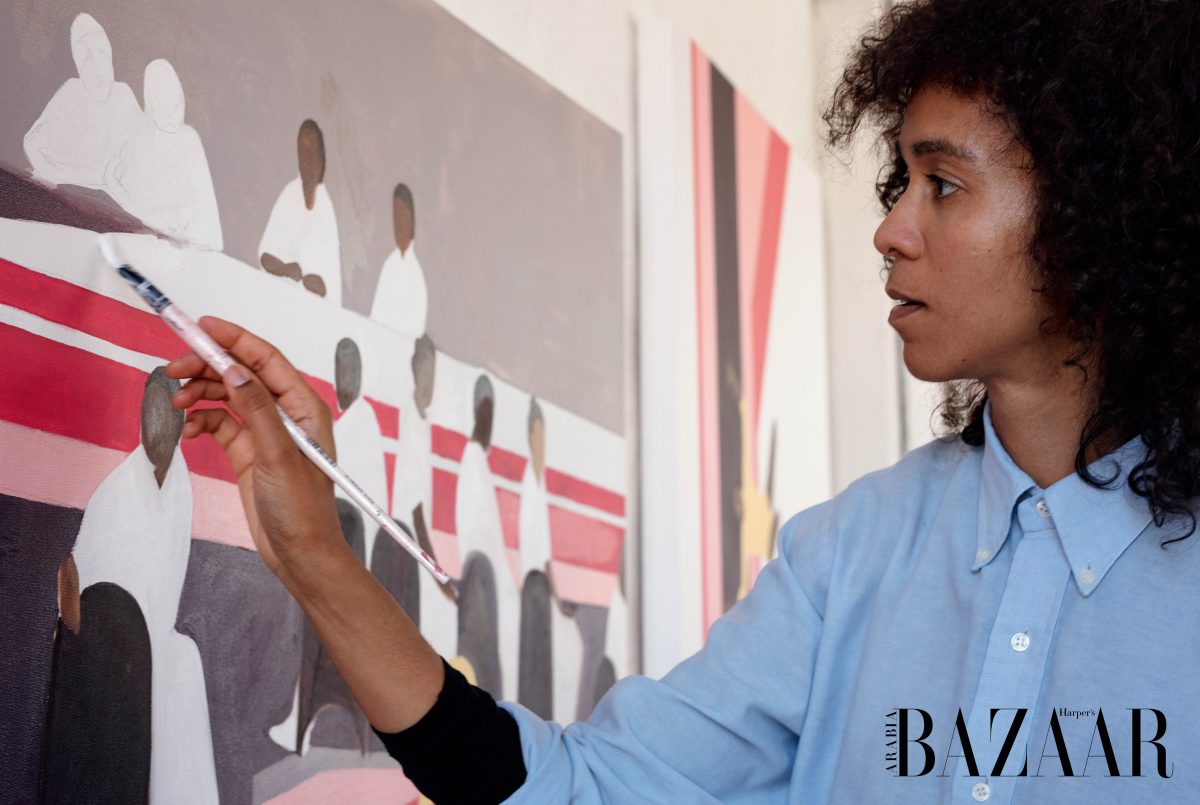
One artist presenting a new historical perspective is Thenjiwe Niki Nkosi, the proud daughter of South African freedom fighters, who was born in New York, and raised between Harare and Johannesburg. According to the exhibition text on display at Sharjah Art Museum alongside her work, “Thenjiwe Niki Nkosi’s multimedia and performance practice investigates power structures and imagines possible alternatives. Heroes (2012-ongoing) pays tribute to well-known and unsung figures linked to the struggle against apartheid and colonialism. By employing square canvases reminiscent of ID photos, she creates a space of equality between view and image. Through flat, monochromatic backgrounds that replace signifying detail, the figures are placed in a timeless, contextless realm… evoking a more inclusive notion of personhood while rejecting tendencies of conventional hero worship.”
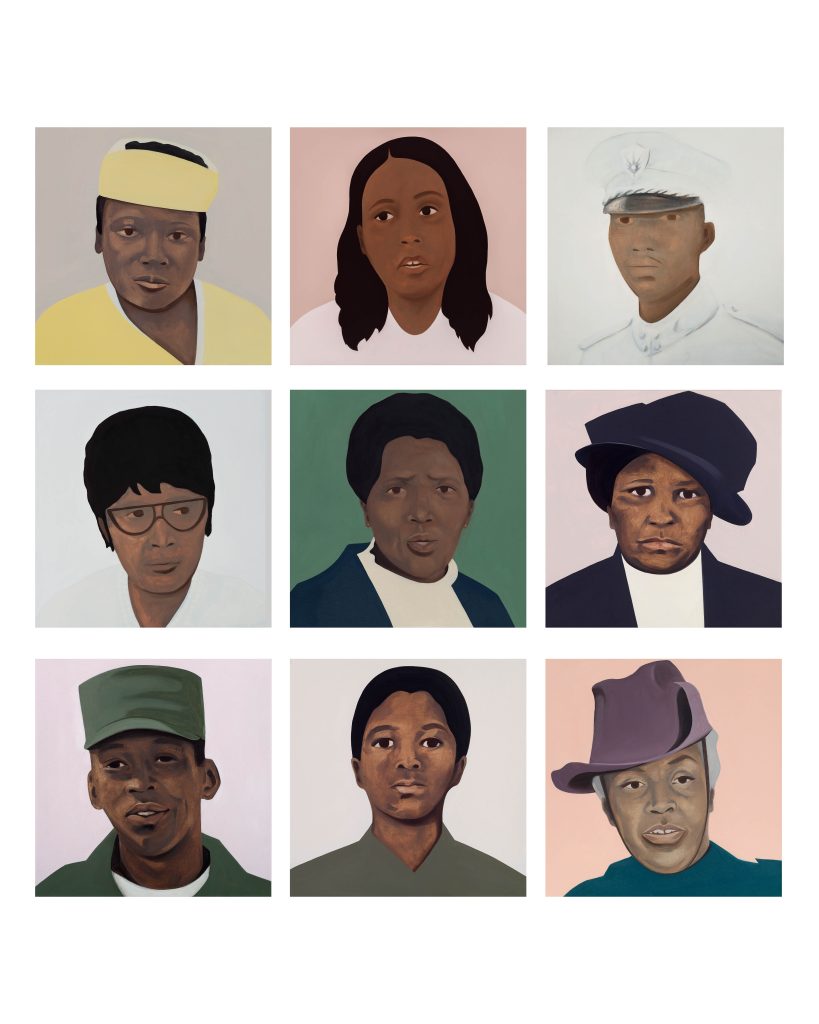
Top row from left: Prophet (After Nongqawuse) 2016 • Freeman (After Catherine “Cathy” Astrid Salome Freeman) 2021 • Upright Man (After Thomas Sankara) 2012. Middle row from left: Mother (After Winnie Mandela) 2013 • Lorde (After Audre Lorde) 2017 • Buthelezi (After Julia Buthelezi Nkosi) 2018/ Nana (After Julia Buthelezi Nkosi) 2018. Bottom row from left: James Marshall (After Jimi Hendrix) 2017 • Nana (After Gladys Nana Nkosi) 2018 • Kennedy (After Florynce Rae Kennedy) 2017
Thenjiwe observes, “In order to consolidate power and how to create national narratives, what often happens is that we distil our heroes into little boxes and into single people. I grew up in exile, and I started thinking about my father as my hero. He was a member of the Pan-Africanist Congress and I wanted to remember more of the people who contributed to the struggle in South Africa and to freedom in all aspects of life so I started painting for people that I wanted to think about more deeply, and then it became something beyond that.”
Among the portraits on show at the Sharjah Biennial are: former president of Burkina Faso, Thomas Sankara, Nelson Mandela’s wife Winnie who South Africans call the Mother of the Nation, Betty Shabazz who was married to Malcolm X, feminist thinker Audre Lorde, and two paintings of charismatic rock musician Jimi Hendrix. Alongside hang depictions of her Uncle Stan, her grandmother and other beloved relatives. “I started with Thomas Sankara, a leader of Burkina Faso who was assassinated for his feminist, communist ideologies, and uplifting Africa in a way that we have, in a lot of our states, failed to emulate. You’ll see people who are known or unknown. And the question for me is really, who gets remembered and who doesn’t, who gets memorialised?”
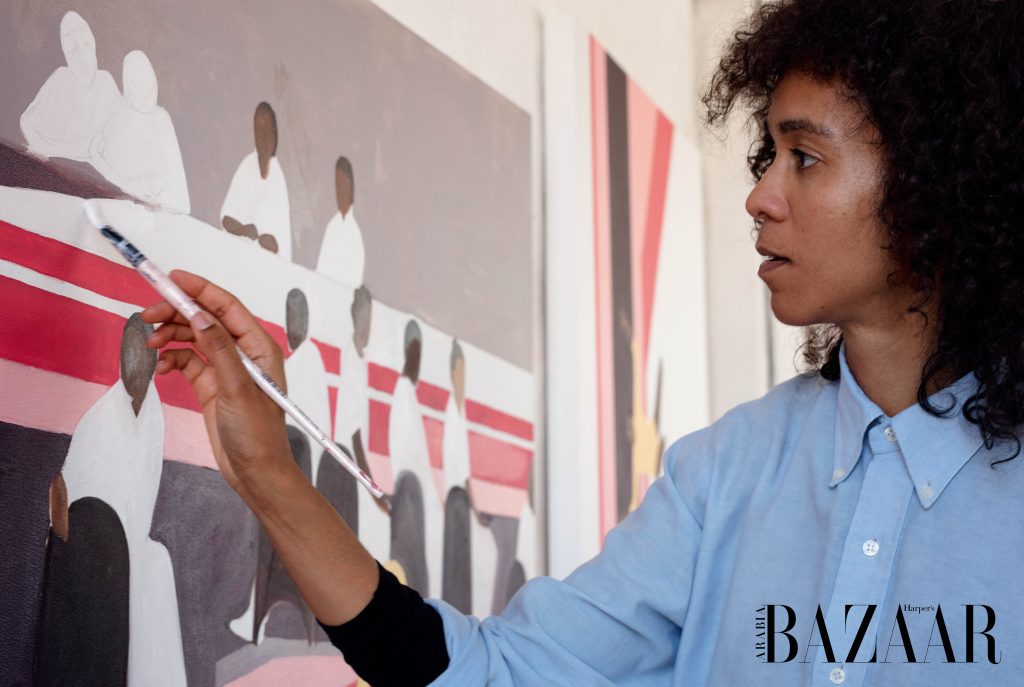
Elaborating on what it meant to her to grow up in exile, Thenjiwe explains, “My father was an exile from South Africa for 30 years, so for me, his exile was our exile because we couldn’t go back to his home until Apartheid started being dismantled. So it was a strange situation to be in when my father was exiled from his home, but we were always told that the place that he was exiled from was our home. For me, it was a very strange experience finally getting to South Africa at the fall of Apartheid and realising that I wasn’t of this place that I had known as home, where I was told that I was from and that was home. So being an exile also meant that I grew up with the sense of not ever being in the place where I was supposed to be, and having a misplaced sense of belonging.”
Poignantly, out of this exile, Thenjiwe has created her own sense of belonging via Heroes, which she describes as “my personal pantheon”. She admits, “It was quite an emotional experience for me to see them all. I don’t see the paintings in this way,” Thenjiwe confesses. “I paint one, and then it goes off into the world. So when I walked in, I actually felt like I was being received by a gathering of, in some ways, what felt like witnesses. Some of them are literally my ancestors, some of them are friends, some of them are people that I’ve never known, but I really felt like there was this council of people who are holding me. And they’re all people that I somehow look to, to understand my own humanity and my own human experience. I just felt this kinship when I walked into the installation,” she pauses. “It was unexpected.”

Top row from left: Mido (After Mido Macia) 2013 • Chiponda (After Melania Chiponda) 2020 • X (After Betty Shabazz) 2013. Middle row from left: Abrams (After Stacey Yvonne Abrams) 2021 • Oglesby (After Sid Oglesby) 2018 • Legote (After Grace Matsetsa Legote) 2018. Bottom row from left: Bullard (After Robert Doyle Bullard) 2020 • Sunstrum (After Pamela Phatsimo Sunstrum) 2017 • Uncle Stan (After Stanley Fanuel Nkosi) 2017.
Thenjiwe means ‘the trusted one’ in isiZulu, the language spoken in Southern Africa, which has bestowed her with a pre-determined purpose she’s fulfilling with her paintings that’s perhaps more obvious to the observer than it is to the artist herself. “My whole life really has been this dance between being myself and trying to carry on the work of both my parents because both of them were activists,” she sighs. “It’s something I think that plagues the children of freedom fighters. For me, wanting to be an artist was this difficult decision that I felt I was making because I understood that art could be political, but to a point, that it also exists in the world of capital and capitalism, and in the world of creativity and joy. I don’t use the term activism in relation to what I’m doing, but I like to act to be active towards some intentional end, whether it’s sharing opportunities and platforms; creating more accessibility for other artists who don’t have the same chances that I have; or trying to change a social situation that I feel that I can be useful in changing. Their work has inspired me, but I have a very high standard of what active work really looks like – work that’s making a real contribution. I don’t know where to place my work in that.”
The answer may be closer than she thinks. “I’m using the series to really explore what a hero is, and the more I work through the portraits, the more I add people into the group, the more I see that there is no such thing as a hero, really. That’s what this series is about,” she reflects. “It’s about undoing the idea of these distinct categories of people, and questioning what is activism? Does it need to look a particular way? In some sense, I’m saying, this group of people is infinite, and it includes everybody, in some way. There are activists who are committed to social justice, made change in their communities or fought against the dominant forces or powers, but there are also figures there, who in their everyday lives, just made choices to be true to themselves, even if that truth was unpopular in that moment, but was somehow right for them. There is no set definition here. This series is an exploration of what it means to be human and what it means to be a complex being that is a capable at once of being selfless and in service to others, but also selfish and perhaps, just in service of oneself.” And by redefining what it means to be an activist, in the same way she’s reframing what it is to be hero, then perhaps Thenjiwe can make peace with these notions in a way that’s right for her, and finally find her place in the world after all?
“I paint one, and then it goes off into the world. So when I walked in, I actually felt like I was being received by a gathering of, in some ways, what felt like witnesses”
Thenjiwe Niki Nkosi
To the viewer, these oil-on-canvas portraits certainly possess their own quiet power, but when it comes to the impact she wishes Heroes have on the audience, the artist would encourage us to “reconsider these dominant narratives, and become curious about who else was there, and ask what the story is when we start to peel back the layers. Particularly in relation to the South African history, there were so many people who contributed to the struggle, so many people who were unnamed, and so many efforts that have been forgotten, and in that forgetting, we of course, miss important examples to emulate.”
An enquiring mind and a spirit of curiosity are certainly qualities the president and director of Sharjah Art Foundation is keen for visitors to nurture. “This Biennial doesn’t have a beginning and an end. It doesn’t have a direct route,” muses Hoor. “There is a circularity. I’m interested in the different viewpoint. Whether you start in the East Coast or whether you start in the central region, it’s really important that the Biennial comes full circle and gives you many experiences, but in the same way, comes with the same message of power and solidarity and strength and friendship.”
Entry is free and open to the public, Sharjah Biennial 15 runs until the 11th of June 2023.
Images Courtesy of The Artist and Stevenson
From Harper’s Bazaar Arabia’s March 2023 issue