Emirati Actress Fatima Al Taei On Breaking Barriers and Following Her Dream
Here how the thespian has overcome every social and cultural impediment to follow her aspirations of making it to the silver screen
Starring in an Oscar-nominated film is one of the highest accolades any actor could wish for, so it’s no surprise that Emirati actress Fatima Al Taei is nervously counting down the days to the announcement of the Academy Awards shortlist. She stars in the film Scales, which has been submitted as Saudi Arabia’s Oscar entry, making Fatima the first Emirati actress ever to star in a film that’s been submitted for an Oscar nomination. Scales, which is only Saudi Arabia’s fourth-ever submission to the Oscars, is the brainchild of acclaimed Saudi writer and director Shahad Ameen and tells the fantasy story of Hayat, a girl who lives in a village that sacrifices female children to monstrous mermaids living in the sea, but when her turn comes to be sacrificed, she rebels against tradition. Fatima plays the complex role of Hayat’s mother, Aisha, who encourages the sacrifice of her own daughter to save face in the community, a role that mirrors some of the difficult decisions still faced by women in parts of the Arab world today.

Film poster of Scales, Saudi Arabia’s entry for Oscar nomination
Scales had its world premiere at the Venice Film Festival in 2019, where it won the Verona Film Club award for innovative filmmaking. It was also shown at festivals in London, Cairo and Singapore – where it went on to recieve the award for Best Film in the Asian Feature competition.
The picture, which was filmed in Oman, was screened at cinemas in Saudi Arabia in November, with a global release expected later this year after receiving international praise for its feminist messaging.
But it’s not the first time Fatima has made headlines. The 36-year-old thespian from Abu Dhabi received critical acclaim for playing the lead role of lawyer Farah in the legal drama Justice, which was first aired on OSN, before becoming the first Emirati TV series to stream globally on Netflix, in 2019.
Farah goes against her father’s wishes to join the family legal firm, instead working as a defence attorney and pursuing cases that on the surface look like lost causes, with many storylines based on real-life cases that have been heard in the Abu Dhabi courts.
-(1).jpg?uTNPb9lb) A still image from the first Emirati global Netflix series, Justice, where Fatima plays the lead role of Farah, an Abu Dhabi lawyer
A still image from the first Emirati global Netflix series, Justice, where Fatima plays the lead role of Farah, an Abu Dhabi lawyer
There’s no doubt that Fatima’s star is well and truly rising, and she spoke to Bazaar about being a female actress in the Middle East, the complexities of the characters she’s played and her Oscar excitement…
What is your first memory of acting?
My childhood was full of acting. I used to create stories in school and act them out all the time, I knew it was what I wanted and I have been to 10 schools across London, Abu Dhabi, Istanbul and Bahrain to enhance my ability.
What was your family’s reaction when you said you wanted to act?
No one encouraged me, friends didn’t either (laughs). It was something new in my family and I didn’t know anyone in the industry, plus it’s not a guaranteed way to make a living and it was going to be a [type of] ‘exposure’ [for my family].
How did you manage with no encouragement?
Determination is powerful, and so is believing [in yourself], and that’s what you need to make things happen. You will find the right people and the right circle. I think creativity requires the ultimate faith.
What was your first acting job?
It was a play called The Seagull by Anton Chekhov at the Resuscitation Theatre in Abu Dhabi, it was in April 2011 I think, and I was 27. I played Nina (one of the four main characters), and I was overwhelmed but also felt it was a big sign that things were happening and I should follow my heart. My second theatre performance followed at the same venue – an adaption of The Cocktail Party by T. S. Eliot.
Tell us about working on Scales
I really loved the script for Scales from the beginning, the [calibre of] the director and the cast made me even more excited about the result of the film. I felt people would relate to the characters, because [the film] speaks of so many stories, especially related to women.
I really enjoyed working with Shahad (Ameen – the writer and director), we had sessions before the shooting and she was so flexible and open to discuss how I felt towards the character.
Tell us about your character
I play Aisha, the mother of Hayat, she is a complicated character. So much goes on inside her: the blame and pressure [she feels] from society because of the choice Hayat’s father makes [to not sacrifice their daughter]. Aisha wanted to be the mother that follows the rules and traditions, but the events somehow didn’t give her that chance. She becomes cruel towards her daughter because she isn’t sacrificed as per the island rules.
.jpg?p6fJCW0-)
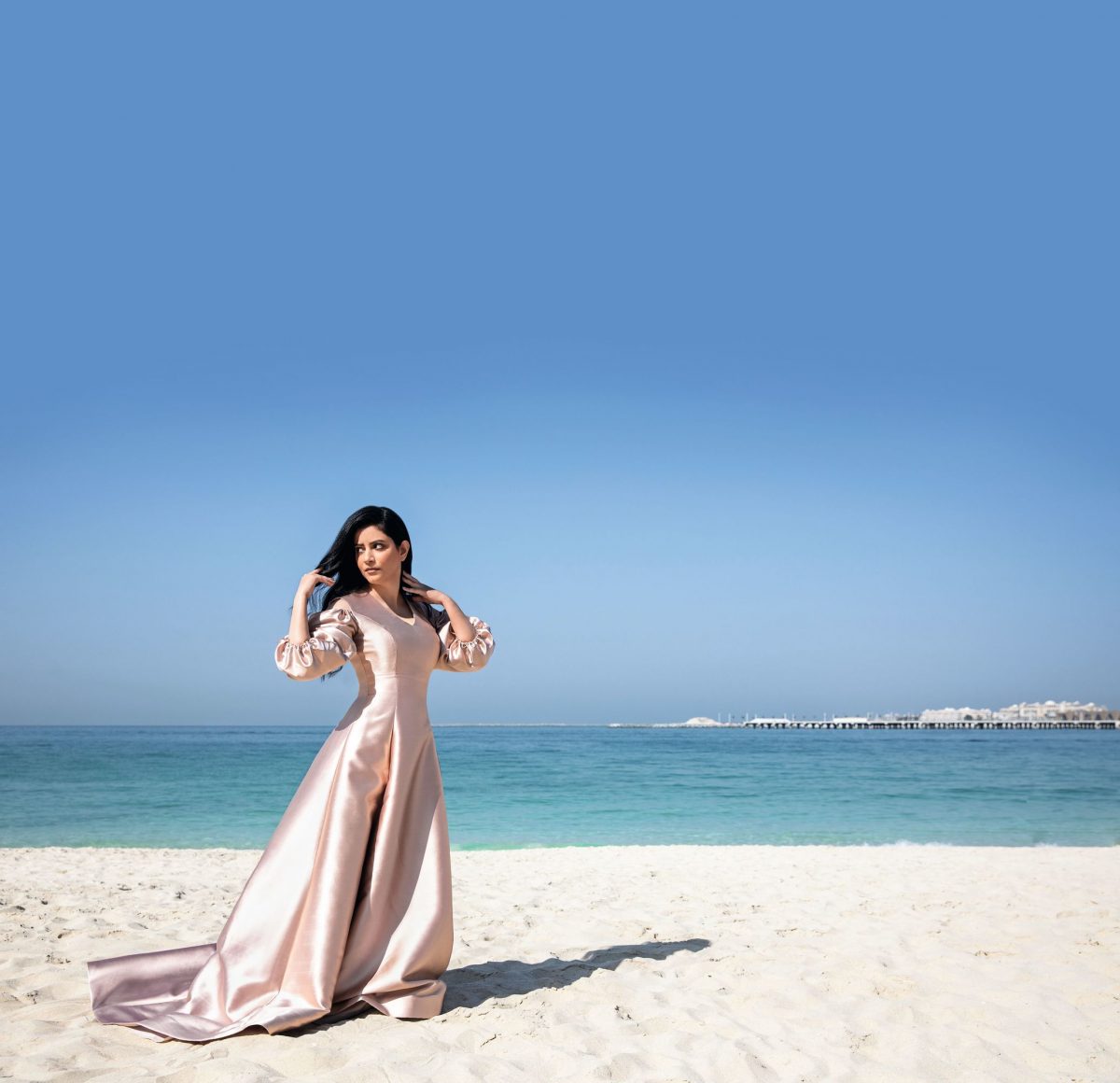
Fatima wears: Dress, Amal al Raisi. Fatima is hoping to become the first Emirati actress to star in an Oscar-nominated film
Why do you think it’s been described as a feminist film?
It has many symbolic messages of how women should behave, and what is expected from them in society and from their family, and the silent punishments that mean they suffer internally.
How do you feel about Scales being submitted for an Oscar nomination?
So excited for all of us, I think it’s a big step and I am honoured. I’m hoping we are nominated and I can attend the Oscars in person! The submission brings attention to [Arab cinema] and also develops the sense of making new films that can compete at the next level – because we are ready to do so.
Were you surprised at the choice by the Saudi government?
It wasn’t a surprise as there has been many changes in Saudi Arabia that support women’s rights like driving, travelling, and others too, and the film has a strong story and it was filmed beautifully.
Why do you think it’s done so well on an international level?
The story is brave and the picture quality is at international standards, also people are curious [about the region]. It’s an important story that needs to be told, because reality hasn’t changed that much for some women in the Arab world, even if it seems it has.
You’re most famous for playing lawyer Farah in Netflix series Justice, are there any similarities between you and your character?
I would say strength, loyalty, love of helping others and stubbornness. Also, like Farah, I fight for what I want, I never give up, and really stand for the things I believe in. We are not here to take permission from our families, we are born free and we must continue living with the freedom of choice. I like that Farah will help a person even if he doesn’t care to help himself, because she believes everyone deserves a hand.
How are you different to Farah?
She wanted her parents to be proud of her; I am not searching for approvals [for] the way I should live or work. I believe I’ve got that from God, and that is more than enough to be brave and not to wait for anyone to say: “I agree”.
Why is this role of Farah important for Arab women to see?
To stand for their value first as a human, and to see they definitely will go through challenges [but] they can overcome [them]. I honestly was surprised that a lot of Arab women contacted me after watching Justice from different countries around the world, and said thank you for giving us strength and showing us a woman with power, and what she goes through.
Is having the lead role played by a female unusual in Arab shows?
As a lawyer yes, but as a wife and good mother, no (laughs). I feel I am living my dream bringing characters to life, and encouraging those who say they can’t act because of their families – here in the Arab countries especially. Many in the Arabian Gulf may think it’s disgraceful, unfortunately.
What was the reaction of your friends and family when they watched it?
Friends suddenly became supportive. Family were surprised and some congratulated me. Success is not easy if you are doing something powerful, you need to know that this is part of living. Farah is a very interesting character to play, I loved that I learned so much from her and the way she stood against her father, believing in her dream to became a lawyer.
What’s your advice for up-and-coming female actors?
You are born free, so the choice is yours. It might take time and it’s not easy, but it’s worth it. Don’t wait for financial support or agreement from other people: it’s your vision.
From Harper’s Bazaar Arabia’s February 2021 issue