
Dior’s Maria Grazia Chiuri On Working With Anya Taylor-Joy, Celebrating Female Artists and Championing A Feminist Spirit Through Her Work
While in Doha to celebrate Christian Dior: Designer of Dreams, the Creative Director discusses femininity, feminism, and the future of fashion
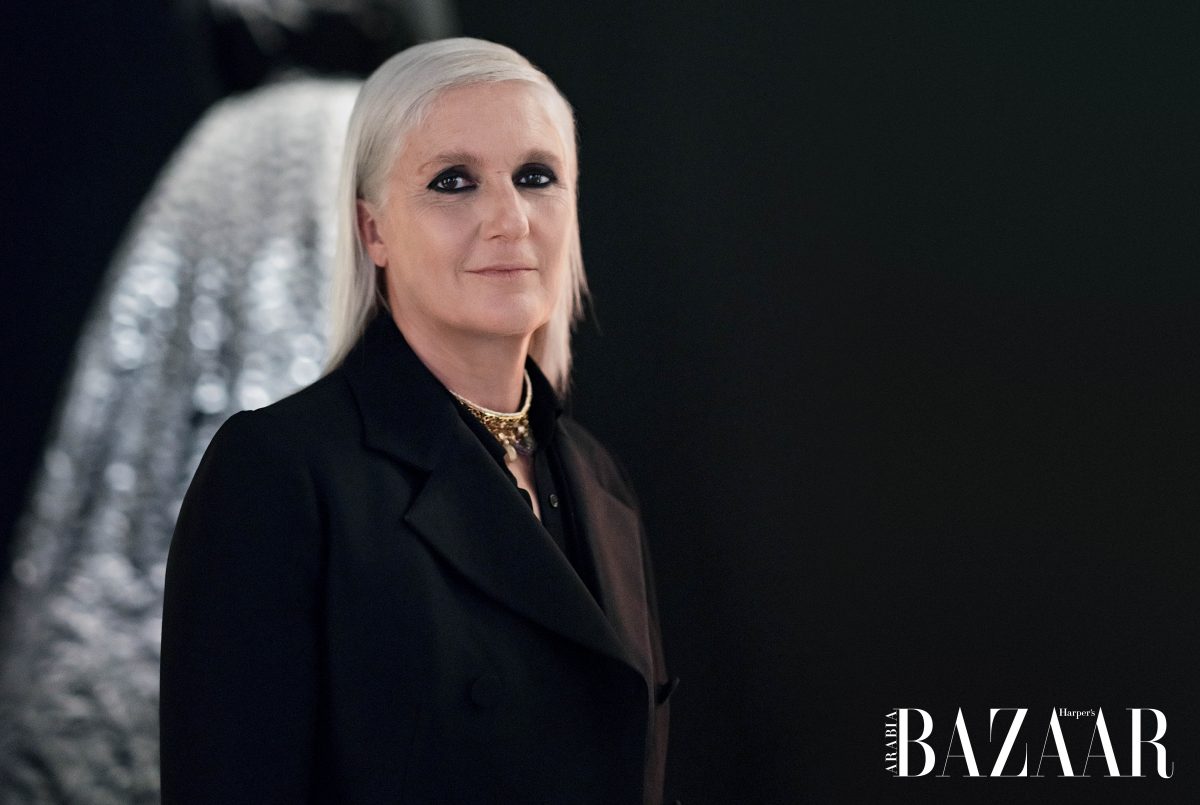
Maria Grazia Chiuri, the Creative Director of Dior, is perched on the side of a sofa in a suite at Mandarin Oriental Doha wearing white jeans and a plain T-shirt, her platinum locks slicked back, and eyes outlined with characteristic kohl. She exudes the ease which comes from being perfectly at home in oneself; an assuredness that breeds confidence in those around her, so that our interview can be best described as a conversation amongst comrades that have never before met.
The first woman to be appointed to lead the ateliers and design teams of Christian Dior, she has approached her role by defining femininity from a point of view that is decidedly feminist; using her platform to shine a spotlight on female voices and reclaiming the notion and philosophy underwriting feminism for women themselves. Earlier this year, she released Her Dior: Maria Grazia Chiuri’s New Voice, a book featuring images of 33 women photographers who have collaborated with Dior and Maria Grazia since 2016. The premise of highlighting the work of these artists – women who see the females they are photographing as subjects not objects; women who present work through their own female gaze – was a tangible celebration of innovation and the feminist spirit that guides her.
It was a gauntlet Maria Grazia threw down in September 2016 when, for her debut collection with the brand, she looked to Chimamanda Ngozi Adichie’s TEDx talk on the future of feminism to create a slogan T-shirt bearing the words, ‘We Should All Be Feminists’. Simple, direct, to-the-point, it was an overnight success. Feminism was back on the agenda; it was a choice again, not a set of predefined rules.
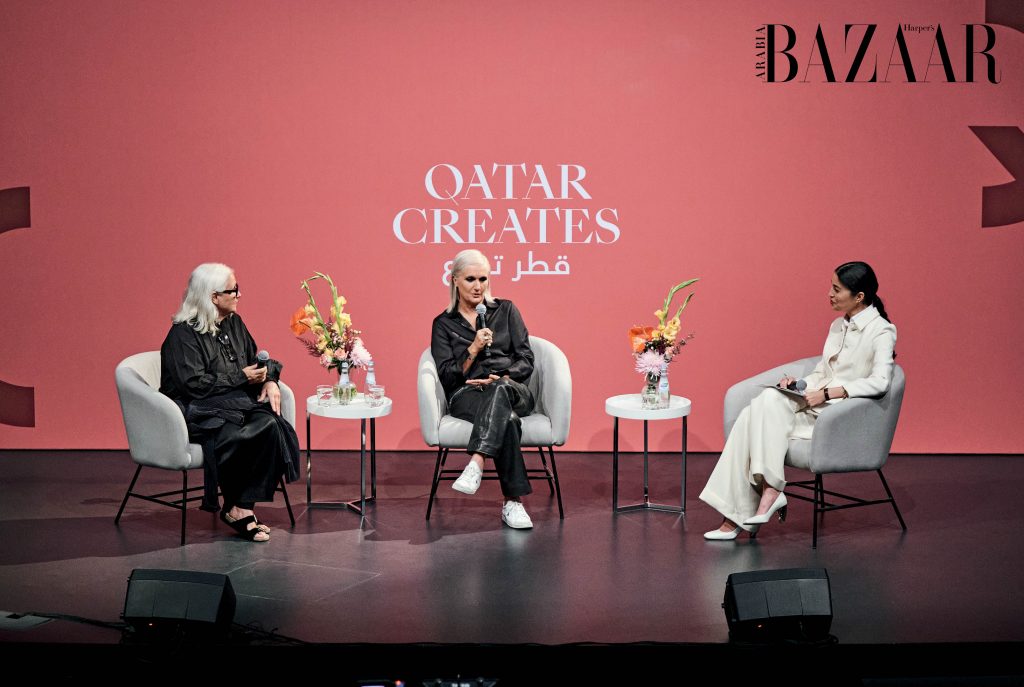
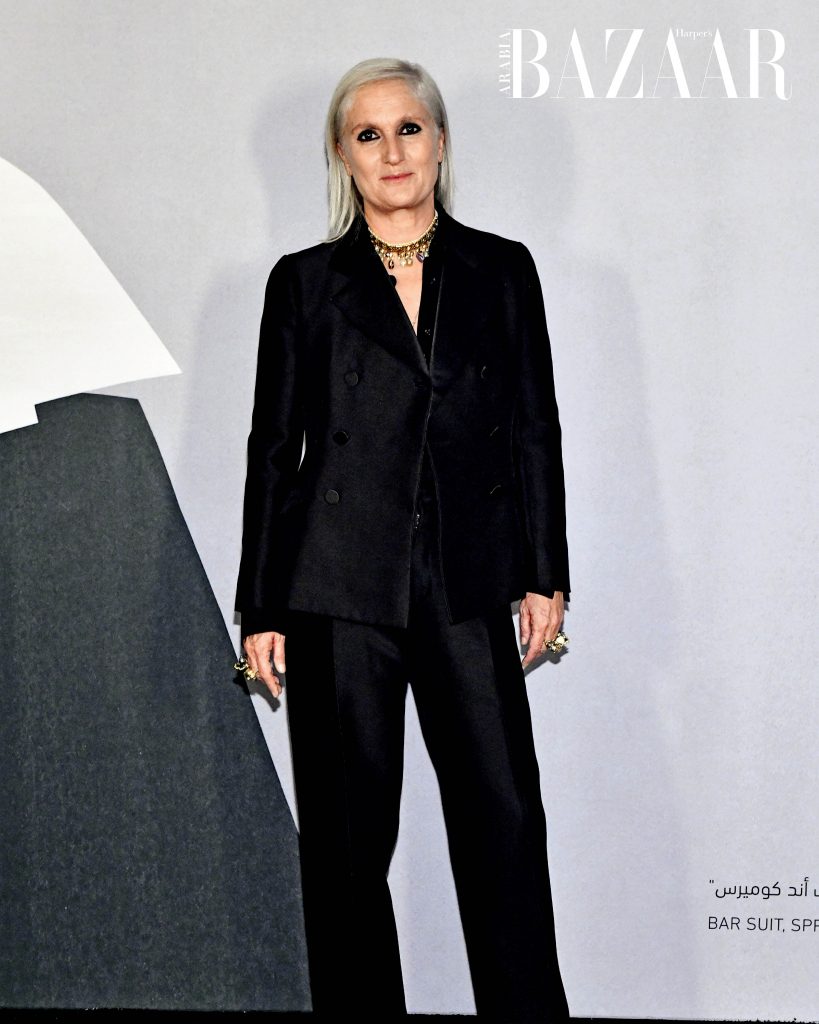
Maria Grazia recently travelled to Doha to celebrate the opening of the Christian Dior: Designer of Dreams exhibition at M7. Following iterations in Paris, London, Shanghai, and New York, and finally arriving in the Middle East for the first time. How has it been adapted from a curatorial perspective for Qatari audiences? “We never adapt exhibitions for visitors,” said Maria Grazia. “It is more about being in conversation. This is the most important thing because it gives us the opportunity to maintain the concept of our exhibition, which is to show all of the history of Dior. It’s an important exhibition because it doesn’t only speak about Mr Dior but of all the designers that went after him. Each exhibition is different because it’s in conversation with the place in which it takes place. We’re really proud that Her Highness Sheikha Moza has given us a selection of her wardrobe to show as part of the exhibition – in which you can see all of the different designers of the brand. This is important for us because it plays well into the idea that collections are created in different times, in different ways, and by different designers, but the same element of our heritage is always expressed.”
Coming out of the global lockdown imposed by COVID, the opening took on an emotional element – serving as a reminder of all that is beautiful and creative and the joy that comes with experiencing it in a sensory, physical way. The pandemic, elucidating social and political disparities around the world, has had a profound impact. What role should, or must, fashion play, does she believe, in addressing these social and political concerns? “I think fashion is a category that is very complex, so it’s difficult to answer this question,” she said. “The evolution of fashion has been incredible. Initially, fashion was something very small, in dialogue with just an elite group. Today, fashion is not just about making clothes. Fashion is also about asking questions, finding creative ways to build a consciousness, to pay more attention to what we do. I believe in any case that fashion speaks about humanity. It speaks in some way about identity,” said the designer.
It also speaks, increasingly, of environmental concerns, something reflected in the Dior Spring/Summer 2020 show, in which Maria Grazia created an ‘inclusive garden’ that was inspired by archival photographs of Catherine Dior, Christian Dior’s sister, showing her surrounded by flowers in her garden. Following the show, which was curated with a specialist group of landscape gardeners, Dior donated each tree to various community garden projects, using the hashtag #PlantingForTheFuture to raise awareness. It was a show that demonstrated many layers at work – the inspiration drawn from an essential female protagonist of the house; a focus on sustainability; and, in the act of replanting, a means of transforming the idea of the heritage of Dior into action.
With its Resort 2021 collection, staged in Lecce in the South of Italy, and again with its spectacular Cruise 2022 show at the Panathenaic Stadium in Athens, Maria Grazia again succeeded in creating something that felt more than a fashion show – projects that in their scope and their engagement with local craftspeople, were something greater. “I can do projects like this because I’m with Dior. I’m lucky,” she admitted. “It’s super complex, and also expensive, to realise these community projects and this vision. We have to travel with the team to another country, to conduct research, and to deliver but it allows us to realise this special kind of dialogue between Dior and local artisans.”
Another dialogue that she has fostered is that which shines light on female artists that have traditionally been excluded from the canon; victims of a history written by men. In terms of that dialogue, how important is to her, not just to continue that conversation with consumers, but to make an impact within the industry itself? “It’s only when we use female photographers that we can have a point of view about beauty,” she recounted. “And it’s only after working with women artists that we can touch an argument that is important for women around the world. I think it’s very important because we’re living in a world in which it isn’t so easy to be in a position of power for women, so we have to support other women to use their voices.
We have to be insistent that their voices be heard around the world. We have to support each other, to help to create a community where it’s possible for everybody who has talent to express themselves in a way that is very unique. In the past, fashion wasn’t as conscious of that; it imposed too many rules, too many standards on women’s beauty. I think we have to be conscious that beauty is something that is very one-of-a-kind. So this dialogue with artists, photographers, dancers, and painters, can help me to work in the right way in the future.”
One such woman is actress Anya Taylor-Joy, recently unveiled as Dior’s new global brand ambassador. Celebrated for her award-winning turn as Beth Harmon in Netflix’s smash hit series The Queen’s Gambit, Taylor-Joy will act as ambassador for both women’s fashion and make-up, overseen by Maria Grazia and Peter Philips, respectively. How does she fit into that female narrative? “She approaches fashion in a way that is completely different; she sees an outfit with the idea that she is a character, she wants to play with fashion. She can decide who she wants to be. It’s the idea that fashion can help her to embody the character that she decides to play for whichever event she is attending. It’s that sense we all had as children of wanting to dress up, to become a princess, or something else entirely,” said Maria Grazia.

That idea of being many things at once, multifaceted, playful, not tied down to something immutable and fixed underwrites the liberating notion of feminism at the heart of Maria Grazia Chiuri’s ethos. What then, would she like her legacy to be? “I hope to leave the idea that there are many different types of femininity, not only one.”
Photos: Getty, Daniel Sim, Nelson Garrido
From Harper’s Bazaar Qatar’s Winter 2021/2022 issue