Meme Makers: Why 2021 Became A Watershed Moment For Meme Culture in Fashion
From Kim Kardashian’s eccentric Balenciaga look to Alexandria Ocasio-Cortez’s striking Met Gala gown, this year’s events caused quite the social media storm
Arguably the most famous fashion meme moment to date has to be when Rihanna walked the Met Gala’s red carpet in 2015 in an impressive yoke-yellow gown by Chinese designer Guo Pei. The meme fallout the next day saw the train of the dress photoshopped into everything from a pepperoni pizza to an omelette, which put the look squarely in the fashion meme hall of fame. But last month something even more significant happened that underlines just how much fashion’s ability to connect with the public is now in the hands of meme-makers; the Met Gala got its first official ‘meme correspondent’.
Saint Hoax, a Syrian artist and meme-fluencer with more than 2.8 million followers on Instagram, was tapped by the social-media platform for the gig. Instagram was one of the Met Gala’s 2021 sponsors and they enlisted Saint to attend the event and live meme the red carpet arrivals to help generate more social media reach, engagement, and therefore coverage, of the night. But Saint wasn’t alone. Instagram pulled together a posse of meme creators to be on hand that night to add their unique voices to the fashion conversation.
“Now, more than ever, we’re seeing an entirely new generation of fashion gurus and culture-shapers emerge on the platform – they also happened to grow up on memes. I’m really excited to watch the meme community continue to play such an influential role in driving cultural commentary around these awesome moments. It’s only fitting that there’s now an Instagram Meme Correspondent on fashion’s biggest red carpet,” Ricky Sans, Strategic Partner Manager for Memes at Instagram told Harper’s Bazaar Arabia.
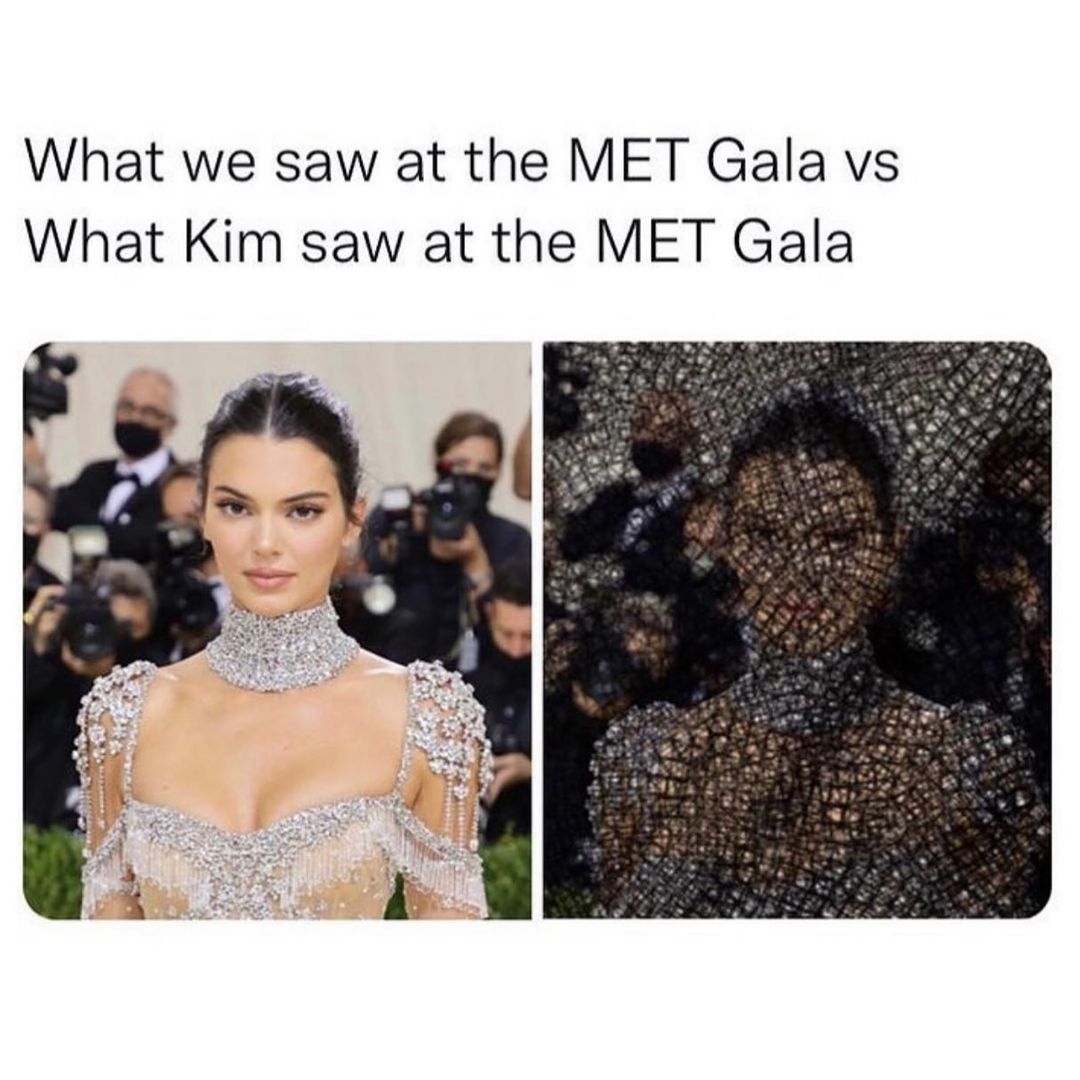
Looking at the outfit choices from the night, you could make the argument that designers and celebrities were no longer dressing to match the topic of the Met’s Costume Institute exhibition, which this year was In America: A Lexicon of Fashion, as is traditionally done. But rather each outfit was created for maximum meme effect. The hope, to create another viral image destined for meme-famy. The hands-down winner this time was Kim Kardashian in her face-effacing ensemble by Demna Gvasalia, the creative director of Balenciaga.
Other members of Instagram’s meme team included creators @Mytherapistsays, @ideservecouture, @Mufashdia, and @eljosecriales. And their group effort – while they sat in a room together in convivial rivalry trying to out-meme each other, or at the very least make the others laugh out loud – got the hashtag #memethemet trending. Which is really saying something when, according to Instagram, there are over 209 million posts on the platform that have used the hashtag #memes.
For Hanan Besovic, the mastermind behind the Instagram feed @ideservecouture, the rise to meme stardom has been impressively quick and illustrates how quality content is still able to pierce the social media noise and be impactful even amongst the millions of posts going up online on a daily basis. Born in Bosnia and raised in Croatia, Hanan was working in a hotel in Florida when COVID-19 hit and he found himself furloughed. With so much free time on his hands, Hanan decided to dedicate 100 per cent of his time to his Instagram feed. “It blew up,” admitted the meme fashion commentator. “But I have been following fashion closely, as a fan, for over ten years.”
It was Instagram that reached out to Hanan and got him a one-to-one meeting with Daniel Roseberry, the artistic director of Schiaparelli earlier this year. “That was surreal. It was my first fashion presentation ever,” he recounted. They also facilitated his trip to Venice to take in, and report on, the Valentino haute couture show. There he hung out with designer Pierpaolo Piccioli and got to go backstage to document the BTS prep for the real-life show in his IG stories and memes. And last month, Hanan found himself at the Met Gala in New York City, memeing it up with his fellow creatives. “Admit it or not, memes are helping you,” he said. “People are talking about your product, your brand because of memes. But nobody is not going to buy a bag or a dress because of a meme. Look at Demna and Balenciaga, the man understands how social media works. In every collection he does there is something that is intended to go viral.”
Over the past few years, meme culture, and in particular fashion memes, have moved from the fringes of the social media conversation to take up residence at its centre. For meme-maker @dubaiproblems, who launched his Instagram account eight years ago, a recent decision to go full-time with what was once his side hustle shows just how far the business of memes has come. His plan is to launch a Dubai Problems website later this month, in the vein of satirical digital media platform The Onion, but for the region. He has also recently started adding affiliate links onto his feed and taking on sponsored posts as well.
According to @dubaiproblems, for a meme to truly be successful it has to have some key ingredients. “Number one, it has to be relatable, and then I would ask myself before posting a meme ‘is it catchy? Is it easy to digest the information at a glance?’ And a successful meme always has to have an element of truth to it”. The ‘memification’ of pop culture and social discourse has also become a powerful way for individuals and industry outsiders to call out bad actors, or tone-deaf brands trying to take advantage of a movement or a moment.
The account @dietprada, which started out in 2014 as a laidback feed that pointed to the similarities between the work of different fashion designers, has today become a bellwether social media platform actively pushing for more industry accountability across the board. It has been dubbed ‘the most feared Instagram account’ in the industry by the Business of Fashion for its now unrelenting quest for brand accountability.
“Memes are a way for people to relate to one another, often translating emotions or ideas even through language barriers, making them a sort of a ‘universal language,’” noted Zack Sweat, lead editor at Know Your Meme, an internet meme database. One of the reasons memes are so powerful and resonate so strongly with such a wide swath of people is that, more often than not, they use humour to get various deeper messages across to the public.
“I think that brands that notice me, they understand what I am doing. I am not trying to cancel anybody. I am trying to help them. I am not on their payroll and I am giving them my honest opinion from behind the screen. I want everything that I post to come from a place of love,” said Hanan, whose @ideservecouture Instagram feed and stories will call brands out for both their wins and their misses. But his posts are almost always couched in humour and positivity.
The growing cultural significance of memes is the reason why the Know Your Meme website was launched back in 2008. It acts like a digital archive of this unique medium of expression and has become the authority on the history and the global impact of memes and viral video content. The platform has also helped to give a structure to this free-flowing form of online social commentary, keeping track of all of the many types of memes. “For the overarching categories, we have things like exploitables, image macros, photoshops, parodies, copypaste, catchphrases, and reactions,” laid out Zach about how his site is structured.
But with any large revolutionary movement, at some point, it ends up going mainstream. Its power and influence becomes targeted and tapped into by brands looking for new ways to connect with the public. There are even companies that are actively looking to hire a chief meme officer to engage with the Zoomer generation via their most preferred mediums of communication. Other brands will outsource their meme-making to the experts, like @dudewithsign or @siduations. But what is even worse than a brand trying to tap into memes in an inauthentic way as a new marketing channel is one that falls victim to its massive online power.
The perfect example of a brand’s inability to ‘read the room’ is the Kendall Jenner Pepsi commercial from 2017. Not only did it damage the brand’s reputation and show how disconnected it was with the general public – with its feigned sincerity as it blatantly attempted to capitalise on the Black Lives Matter movement – it also did damage to Kendall’s personal brand. Since its debut, the ad has become something of a meme posterchild for the concept of appropriation. To this day, memes from the campaign will crop up on social media every time a company makes an inauthentic branding misstep.
“One of the quickest ways for a company to lose face is to come off as ‘how do you do, fellow kids?’ when engaging with meme culture. Because of that, meme consultants who are embedded in that world are steadily seeing more companies reaching out to them for their expertise in navigating the online world of memes, and this is only going to become far more prevalent in the future,” confirmed Zack.
“Pierpaolo said to me, ‘you can do serious work without being serious’ and that makes total sense. I mean, it’s fashion. If you’re not having fun with it, I don’t know what you’re doing then,” stated Hanan. “Fashion for me is a form of art that I love to comment on, but I always bring humour into the situation.”
Because, let’s be honest, when having to deal with what is going on in the world, and in fashion for that matter, it’s much easier to face it when viewed through the prism of a really good meme.
Lead image courtesy Instagram/@mytherapistsays
From Harper’s Bazaar Arabia’s October 2021 issue